Break Even Calculator for Small Business: 7 Steps
A break even calculator for small business answers the single most important question an owner can ask: how much do I need to sell before I actually start making money? Without that number, you’re flying blind—pricing on gut feel, guessing at goals, and hoping the bank balance holds.
The good news is that break-even math is simple once you see it laid out. This guide walks you through the formula, a 7-step process, and the exact costs to plug in, so you can find your number today and price with confidence.
Quick answer: A break even calculator for small business divides your fixed costs by your contribution margin per unit (price minus variable cost per unit). The result is the number of units—or the revenue—you must sell to cover all costs. Below that point you lose money; above it, every sale adds profit.
What is a break even calculator for small business?
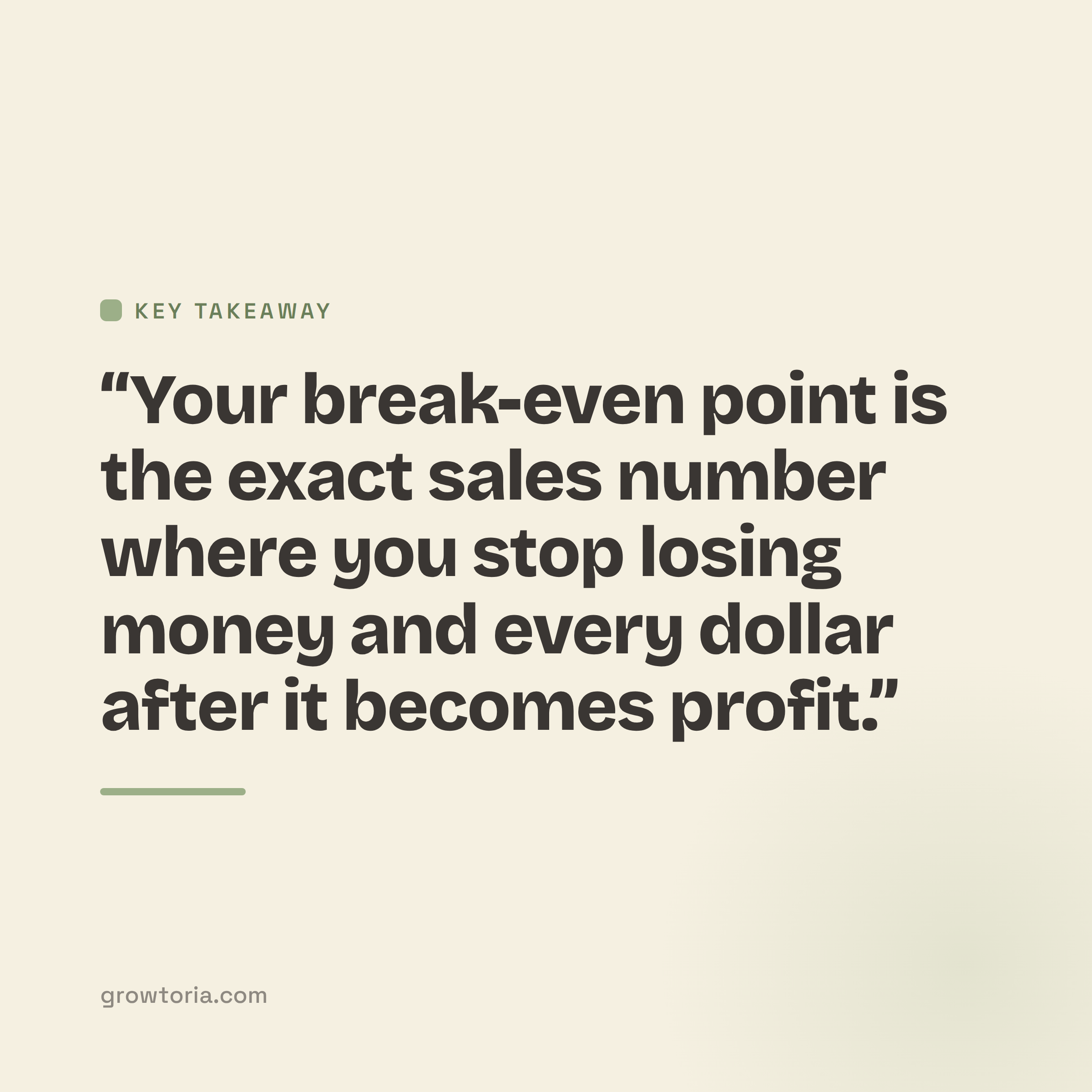
A break even calculator for small business is a tool that tells you exactly how many sales you need to cover all your costs. At the break-even point, profit is zero: you’re not losing money, and you’re not yet earning it.
It works by separating your costs into two buckets—fixed and variable—then measuring how much each sale contributes toward covering the fixed ones. Once fixed costs are fully covered, every additional sale drops profit straight to your bottom line.
Owners use it for three big decisions:
- Pricing: testing whether a price actually leaves room for profit.
- Goal-setting: turning a vague “sell more” into a concrete monthly unit target.
- Go/no-go calls: deciding if a new product, hire, or location can realistically pay for itself.
How does the break-even formula actually work?
The core formula is short: Break-Even Units = Fixed Costs ÷ (Price per Unit − Variable Cost per Unit). The part in parentheses is your contribution margin—the money left from each sale after you pay the costs tied directly to making it.
Say you sell a product for $50. It costs you $20 in materials and fees to produce and ship each one. Your contribution margin is $30 per unit.
If your fixed monthly costs (rent, software, insurance) total $6,000, then:
- $6,000 ÷ $30 = 200 units to break even.
- At 200 units you’ve earned $10,000 in revenue and covered every cost.
- Unit 201 is the first one that puts real profit in your pocket.
Want the revenue version instead of units? Use Break-Even Revenue = Fixed Costs ÷ Contribution Margin Ratio, where the ratio is contribution margin divided by price ($30 ÷ $50 = 0.6). That gives $6,000 ÷ 0.6 = $10,000. Same answer, framed as sales dollars—handy for service businesses that don’t sell neat “units.” For more worked examples, see our break even point examples with answers.
How do I use a break even calculator for small business in 7 steps?
Here’s the exact process. You can run it on paper, in a spreadsheet, or with our free break-even calculator for small business—the steps are identical.
- List your fixed costs. Add up everything you pay regardless of sales: rent, salaries, software subscriptions, insurance, loan payments.
- List your variable costs per unit. Materials, packaging, payment-processing fees, shipping, and any per-sale labor.
- Set your selling price. Use your current price, or test a new one to see how it moves the number.
- Calculate contribution margin. Subtract variable cost per unit from price.
- Divide fixed costs by contribution margin. That’s your break-even in units.
- Convert to a monthly target. Break-even units ÷ working days = the daily sales pace you need to hit.
- Stress-test it. Re-run with a 10% price drop and a 15% cost increase to see how fragile your margin is.
That last step matters more than most owners realize. A business that breaks even at 200 units but jumps to 260 the moment costs tick up has almost no cushion.
What counts as fixed vs variable costs?
Getting this split right is where most break-even calculations go wrong. Fixed costs stay the same whether you sell 10 units or 1,000. Variable costs rise and fall with each sale.
Here’s a side-by-side to sort yours quickly:
| Cost Type | Fixed Cost (stays the same) | Variable Cost (per sale) |
|---|---|---|
| Space | Rent, property tax | — |
| People | Salaried staff | Hourly production labor, commissions |
| Product | — | Materials, packaging, freight |
| Software | Monthly SaaS subscriptions | Per-transaction payment fees |
| Other | Insurance, loan payments | Sales tax collected, marketplace fees |
A common trap: treating payment-processing fees as fixed. They scale with every sale, so they belong in the variable column and directly shrink your contribution margin. If you sell on marketplaces, our Etsy shop bookkeeping spreadsheet guide shows how those cuts add up.
What is a good break-even point?
A good break-even point is one you can hit comfortably within your normal sales month—ideally with 20–30% of capacity left as a safety margin. There’s no universal “right” number; it depends on your industry’s typical margins.
What you’re really watching is how quickly you cross the line. A business that breaks even in the first two weeks of the month has 15+ days of pure profit ahead. One that breaks even on day 28 is one slow week away from a loss.
To judge whether your margins leave enough room, compare against benchmarks in our breakdown of the average profit margin for small business. The U.S. Small Business Administration also stresses knowing your break-even before you set prices or seek funding—see their guide to managing business finances.
Lower your break-even point with these levers
If your break-even number feels too high, you have exactly three levers to pull:
- Raise price: even a 5% increase widens contribution margin fast. Get the math right with our guide to markup vs margin.
- Cut variable costs: renegotiate suppliers, reduce packaging, or lower payment fees.
- Trim fixed costs: downgrade unused software, sublet space, or move offline tools you’re paying monthly for.
The done-for-you shortcut
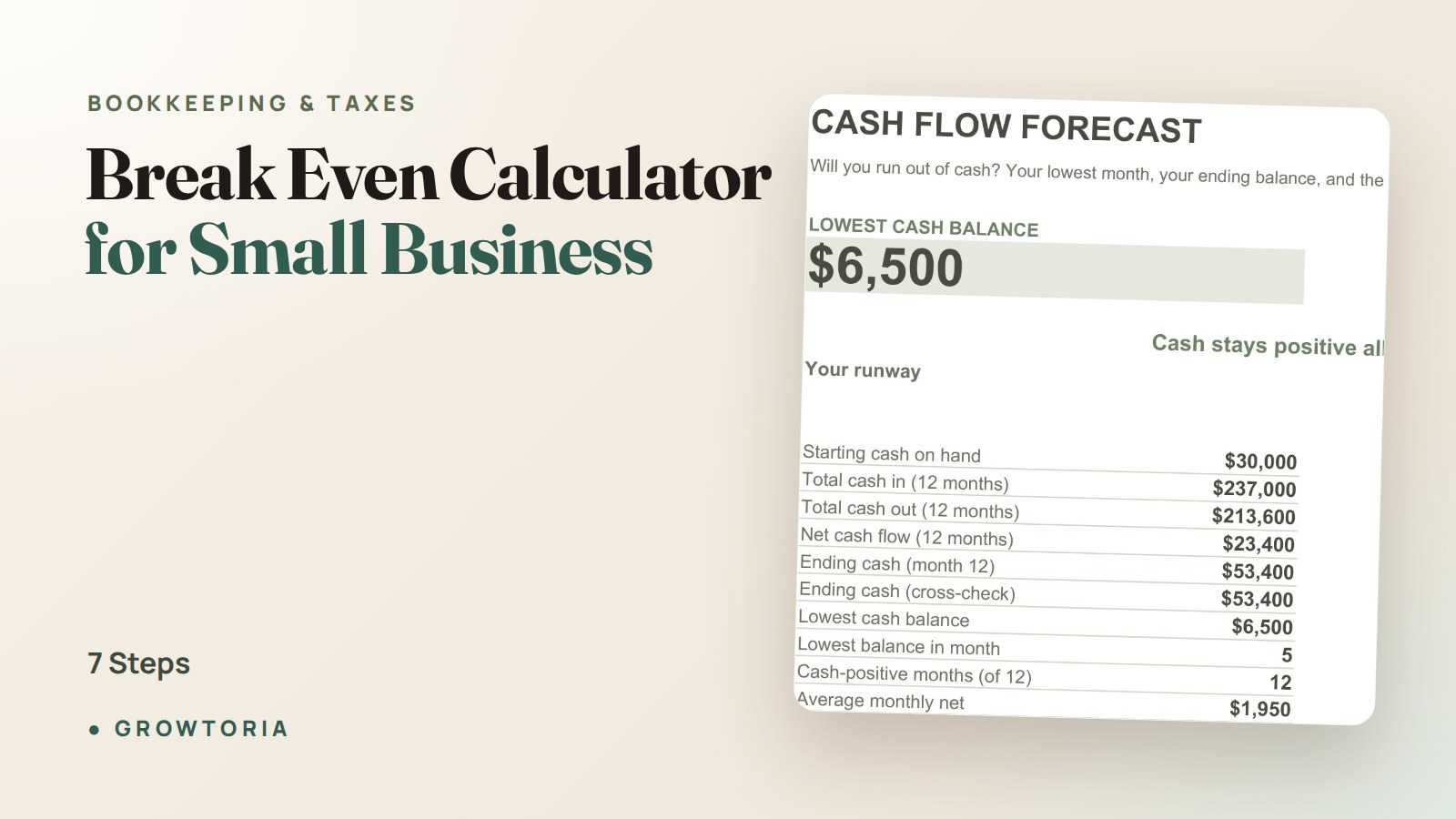
You can build all of this from scratch, but a pre-wired template saves hours and prevents formula mistakes. Our 12-Month Cash Flow Forecast Spreadsheet plugs your break-even number into a full-year runway projection, so you see not just when you cover costs, but whether cash actually holds month to month.
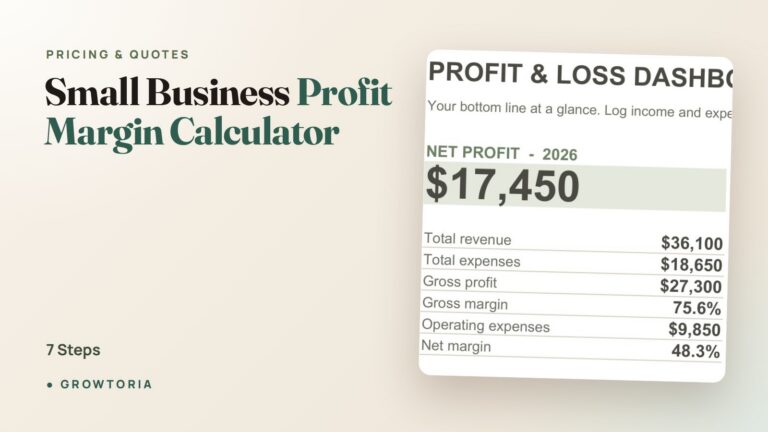
If you want the profit picture in one view, the Small Business Profit & Loss Statement tracks revenue against fixed and variable costs automatically. Both are ready-to-use in Google Sheets and Excel—and you can also grab them on our Etsy shop if that’s where you prefer to buy.
Prefer to start free first? Run your numbers in our break-even calculator or browse all our free tools, then upgrade to a template when you’re ready to plan the full year.
Frequently asked questions
What is the break-even formula in simple terms?
Break-even units = fixed costs ÷ (price per unit − variable cost per unit). It tells you how many sales cover all your costs. Anything sold above that number is profit; anything below is a loss.
How do I calculate break-even for a service business?
Use the revenue version: fixed costs ÷ contribution margin ratio. Treat your billable rate as “price” and any per-project costs (subcontractors, software seats, materials) as variable. The result is the revenue you need to book each month to cover costs. Our guide to setting consulting rates pairs well with this.
How often should I recalculate my break-even point?
Recalculate whenever a major cost changes—a rent increase, a new hire, a price change, or a jump in supplier costs. At minimum, review it quarterly. A break-even number based on last year’s costs can quietly become dangerously wrong.
Does break-even include taxes and my own salary?
It should. Owners routinely forget to pay themselves in the model, which makes the business look healthier than it is. Add your target owner salary to fixed costs, and set aside estimated taxes separately—our tax deductions checklist helps you plan that number.
What’s the difference between break-even and profit?
Break-even is the zero line—costs covered, nothing more. Profit is everything you earn above break-even. Knowing your break-even point is the first step; growing the gap between it and your actual sales is the goal.
Put your number to work
Once you know your break-even point, every other decision gets clearer: what to charge, how many to sell, and whether that next expense is worth it. Run the seven steps today, then build the habit of updating it whenever costs shift.
Start with the free break-even calculator for small business, then map the full year with the 12-Month Cash Flow Forecast. Knowing your number is the difference between hoping you’ll be profitable and knowing exactly when.