Do You Have to Pay Taxes on Etsy? 7 Facts for Sellers
Do you have to pay taxes on Etsy? If you’re selling handmade goods, vintage finds, or digital downloads to make money, the short answer is yes—and understanding how it works keeps you out of trouble and protects your profit. The rules aren’t as scary as they look once you separate what’s taxable from what just triggers a tax form.
This is the hands-on version I wish every new Etsy seller got on day one: what you owe, when the IRS gets a copy, how much to set aside, and the deductions that quietly save you hundreds.
Quick answer: Yes. If you sell on Etsy to make a profit, the IRS treats you as a business and your net earnings are taxable—even if you never receive a 1099-K. Most US sellers owe federal income tax plus 15.3% self-employment tax on their profit, and Etsy usually collects and remits state sales tax for you automatically.
Do you have to pay taxes on Etsy income?
Yes—Etsy income is taxable the moment you’re selling to make money rather than clearing out your closet. The IRS cares about why you sell, not how small the shop is.
There’s no magic dollar amount that flips income from “free” to “taxable.” Earning $300 or $30,000 doesn’t change the principle: profit is income, and income gets taxed. What changes with higher sales is simply the paperwork and how closely it’s watched.
The one real fork is hobby versus business, and it matters more than most sellers realize.
Hobby seller vs. business seller
- Business: You sell regularly and intend to profit. You report income on Schedule C, deduct expenses, and pay self-employment tax on the profit.
- Hobby: You sell occasionally with no real profit motive. You still report the income, but you generally can’t deduct expenses against it—often the worse deal.
If you restock, advertise, or track your numbers, you’re a business in the eyes of the IRS. That’s actually good news, because businesses get to subtract costs before tax.
When does Etsy send a 1099-K—and does it even matter?
Etsy issues a Form 1099-K when your sales cross the federal reporting threshold for the year. But here’s the fact that trips up thousands of sellers every spring: the 1099-K decides whether you get a form, not whether you owe tax.
You owe tax on your profit whether or not that form ever arrives. A seller who makes $2,000 and gets no 1099-K owes exactly the same tax as if the form had shown up.
The threshold itself has bounced around for years as Congress and the IRS kept changing the rules:
| Tax year | 1099-K reporting threshold | Transaction minimum |
|---|---|---|
| 2023 & earlier | $20,000 | 200+ sales |
| 2024 | $5,000 | Any number |
| 2025 (IRS phase-in) | $2,500 | Any number |
| 2026+ (originally scheduled) | $600 | Any number |
Important caveat: Congress has repeatedly delayed and revised these numbers, and 2025 legislation moved to restore the older $20,000 / 200-transaction threshold. Always confirm the current year’s figure directly on the IRS page for Understanding Your Form 1099-K. The threshold only controls the form—never your obligation.
Etsy Seller Profit Kit: 3 spreadsheets for $19
Bookkeeping + product pricing + jewelry pricing in one kit. See your real profit per order after Etsy fees, shipping and materials. Google Sheets & Excel, one-time payment, no subscription.
What taxes do Etsy sellers actually pay?
US Etsy sellers typically face three separate layers of tax. Knowing which is which stops you from double-counting or missing one entirely.
1. Federal (and state) income tax
Your Etsy profit—sales minus allowable expenses—gets added to your other income and taxed at your normal rate. If selling is your only income, your effective rate may be low; if it’s a side hustle on top of a day job, it stacks on top of your salary.
2. Self-employment tax
This is the one new sellers forget. On top of income tax, you owe 15.3% self-employment tax (12.4% Social Security + 2.9% Medicare) on your net profit. An employer would normally split this with you; as your own boss, you cover both halves. The official breakdown lives on the IRS Self-Employment Tax page.
3. Sales tax
Good news here: in almost every US state, Etsy automatically calculates, collects, and remits sales tax to the state for you under marketplace facilitator laws. You generally don’t file it yourself for Etsy orders. If you also sell off-Etsy, that’s where a free sales tax calculator by state earns its keep.
How much should you set aside for Etsy taxes?
A safe default is to park 25–30% of your Etsy profit in a separate account the moment it comes in. That cushion covers income tax plus the 15.3% self-employment bite for most small sellers.
Set aside on profit, not revenue. If you sold $1,000 of candles but spent $400 on wax, wicks, and shipping, you’re taxed on roughly $600—not the full grand.
If your Etsy shop clears a few thousand dollars a year in profit, the IRS also expects quarterly estimated payments rather than one April lump sum. Miss them and you can face an underpayment penalty even if you pay in full later. A simple self-employed tax calculator for 1099 income turns your profit into the four quarterly numbers you actually need.
What can Etsy sellers deduct to lower the bill?
Every legitimate business expense you track is money the IRS can’t tax. This is where disciplined bookkeeping pays for itself many times over.
Common Etsy deductions include:
- Etsy fees: listing, transaction, payment processing, and ad fees all count.
- Materials and supplies: raw materials, packaging, labels, and boxes.
- Shipping costs you pay out of pocket.
- Software and tools: design apps, templates, and bookkeeping tools.
- Home office and a portion of utilities, if you qualify.
- Mileage for supply runs and post-office trips at the IRS standard rate.
That last one is easy money left on the table. Logging trips with a mileage tracker spreadsheet can quietly add up to a meaningful deduction across a year of errands.
How do you track Etsy taxes without the stress?
The sellers who dread tax season are almost always the ones reconstructing a year of orders from memory in April. The ones who don’t have a simple system running all year.
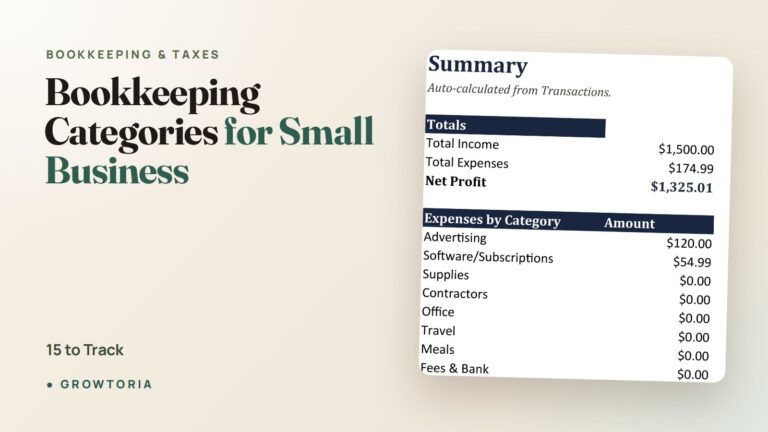
You don’t need accounting software. You need one place that captures every sale, every fee, and every expense, then shows your real profit. If you want the step-by-step build, our guide to the Etsy bookkeeping spreadsheet in 7 steps walks through exactly what to record and why.
Prefer a done-for-you shortcut? The Etsy Bookkeeping Spreadsheet is built for this—it strips out Etsy’s cut and shows your true profit after fees, so your set-aside number and quarterly estimates are accurate. You can also grab it on our Etsy shop if that’s where you’d rather buy. Sellers who run multiple sales channels often pair it with a broader small business expense tracker to roll everything into one profit figure.
Frequently asked questions
Do I have to pay taxes on Etsy if I didn’t get a 1099-K?
Yes. The 1099-K is just a reporting form—its absence doesn’t make your income tax-free. You’re legally required to report all Etsy profit on your return whether or not Etsy sends you a form, and the IRS can still assess tax on unreported income.
How much can I make on Etsy before paying taxes?
Technically there’s no tax-free floor for business income—profit is taxable from the first dollar. In practice, if your total income is very low you may owe little or nothing after deductions, but you’re still required to report it. Self-employment tax generally kicks in once net profit tops $400.
Does Etsy collect sales tax for me?
In almost every US state, yes. Marketplace facilitator laws require Etsy to calculate, collect, and remit state sales tax on your behalf, so you usually don’t file it for Etsy orders. You’re responsible for sales tax only on sales you make outside the Etsy platform.
Can I deduct Etsy fees from my taxes?
Absolutely. Listing, transaction, payment processing, and advertising fees are ordinary business expenses and fully deductible against your Etsy income. Pull the totals from your Etsy payment account each year and record them so they lower your taxable profit.
Do digital product sellers on Etsy pay taxes too?
Yes—selling printables, templates, or downloads is treated the same as physical goods. The profit is taxable income, and you can deduct related costs like design software and the templates or tools you use to create your products.
The bottom line
So, do you have to pay taxes on Etsy? Yes—but it’s manageable once you remember the core rule: profit is taxable whether or not a form ever shows up. Track every sale and expense, set aside 25–30% of profit, deduct everything you’re entitled to, and pay quarterly if your shop is growing.
Start the system today, not in April. Browse the full set of free tools to get your numbers organized, and tax season turns from a scramble into a five-minute export.