Small Business Cash Flow Template: 7-Step 2026 Setup
A small business cash flow template is the one spreadsheet that tells you the truth your profit-and-loss statement hides: whether you will actually have money in the bank next month. Profit is an opinion; cash is a fact. You can be “profitable” on paper and still miss payroll because a big invoice hasn’t landed yet.
This guide gives you the exact rows to track, a 7-step build you can finish in an afternoon, and a copy-ready layout. Whether you run a cleaning crew, a bakery, or a freelance studio, the mechanics are the same.
Quick answer: A small business cash flow template is a spreadsheet that lists your starting cash, all expected cash coming in, and all cash going out – week by week or month by month. Subtract outflows from inflows, add the result to your opening balance, and each period shows your projected closing cash so you can spot shortfalls early.
What is a small business cash flow template?
A small business cash flow template is a timeline of money movement. It answers one question: on any given week or month, will more cash come in than goes out?
Unlike a budget (which sets targets) or a profit-and-loss statement (which measures earnings), a cash flow template tracks timing. It records when money actually hits or leaves your account – not when you invoiced or when a bill was issued.
That timing distinction is everything. A $10,000 invoice booked in March but paid in May counts as March revenue on your P&L, yet your bank account is empty until May. A cash flow template catches that gap before it becomes a crisis.
Cash flow vs profit: why your P&L can lie to you
Profit and cash are not the same number, and confusing them is how solvent-looking businesses go under. A U.S. Bank study widely cited by the SBA and small-business advisors found that poor cash flow management is behind a large share of small-business failures.
Here’s the difference in plain terms:
- Profit = revenue earned minus expenses incurred, regardless of when money moves.
- Cash flow = money that actually entered or left your bank account this period.
You can be profitable and cash-poor at the same time. Growing businesses hit this constantly: they buy inventory or hire ahead of the revenue those bets will produce. For a deeper primer on the concept, Investopedia’s cash flow explainer is a solid reference.
What goes in a small business cash flow template?
Every working cash flow template has four blocks. Keep them in this order so each period flows into the next.
1. Opening cash balance
The actual money in your accounts at the start of the period. Each new period’s opening balance is the previous period’s closing balance – that’s the chain that makes the whole thing work.
2. Cash inflows
Every dollar you expect to receive, dated to when it lands:
- Customer payments and paid invoices
- Deposits and retainers
- Refunds, tax rebates, grants
- Loans or owner contributions
3. Cash outflows
Every dollar leaving your account, dated to when it’s actually paid:
- Rent, utilities, software, insurance
- Payroll and contractor payments
- Inventory, materials, and supplies
- Loan repayments and, critically, tax set-asides
4. Net cash flow and closing balance
Net cash flow = total inflows minus total outflows. Closing balance = opening balance + net cash flow. If any closing balance turns negative, you’ve found a shortfall – and you now have weeks to fix it instead of days.
How do you build a small business cash flow template in 7 steps?
You can build a small business cash flow template in a single afternoon with Google Sheets or Excel. Follow these steps in order.
- Set your columns as time periods. Use weekly columns if cash is tight, monthly if it’s steady. Start with 12 periods so you can see a full quarter or year of runway.
- Enter your real opening cash balance. Pull the actual figure from your bank – not an estimate. Everything downstream depends on this being accurate.
- List every inflow by expected pay date. Move each invoice to the week you’ll realistically be paid, not the week you sent it. Be conservative with slow payers.
- List every outflow by due date. Include the boring recurring stuff and the annual bills (insurance, taxes) split into the months they hit.
- Add formulas for net cash flow and closing balance. Net = inflows – outflows. Closing = opening + net. Link each period’s opening to the prior closing.
- Highlight negative balances. Use conditional formatting to turn any negative closing balance red. This is your early-warning light.
- Update it weekly. A cash flow template is a living document. Ten minutes every Monday keeps it honest and useful.
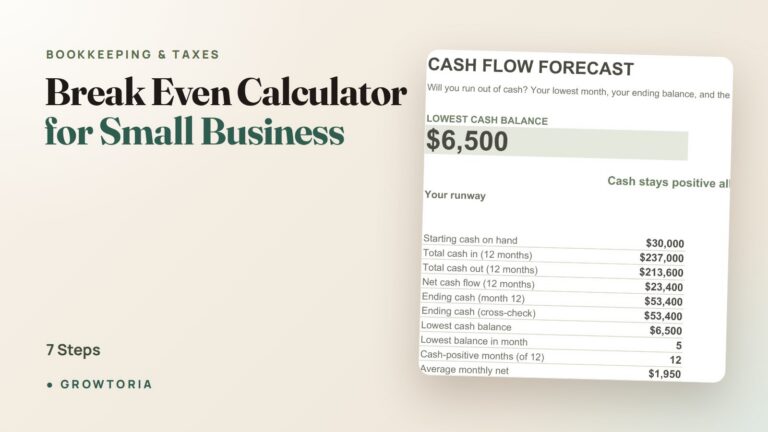
Once it’s running, pair it with a break-even calculator for small business so you know the exact revenue level that keeps you cash-positive.
What does a filled-in cash flow template look like?
Here’s a simplified three-month example for a small service business. Notice how March’s closing balance goes negative – a shortfall you’d want to solve in January, not discover in March.
| Line item | January | February | March |
|---|---|---|---|
| Opening cash | $8,000 | $9,500 | $6,200 |
| Cash in (invoices, deposits) | $12,000 | $9,000 | $7,500 |
| Cash out (rent, payroll, supplies) | -$10,500 | -$12,300 | -$14,000 |
| Net cash flow | +$1,500 | -$3,300 | -$6,500 |
| Closing cash | $9,500 | $6,200 | -$300 |
That red -$300 is the whole point. With two months’ warning you can chase a late invoice, delay a purchase, or line up a small buffer. Without the template, March is just a bounced payroll run.

Weekly vs monthly cash flow templates: which should you use?
Choose your period length based on how tight your cash is, not on habit. Both track the same four blocks – only the resolution changes.
- Weekly: Best when margins are thin, payroll is frequent, or you’re in a fast-moving trade (cleaning, food, contracting). It catches short gaps a monthly view smooths over.
- Monthly: Fine for stable businesses with predictable income and few employees. Easier to maintain, but it can hide a mid-month crunch.
A common approach: run a 13-week rolling view for near-term control, plus a 12-month view for planning. Growtoria’s 12-Month Cash Flow Forecast Spreadsheet does exactly this and projects your runway automatically.
The done-for-you shortcut
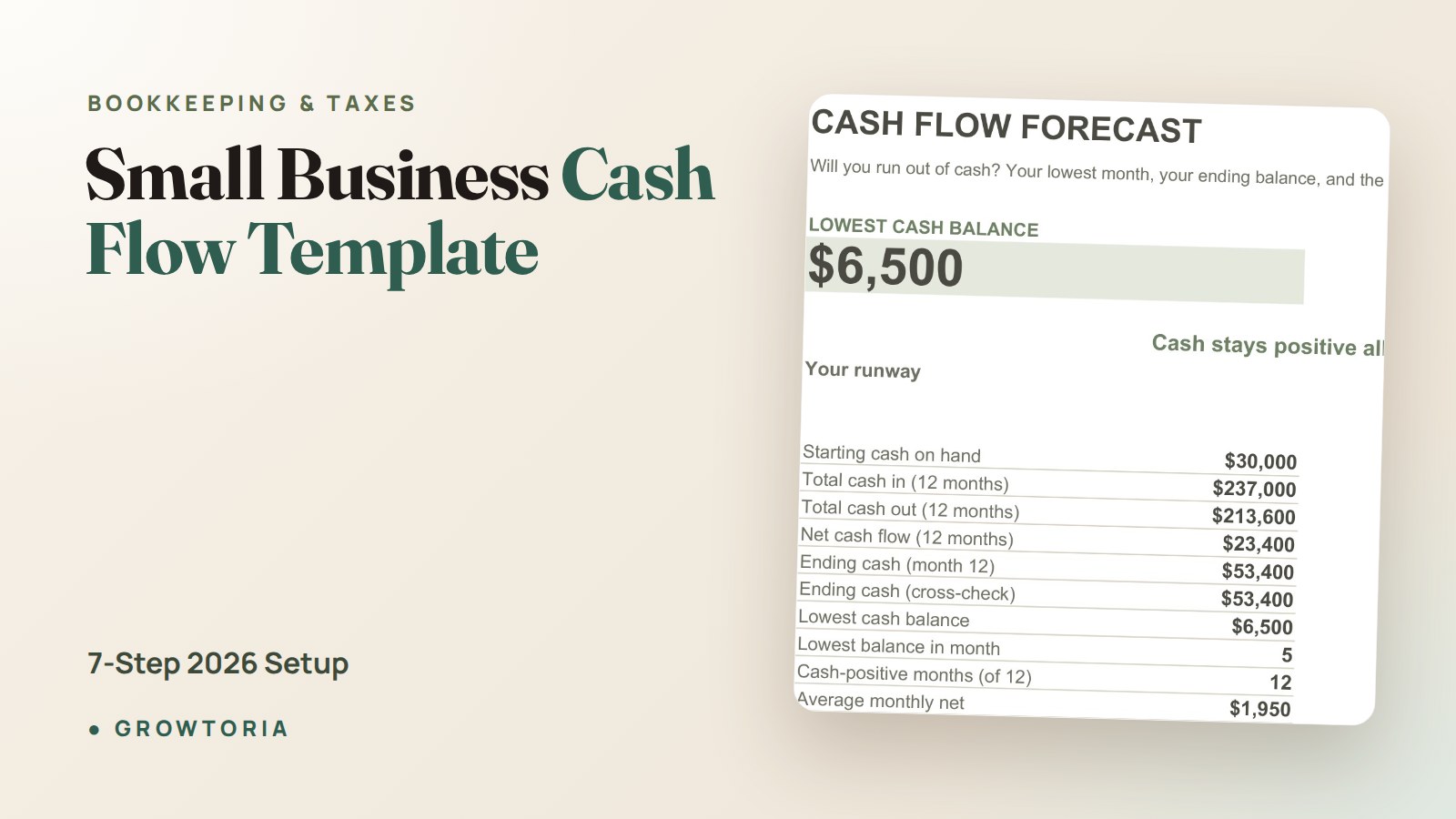
Building your own small business cash flow template is genuinely worth doing once – you learn where your money actually goes. But if you’d rather skip the formula-wrangling, the 12-Month Cash Flow Forecast Spreadsheet ships ready for Google Sheets and Excel, with the opening-to-closing chain, conditional formatting, and a runway projection already wired in.
Prefer to buy where you already shop? You can also grab our tools and templates on our Etsy shop. Either way, plug in your numbers and you’ll see your runway in minutes instead of an afternoon.
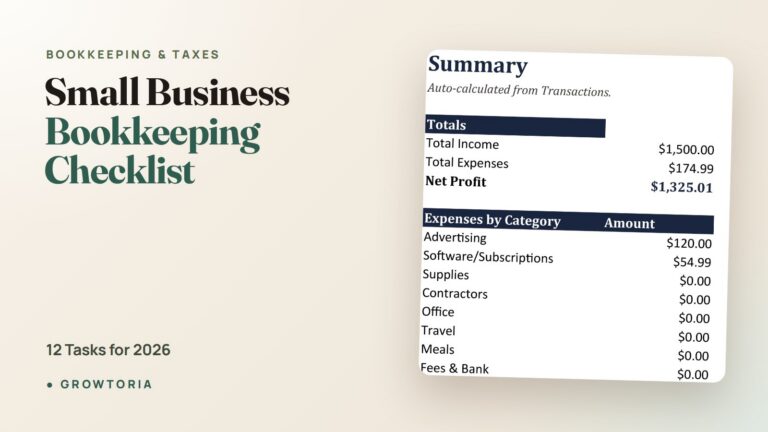
To keep the categories clean as you enter outflows, pair it with our bookkeeping categories for small business guide and the small business bookkeeping checklist so nothing slips through.
Frequently asked questions
What is the best free small business cash flow template?
The best free option is one you’ll actually update. A simple Google Sheets or Excel grid with opening cash, inflows, outflows, and a closing balance beats any fancy tool you abandon. Build the 7-step version above, or start from a pre-built layout and customize it to your business.
How often should I update my cash flow template?
Update it weekly if cash is tight, monthly at minimum. Ten minutes every Monday – moving paid invoices to “received” and adjusting expected pay dates – keeps the forecast accurate. A cash flow template only warns you if it reflects reality.
What’s the difference between a cash flow template and a budget?
A budget sets spending targets for a period; a cash flow template tracks the actual timing of money in and out. A budget says what you plan to spend, while cash flow says whether you’ll have the money when the bill is due. Most businesses need both – see our guide on how to make a budget spreadsheet.
Can I be profitable but still run out of cash?
Yes – it happens constantly. If customers pay 30 to 60 days after you invoice but your bills are due now, you can show a profit on your P&L and still have an empty bank account. That timing gap is precisely what a cash flow template exposes. Watch your average profit margin for small business and your cash position together.
How many months should a cash flow forecast cover?
Twelve months for planning, plus a rolling 13-week view for control. A year-long horizon shows seasonal swings and big annual bills like taxes and insurance, while the 13-week view keeps you on top of near-term payroll and rent.
Start with the timing, not the totals
Most cash crises aren’t about earning too little – they’re about the money arriving after the bills are due. A small business cash flow template fixes that by putting timing front and center, so you see trouble weeks ahead.
Build the 7-step version this week, or shortcut it with our 12-Month Cash Flow Forecast Spreadsheet and browse the rest of our free tools to keep your numbers honest all year.