Small Business Tax Deductions Checklist: 17 to Claim
A well-organized small business tax deductions checklist is the difference between overpaying the IRS and keeping money that is legally yours. Most owners don’t lose deductions because they’re greedy – they lose them because a receipt got lost, a mile went untracked, or nobody knew the expense counted in the first place.
The good news: the rules are simpler than they look. The IRS lets you deduct expenses that are ordinary (common in your trade) and necessary (helpful and appropriate for your business). That’s the whole test.
This guide walks through 17 deductions you can actually claim, the records you need to survive an audit, and a simple system to stop the leaks. Whether you’re a freelancer, a tradesperson, an Etsy seller, or run a small shop, you’ll leave with something you can apply today.
How Small Business Tax Deductions Actually Work
A deduction lowers your taxable income, not your tax bill directly. If you’re in a 22% bracket and you deduct a $1,000 laptop, you save roughly $220 – not the full $1,000. That distinction matters, because chasing write-offs you don’t need is just spending money to save pennies.
Here’s the mental model to keep:
- Ordinary + necessary = deductible. A camera is ordinary for a photographer, not for a plumber.
- Business use only counts. If something is part personal, you deduct only the business percentage.
- You must be able to prove it. No receipt or log, no deduction – that’s where most owners get burned.
The official rulebook is the IRS Tax Guide for Small Business (Publication 334), and most sole proprietors report these on Schedule C. Bookmark both – they settle almost every “can I deduct this?” argument.
The Small Business Tax Deductions Checklist: 17 Write-Offs
Run through this list line by line. For each one, ask: did I spend this to run my business, and can I prove it? If yes to both, it belongs on your list.
Everyday operating costs
- Home office. A dedicated space used regularly and exclusively for work. Use the simplified method ($5 per square foot, up to 300 sq ft) or the actual-expense method.
- Software & subscriptions. Accounting tools, design apps, hosting, email, and the SaaS you run the business on.
- Office supplies & equipment. Laptops, printers, paper, a desk – the tools of the trade.
- Phone & internet. The business-use percentage of your monthly bills.
- Bank & payment fees. Stripe, PayPal, Etsy, and Square fees add up fast and are fully deductible.
Growth, people, and expertise
- Advertising & marketing. Ads, your website, business cards, and content you pay for.
- Contractor & freelancer payments. Anyone you pay $600+ generally needs a 1099-NEC – but the payment is deductible either way.
- Professional services. Your accountant, bookkeeper, lawyer, and consultants.
- Education & training. Courses, books, and certifications that maintain or improve skills for your current business.
- Business insurance. Liability, professional indemnity, and property coverage.
Travel, vehicle, and the ones people forget
- Vehicle mileage. Track business miles and deduct at the IRS standard rate – one of the biggest missed write-offs for anyone who drives to jobs or clients.
- Business travel. Flights, lodging, and 50% of business meals while traveling.
- Client & team meals. Generally 50% deductible when there’s a clear business purpose.
- Startup costs. Up to $5,000 of costs before you opened your doors.
- Retirement contributions. A SEP-IRA or Solo 401(k) is both a write-off and future wealth.
- Health insurance premiums. Self-employed owners can often deduct their own premiums.
- Interest & loan costs. Interest on business loans and business credit cards.
Deductible vs. Not Deductible: Quick Reference
The gray areas trip people up. Use this table when you’re unsure whether an expense makes the cut.
| Expense | Deductible? | The catch |
|---|---|---|
| Business meals with a client | Yes (50%) | Note who and why on the receipt |
| Your daily commute to a fixed office | No | Commuting is personal, not business |
| Home office (dedicated room) | Yes | Must be regular and exclusive use |
| Everyday work clothes | No | Only uniforms/branded gear qualify |
| Mileage to a client or job site | Yes | Keep a contemporaneous log |
| Personal cell phone (100%) | Partial | Deduct only the business-use share |
| Coffee for the office | Yes | Reasonable amounts only |
| A suit you “could” wear to meetings | No | If it’s wearable off the job, it’s out |
The Records the IRS Actually Wants
A deduction is only as strong as the proof behind it. If you can’t substantiate it, expect it to be disallowed in an audit. Keep these for at least three years:
- Receipts and invoices – digital scans are fine and easier to search.
- Bank and credit card statements that match your books.
- A mileage log with date, destination, purpose, and miles.
- Notes on business purpose for meals and travel (who, what, why).
The single biggest upgrade you can make is separating business and personal money. Open a dedicated business checking account and card so every transaction is pre-sorted. It turns tax season from archaeology into a five-minute export.
Build a System So You Never Miss a Deduction
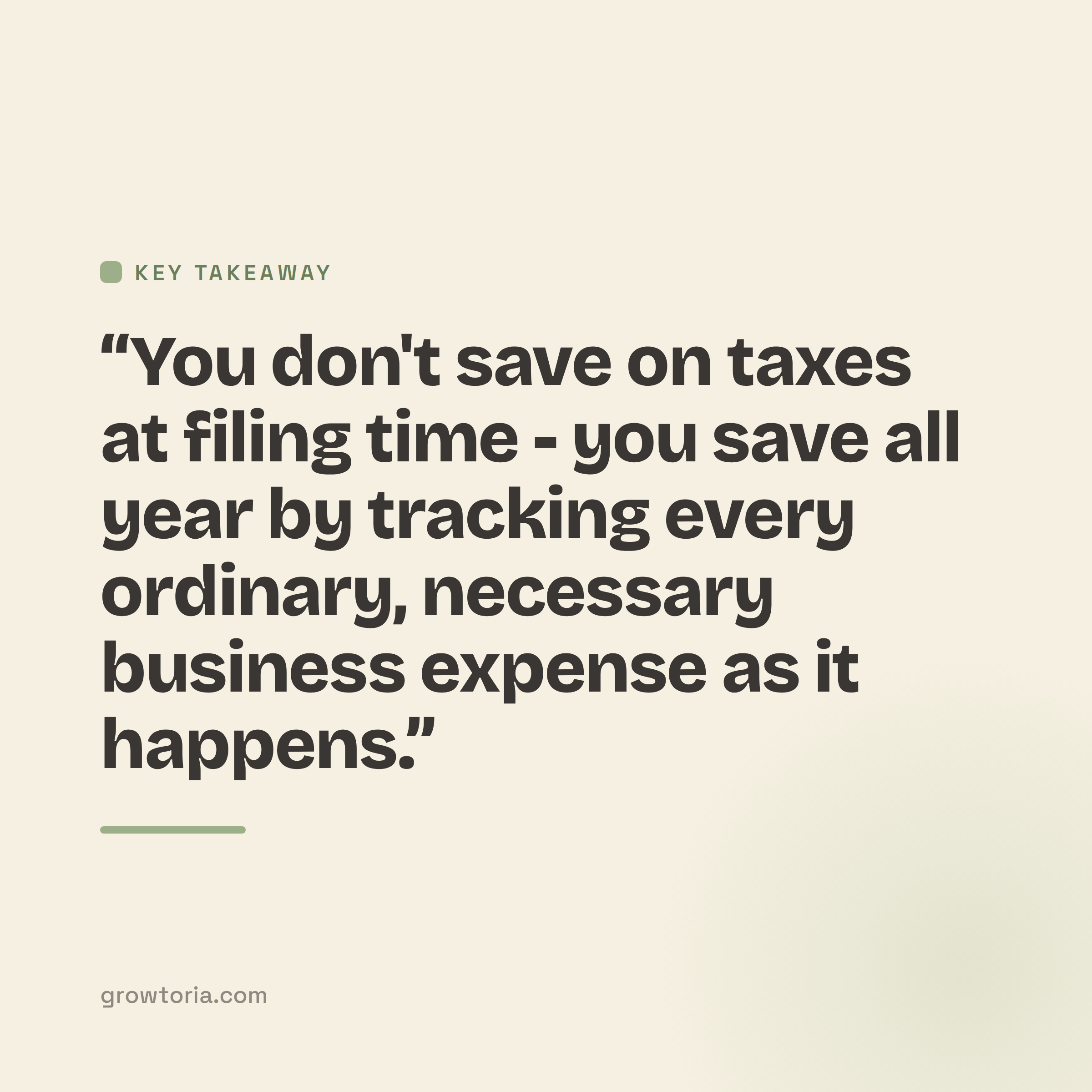
Deductions aren’t found at filing time – they’re captured all year. The owners who pay the least tax aren’t smarter; they just log expenses as they happen. Here’s a workflow that takes minutes a week.
- Log every expense weekly. Ten minutes on a Friday beats a lost weekend in April.
- Categorize as you go using the buckets on Schedule C, so your numbers are return-ready.
- Snap receipts immediately – thermal receipts fade, and memory fades faster.
- Track mileage in the moment with a log you actually keep, not a guess.
- Reconcile monthly against your bank feed to catch anything missing.
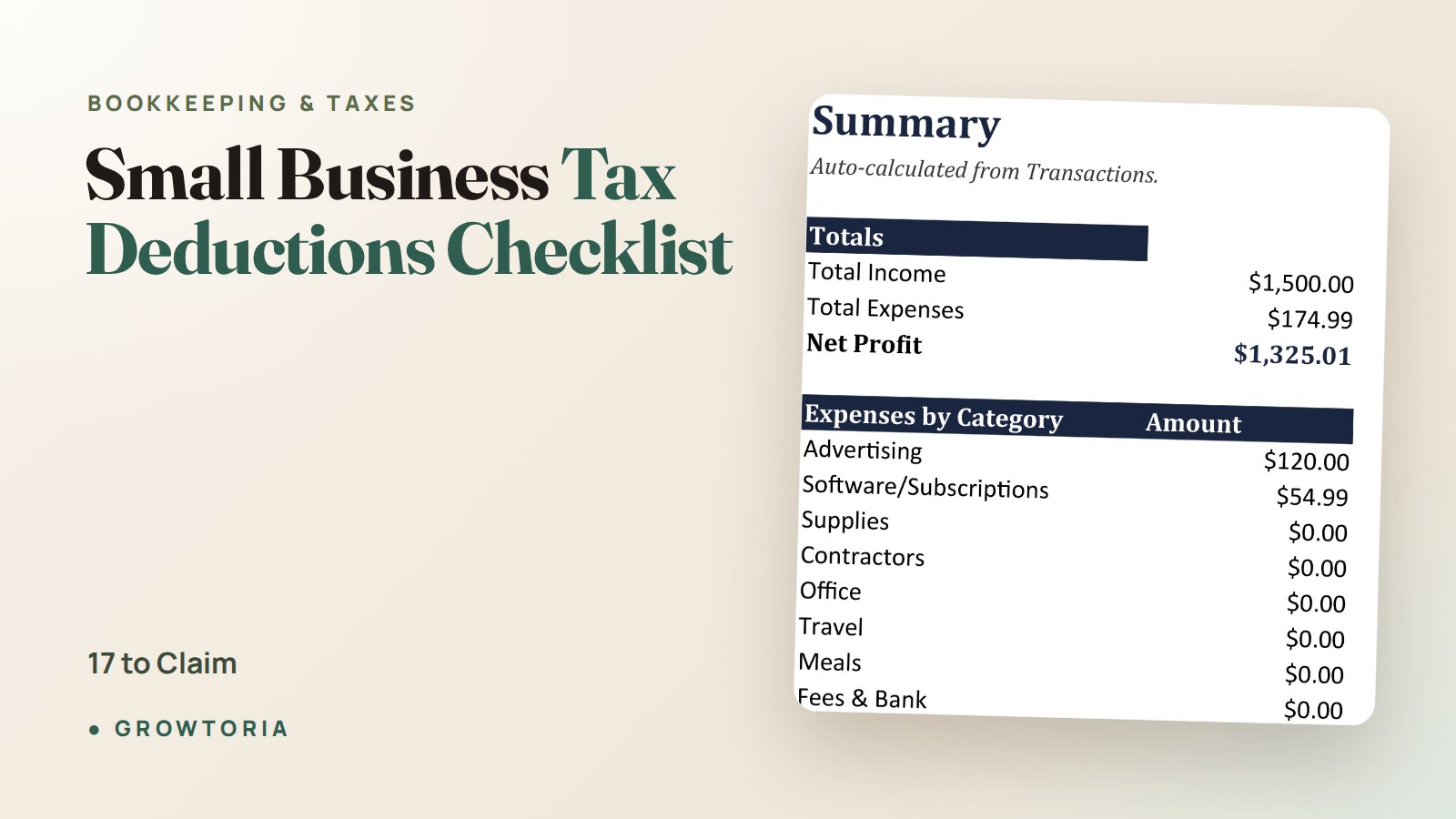
If you’d rather not build the spreadsheet yourself, our small business expense tracker logs income and expenses and instantly shows totals by category – it’s essentially this checklist in spreadsheet form. Drivers can pair it with the IRS mileage log generator, which calculates your deduction at the current IRS rate automatically. Both are also available if you’d rather grab them on our Etsy shop.
Want to see where those write-offs leave your take-home? Run the numbers with our free tools before you file. And if bookkeeping still feels overwhelming, start with the basics in our guide to building a budget spreadsheet.
Deductions by Business Type
Your best write-offs depend on what you do. A few starting points:
- Freelancers & consultants: software, home office, professional services, and self-employment retirement accounts.
- Trades & service businesses: tools, vehicle mileage, job supplies, and licensing. See how it flows into pricing in our plumbing job pricing guide.
- Etsy & handmade sellers: materials, platform fees, shipping, and packaging. Set it up right with our Etsy bookkeeping spreadsheet guide.
- Offline-first owners: if privacy matters, run your books with small business software that works fully offline.
Frequently Asked Questions
What can I write off on a small business tax deductions checklist without receipts?
Very little safely. The IRS can accept reasonable reconstructions for small items, but the burden of proof is on you. Bank and card statements help, yet a matching receipt or log is always stronger – so capture them as you spend.
Can I deduct expenses if my business isn’t profitable yet?
Often yes. Legitimate business expenses are deductible even in a loss year, and startup costs (up to $5,000) can be claimed the year you open. The IRS does expect a genuine profit motive, not a hobby, so keep clear records that you’re running it like a business.
How much of my home office can I deduct?
With the simplified method, $5 per square foot up to 300 square feet (a $1,500 maximum). The actual-expense method deducts the business percentage of rent, utilities, and insurance – it’s more work but can be worth more. The room must be used regularly and exclusively for business.
Do I need separate business and personal bank accounts?
It’s not legally required for sole proprietors, but it’s the highest-leverage habit on this list. Separate accounts make every deduction obvious, protect you in an audit, and cut bookkeeping time dramatically. Open one before your next tax year starts.
When should I hire a bookkeeper or accountant?
When the time you spend on books is worth more than the fee, or when your return gets complex (payroll, inventory, multiple owners). Even then, a clean expense tracker makes their job cheaper – you’re paying for advice, not data entry.
Turn This Checklist Into Real Savings
A small business tax deductions checklist only pays off if you use it every week, not once a year. Separate your accounts, log expenses as they happen, keep the proof, and match each write-off to the ordinary-and-necessary test.
Do that, and you’ll walk into tax season with a return that’s already 90% done – and a bill that’s as low as the law allows. Start your list today, and let a simple system catch the deductions you’ve been leaving behind.