How to Quote a Painting Job: 7 Steps to Win Bids
Learning how to quote a painting job is the difference between a painting business that stays booked and one that either scares clients off with sky-high numbers or quietly loses money on every wall. A good quote does two things at once: it wins the job and protects your profit. Get the math right and you stop guessing—you start bidding with confidence.
This guide walks through the exact 7-step process pro painters use to price interior and exterior work in 2026, including real square-foot ranges, a sample cost breakdown, and the mistakes that eat your margin.
Quick answer: To quote a painting job, measure the total paintable square footage, estimate paint and materials, calculate labor hours at your hourly rate, add overhead and a 20–30% profit markup, then present one clear itemized estimate. Most interior work lands between $2 and $6 per square foot in 2026, depending on prep, coats, and ceiling height.
How to quote a painting job in 7 steps
Quoting a painting job means turning a walkthrough into a defensible number. Follow these seven steps in order and you’ll never send a random guess again.
1. Do a walkthrough and scope the job
Before you touch a calculator, see the space. Note ceiling height, wall condition, trim, doors, closets, and anything that slows a roller down. Prep is where quotes go wrong—cracks, holes, water stains, and old glossy paint all add hours.
Ask three questions on site:
- How many coats? Dark-to-light color changes usually need two coats plus primer.
- What’s the surface? New drywall, previously painted, or bare wood each behave differently.
- Who moves the furniture? Spell it out so it doesn’t become a surprise on the invoice.
2. Measure the paintable square footage
Accurate measurement is the backbone of a fair quote. For walls, multiply the room perimeter by the ceiling height. For a 12 ft × 14 ft room with 9 ft ceilings, that’s a 52 ft perimeter × 9 ft = 468 square feet of wall.
Then subtract large openings (roughly 15–20 sq ft per door and 15 sq ft per standard window) if you want precision, or leave them in as a buffer for trim work. Measure ceilings separately (length × width) since they paint at a different rate than walls.
3. Estimate paint and materials
A gallon of interior paint covers about 350–400 square feet per coat on smooth walls, per most manufacturer specs from brands like Sherwin-Williams. Divide your square footage by 375, then multiply by the number of coats.
Don’t forget consumables. Tape, plastic, drop cloths, brushes, roller covers, spackle, and primer add up. A safe rule of thumb is to add 10–15% of your paint cost for materials, or track them as a flat line item.
4. Calculate your labor hours and rate
Labor is the biggest number in almost every paint quote—usually 70–85% of the total. Estimate how many hours the job realistically takes, then multiply by your loaded hourly rate.
A useful production benchmark: an experienced painter covers roughly 150–200 square feet of wall per hour for cutting and rolling one coat, slower for detailed trim and heavy prep. According to the U.S. Bureau of Labor Statistics, the median wage for construction painters was about $22 per hour in 2024—but your billing rate must be far higher to cover overhead and profit.
If you’re still setting your rate, our step-by-step guide on how to price a job as a tradesman breaks down the full formula, and the approach mirrors what plumbers use in our plumbing job pricing guide.
5. Add overhead and profit markup
Here’s where most painters underprice. Your labor rate covers the person doing the work—it does not cover insurance, fuel, your truck, phone, software, or the hours you spend quoting jobs you don’t win.
Add overhead (often 10–20% of the job) and then a separate profit markup of 20–30% on top. Markup and margin are not the same thing, and confusing them is a classic money-loser—our breakdown of markup vs margin shows exactly why a 30% markup is not a 30% profit margin.
6. Build the total and sanity-check per square foot
Add it all up: paint + materials + labor + overhead + profit. Then divide the total by your square footage and compare it to market ranges. If your interior quote comes out to $1.20 per square foot, you’ve made an error. If it’s $9, you may be over-scoping or the job is genuinely complex.
Here’s a realistic 2026 reference table for interior work:
| Job type | Typical price per sq ft | What’s included |
|---|---|---|
| Walls only, 1 coat, minimal prep | $1.50 – $2.50 | Light patching, one finish coat |
| Walls, 2 coats, standard prep | $2.50 – $4.00 | Patching, priming, two coats |
| Walls + ceilings + trim | $3.50 – $6.00 | Full room, cut-in, trim, doors |
| Heavy prep / repairs / high ceilings | $5.00 – $9.00 | Drywall repair, staining, scaffolding |
| Exterior (siding + trim) | $2.00 – $5.00 | Power wash, scrape, prime, 2 coats |
These are ballpark figures—your local market, competition, and cost of living shift them. Use them as a gut-check, not gospel.
7. Present one clear, itemized estimate
The quote that wins isn’t always the cheapest—it’s the clearest. Break the estimate into scope, materials, labor, prep, and total, with a start date and payment terms. Vague quotes make clients nervous; itemized quotes make you look like the professional.
Always put your assumptions in writing: number of coats, colors included, who moves furniture, and what happens if hidden damage appears. That single paragraph prevents 90% of scope disputes.
What should a painting quote include?
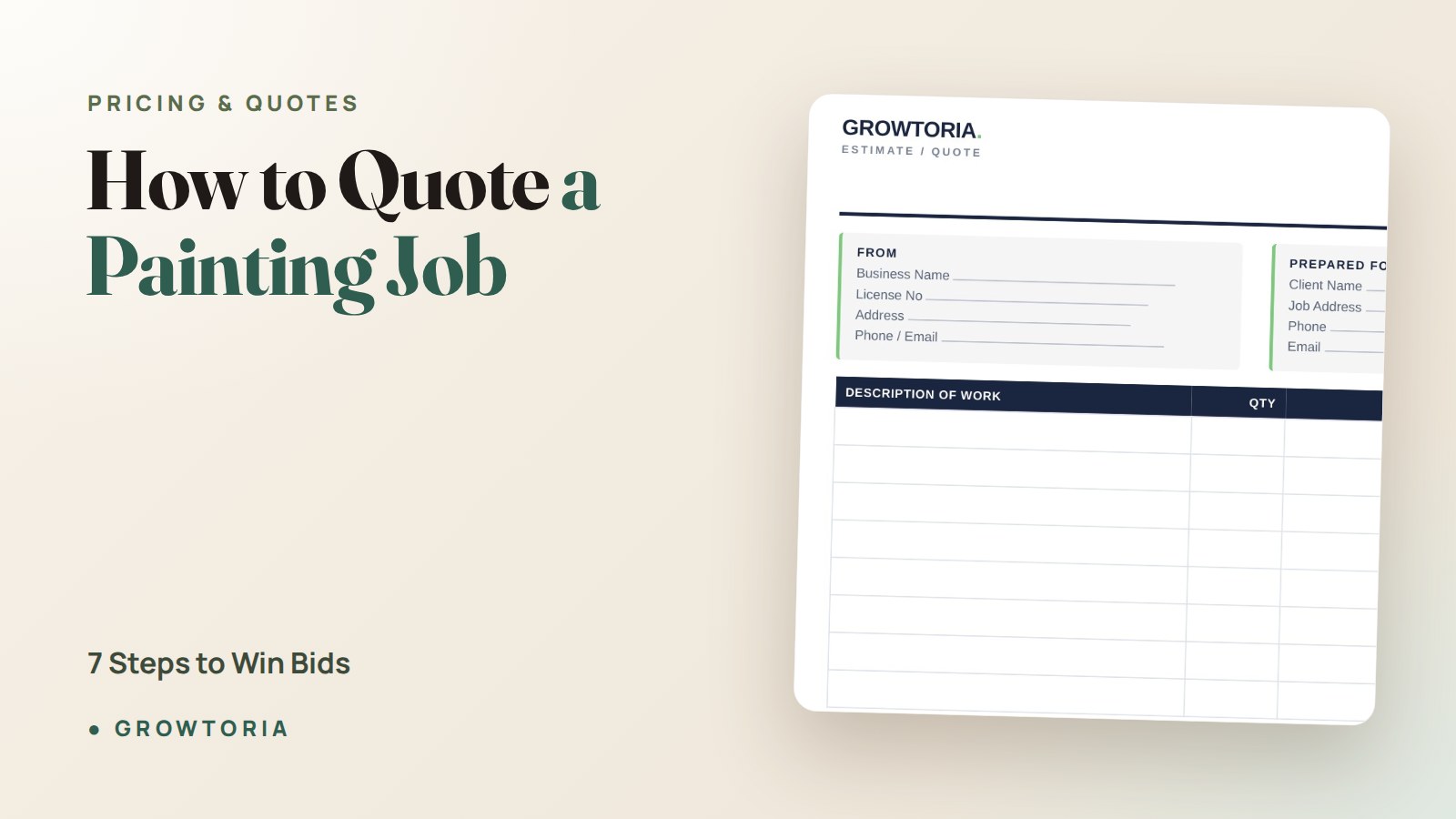
A complete painting quote answers every question before the client asks it. At minimum, include:
- Your business name, license, and insurance — trust signals that justify your price.
- A clear scope — rooms, surfaces, coats, and colors.
- Itemized costs — materials and labor split out.
- Prep and exclusions — what’s included and what isn’t.
- Timeline and payment terms — deposit, milestones, final balance.
- Validity window — “this quote is valid for 30 days” protects you from rising paint costs.
You don’t have to build this from scratch. Our contractor estimate template gives you an itemized, professional quote form you can fill in and export as a PDF in minutes—ideal if you’d rather send quotes than format spreadsheets. If you prefer Google Sheets, the walkthrough in our estimate template for Google Sheets post shows how to set one up step by step. Prefer to buy on a marketplace? You can also grab our templates on Etsy.
How do you price paint and labor without underquoting?
The single most common mistake is pricing off gut feel and forgetting your own time. To avoid it, separate the three cost drivers and price each deliberately:
- Materials — real product cost plus 10–15% consumables.
- Labor — realistic hours × your billing rate, not your take-home wage.
- Profit — a deliberate markup, never “whatever’s left.”
If you want to pressure-test the profit side, run your numbers through a free profit margin calculator or check your break-even point before you commit to a price. Knowing the exact job where you start making money keeps you from bidding yourself into the ground during slow months.
Interior vs exterior: what changes in your quote?
Exterior jobs carry more risk, so they price differently. You’re dealing with weather delays, ladders and scaffolding, power washing, scraping, and often multiple surface types (siding, fascia, soffits, trim). Prep alone can be half the job.
Two extra factors to build in for exteriors:
- Height and access — a two-story home with steep grading needs more equipment and time.
- Surface repair — rot, caulking, and failed old paint add labor you must scope up front.
One important caveat: if the home was built before 1978, federal EPA Lead Renovation, Repair and Painting (RRP) rules may require certification and specific containment practices. That’s a compliance cost—and a selling point—you should reflect in your quote.
Frequently asked questions
How much should I charge to paint a room?
For a standard 10 ft × 12 ft bedroom with 8–9 ft ceilings, two coats and light prep, most painters charge between $350 and $800 in 2026. That range assumes walls only; adding ceilings, trim, and doors pushes a single room toward $900–$1,200. Always confirm coats and prep before committing.
How do painters calculate square footage for a quote?
Painters multiply the room’s perimeter by the ceiling height to get wall area, then add ceiling area (length × width) separately. Large doors and windows can be subtracted at roughly 15–20 sq ft each for accuracy, or left in as a buffer that covers trim and cut-in work.
Should I quote per square foot or per hour?
Quote the client per square foot or as a flat project price—it’s easier for them to approve and rewards your efficiency. Internally, always build the number from hours × rate so you know your true cost. Per-square-foot is how you present it; per-hour is how you calculate it.
How much profit should a painting business make per job?
Aim for a net profit margin of 15–30% after all labor, materials, and overhead are covered. A deliberate 20–30% markup on your combined costs typically gets you there. If you’re consistently below 10%, you’re likely underpricing labor or forgetting overhead like insurance and vehicle costs.
What’s the fastest way to send professional painting quotes?
Use a reusable template so you’re editing, not rebuilding. A fill-in-the-blank estimate form lets you go from walkthrough to a polished PDF the same day—speed of response is one of the biggest reasons homeowners pick one painter over another.
Turn a good quote into a booked job
Knowing how to quote a painting job comes down to a repeatable system: scope it, measure it, price paint and labor separately, add real overhead and profit, then present one clean itemized estimate. Do that every time and you stop leaving money on the table—and you start looking like the pro clients actually want to hire.
Ready to speed things up? Skip the spreadsheet formatting with our done-for-you contractor estimate template, or browse the full library of free small business tools to price your next job with confidence.