Markup vs Margin Explained: 7 Formulas That Save Money
Markup vs margin explained in one honest sentence: markup is the amount you add on top of your cost, and margin is the slice of the selling price you actually keep. Confuse the two, and you can undercharge by 10-20% without ever noticing — because the math still “looks fine” on a receipt.
This guide gives you the formulas, a worked example, a conversion table you can bookmark, and the exact moment each number should be used. No jargon. No fluff. Just the pricing math that actually protects your profit.
Markup vs margin explained in one sentence
Say a product costs you $10 and you sell it for $15. Your markup is $5, which is 50% of the cost. Your margin is also $5, but it’s only 33.3% of the selling price. Same $5. Very different percentages.
That gap is where most small businesses quietly leak money. A team hears “we need 40% margin,” adds 40% to their cost, and ships a product with only a 28.6% margin. Multiply that miss by every unit for a year and it becomes a real number.
Here’s the mental model that keeps it straight: markup looks backward at what you paid; margin looks forward at what you charged. Both start from the same dollar of gross profit — they just divide it by a different denominator. Cost for markup, selling price for margin. Once that clicks, the rest of this guide is arithmetic.
Why the same dollar produces two percentages
Gross profit is the dollar figure both terms are built on. On that $10-cost, $15-price candle, gross profit is a flat $5. Markup divides that $5 by the smaller number (cost, $10) so the percentage looks bigger. Margin divides it by the larger number (price, $15) so the percentage looks smaller. Nothing about the actual money changed — only the reference point did. That single shift in denominator is the entire source of confusion, and it’s why a “good-looking” markup can hide a thin margin.
The formulas you actually need
You only need four formulas. Save this section — it’s the entire cheat sheet.
1. Margin formula
Margin = (Selling Price − Cost) ÷ Selling Price × 100
Example: ($15 − $10) ÷ $15 × 100 = 33.3% margin.
2. Markup formula
Markup = (Selling Price − Cost) ÷ Cost × 100
Example: ($15 − $10) ÷ $10 × 100 = 50% markup.
3. From target margin to selling price
Selling Price = Cost ÷ (1 − Desired Margin)
Want a 40% margin on a $10 product? $10 ÷ (1 − 0.40) = $16.67.
4. From target markup to selling price
Selling Price = Cost × (1 + Desired Markup)
Want a 40% markup on a $10 product? $10 × (1 + 0.40) = $14.
Notice how a “40%” label produces two different prices: $16.67 or $14. That’s the whole story of why this matters.
Bonus: converting markup to margin (and back)
If you already price in markup but your accountant wants margin, you don’t have to redo everything. Two quick conversions:
Margin = Markup ÷ (1 + Markup). A 50% markup becomes 0.50 ÷ 1.50 = 33.3% margin.
Markup = Margin ÷ (1 − Margin). A 40% margin becomes 0.40 ÷ 0.60 = 66.7% markup.
Side-by-side comparison
Here’s the same product priced two ways so you can see the gap at a glance.
| Cost | Target Number | Method | Selling Price | Actual Margin | Actual Markup |
|---|---|---|---|---|---|
| $10 | 40% | Added as markup | $14.00 | 28.6% | 40% |
| $10 | 40% | Priced for margin | $16.67 | 40% | 66.7% |
| $10 | 50% | Added as markup | $15.00 | 33.3% | 50% |
| $10 | 50% | Priced for margin | $20.00 | 50% | 100% |
| $10 | 60% | Added as markup | $16.00 | 37.5% | 60% |
| $10 | 60% | Priced for margin | $25.00 | 60% | 150% |
Read the middle row a few times. A “50% markup” and a “50% margin” are $5 apart on a $10 product. On 1,000 units, that’s $5,000 you either keep or hand back.
One pattern worth internalizing: the higher the percentage you’re chasing, the wider the gap between the two methods grows. At 40% the two prices differ by $2.67. At 60% they differ by $9. So the more ambitious your target, the more a markup-vs-margin mix-up costs you.
A worked example: pricing a $10 product
Let’s walk through it like a real business decision.
You make a candle. Total unit cost — wax, wick, jar, label, packaging, shipping supplies, a share of your monthly booth fee — comes to $10.00. You want a 60% gross margin because that’s the industry benchmark and it leaves room for marketing, returns, and tax.
Wrong way: “Add 60%.” You price at $16. Your actual margin? 37.5%. You just missed your target by 22 percentage points.
Right way: Selling Price = $10 ÷ (1 − 0.60) = $25.00. Now every unit clears $15 of gross profit, and 60% of each sale is yours to work with.
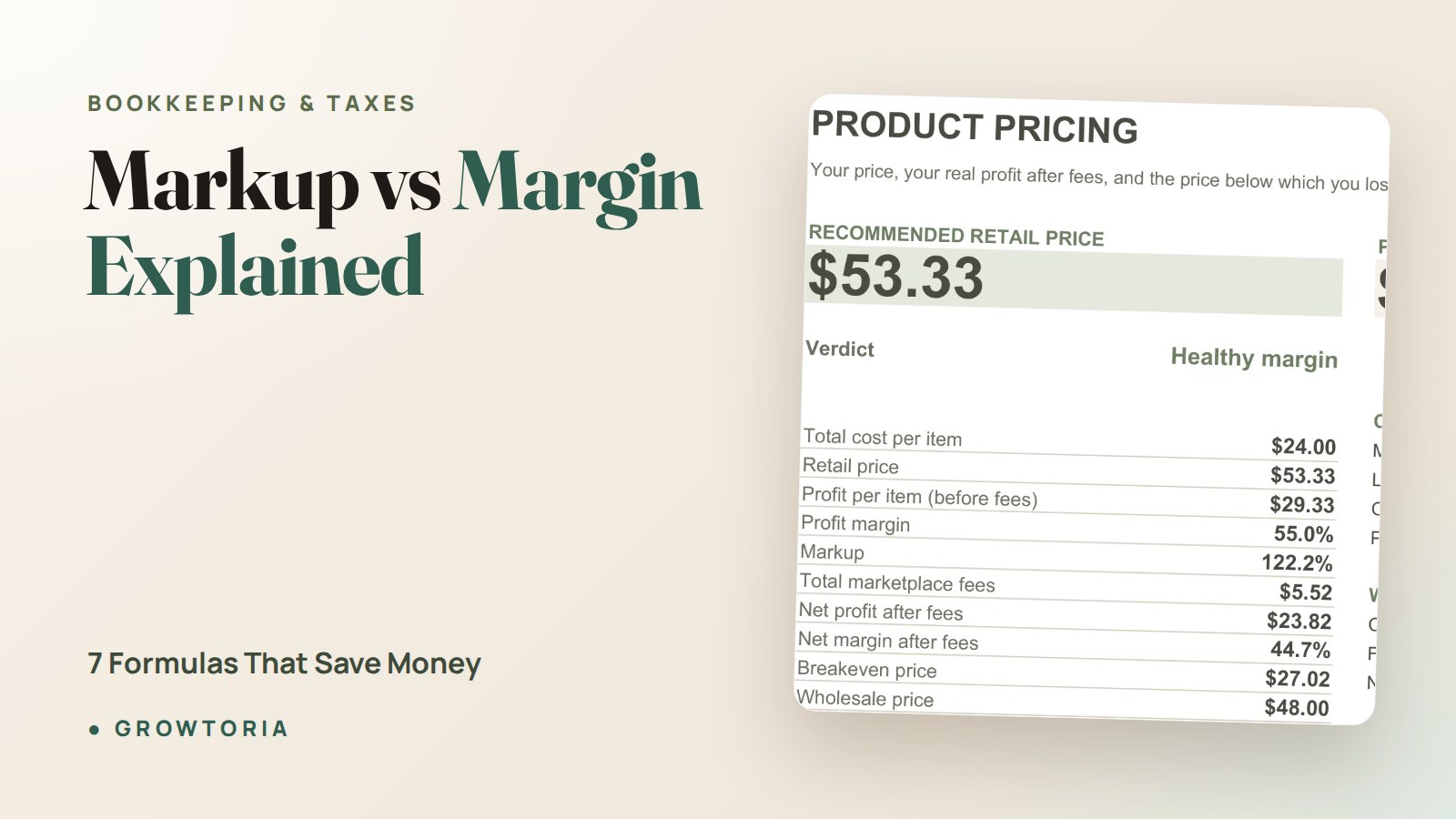
If your unit cost isn’t clean yet, that’s the first thing to fix. Our Product Pricing Calculator collects every input (materials, labor, packaging, platform fees) and hands you both numbers — the markup you’re charging and the margin you’re actually keeping. Prefer to browse alternatives? You can also grab it on our Etsy shop.
Why this mistake costs real money
The reason markup gets confused with margin is that many industries default to markup thinking. “Keystone pricing” in retail, for example, is a 100% markup — which happens to land at a 50% margin. So a shop owner who doubles their cost feels like they’re keeping half of every sale, and in that specific case they’re right. The trouble starts when the same person hears a supplier or a spreadsheet talk in margin terms and keeps applying markup math out of habit.
Your accountant, your loan officer, and your tax return all speak in margin. Gross margin is what shows up on an income statement, and it’s the number lenders and investors benchmark you against. If you run your pricing in markup and report your health in margin, the two views never quite reconcile — and you’ll spend evenings hunting for profit that math already spent.
The stakes scale with volume and with discounting. Knock 20% off a product you priced with a thin, accidental margin and you can slip below cost without realizing it. That’s how a “successful” flash sale ends the month with less cash than it started. The U.S. Small Business Administration’s guidance on managing business finances makes the same point in plainer language: you have to know your true costs and margins before you set a price, not after.
When to use markup vs when to use margin
Use markup when you’re at the point of purchase and thinking “how much do I add to this cost to set a shelf price?” It’s fast at the counter and it’s how most wholesale and distributor conversations are framed.
Use margin when you’re thinking about the health of the business — profitability targets, break-even, comparing product lines, or anything that touches your financial statements. If a number is going to be reported, budgeted, or compared to a benchmark, express it as margin. For a deeper accounting-side breakdown, Investopedia’s explainer on the difference between profit margin and markup is a solid reference to keep bookmarked.
Quick reference: common targets converted
Keep these pairs in your head and you’ll rarely get caught out. A 25% margin equals a 33% markup. A 33% margin equals a 50% markup. A 50% margin equals a 100% markup. A 60% margin equals a 150% markup. Whenever someone says a flat percentage without saying which one, ask — because as the table above showed, the price swings hard depending on the answer.
Frequently asked questions
Is a 50% markup the same as a 50% margin?
No, and this is the single most expensive mix-up in small-business pricing. A 50% markup on a $10 cost gives a $15 price and only a 33.3% margin. A true 50% margin on that same $10 cost requires a $20 price. Same label, $5 apart per unit.
Which should I use to set my prices — markup or margin?
Set the target in margin because that’s what your profitability and financial statements are measured in, then use the formula Selling Price = Cost ÷ (1 − Desired Margin) to convert it into an actual price. Markup is fine as a shortcut once you’ve confirmed which markup delivers the margin you actually need.
Can margin ever be higher than markup?
No. For the same product, markup is always the larger percentage because it divides gross profit by the smaller number (cost) instead of the larger number (selling price). Margin tops out just below 100% and can never reach it, while markup has no ceiling.
What is a “good” margin for a small business?
It depends heavily on your industry, but many product-based small businesses aim for a gross margin of 50-60% so there’s room left for marketing, returns, shipping surprises, and tax. Service businesses often run higher; grocery and low-touch retail run much lower on thin, high-volume margins. Benchmark against your own category, not a universal number.
How do I convert markup to margin quickly?
Use Margin = Markup ÷ (1 + Markup). A 40% markup becomes 0.40 ÷ 1.40 = 28.6% margin. To go the other way, Markup = Margin ÷ (1 − Margin). Memorize those two and you can translate any pricing conversation on the spot.
The one-line takeaway
Markup is added on top of cost; margin is carved out of the selling price. Set your goal in margin, price with the Cost ÷ (1 − Margin) formula, and double-check every “percent” someone throws at you. Do that and you’ll stop leaving 10-20% of your profit on the table — one correctly priced unit at a time.