Small Business Profit Margin Calculator: 7 Steps
A small business profit margin calculator turns your revenue and costs into the one number that actually matters: how much of every dollar you get to keep. Most owners can tell you their sales. Very few can tell you their margin — and that gap is exactly where profit quietly leaks out.
This guide walks you through the real formulas, honest benchmarks by industry, and a repeatable 7-step process you can run on any product, service, or job. No accounting degree required.
Quick answer: A small business profit margin calculator divides your profit by your revenue, then multiplies by 100. Subtract the cost of goods from revenue for gross margin, or subtract every expense for net margin. If a $100 sale costs you $70 all-in, your net profit margin is 30%.
What is a small business profit margin calculator?
A small business profit margin calculator is a tool that converts your sales and expenses into a percentage showing how profitable each sale really is. You enter revenue and costs; it returns your margin.
The point isn’t the math — it’s the decision the number unlocks. Margin tells you whether to raise prices, cut a cost, drop a product, or keep going exactly as you are.
There are three margins worth knowing, and they answer different questions:
- Gross profit margin — profit after the direct cost of making or delivering the thing.
- Operating profit margin — profit after running costs like rent, software, and wages.
- Net profit margin — what’s left after everything, including tax and interest.
If you only track one, track net. It’s the honest one. You can run the numbers in seconds with our free small business profit margin calculator, or build the logic yourself with the steps below.
How do you calculate profit margin for a small business?
To calculate profit margin, subtract your costs from your revenue to get profit, divide that profit by revenue, and multiply by 100. The result is your margin as a percentage.
Here are the three formulas in plain terms:
- Gross margin % = (Revenue − Cost of Goods Sold) ÷ Revenue × 100
- Operating margin % = Operating Profit ÷ Revenue × 100
- Net margin % = Net Profit ÷ Revenue × 100
Quick worked example. You sell a product for $50. Materials and shipping cost $20, so gross profit is $30 and gross margin is 60%. After you fold in your share of rent, fees, and time, total cost is $38 — net profit is $12 and net margin is 24%.
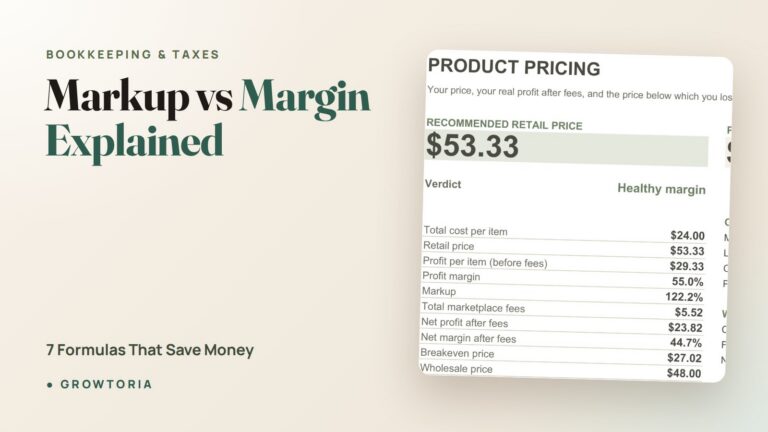
That drop from 60% to 24% is the story most owners never see. It’s also why margin and markup get confused so often; if that trips you up, our breakdown of markup vs margin clears it up with seven quick formulas.
The 7 steps to use a profit margin calculator
Follow these seven steps and you’ll have an accurate margin for any product, service, or job — plus a clear read on whether it’s worth doing.
1. Pull one clean period of revenue
Start with a single, tidy number: total sales for one month, one quarter, or one job. Use money actually earned, not invoiced-but-unpaid. Mixing periods is the fastest way to a garbage margin.
2. List your direct costs (COGS)
Write down every cost tied directly to delivering the sale: materials, packaging, shipping, payment fees, subcontractors, and hourly labor on the job. These are the costs that vanish if the sale doesn’t happen.
3. Calculate gross profit and gross margin
Subtract those direct costs from revenue for gross profit, then divide by revenue for gross margin. This is your ceiling — no business keeps more than its gross margin.
4. Add your overhead
Now layer in the fixed costs of being open: rent, software subscriptions, insurance, your own salary, marketing. Spread them fairly across your sales so each product carries its share.
5. Calculate net profit and net margin
Subtract overhead (and set aside tax) to reach net profit, then divide by revenue. This is the real number — the one that tells you if the business pays you.
6. Compare against a benchmark
A margin means nothing in isolation. Compare it to your industry’s typical range (table below) and to your own past periods. Flat sales with a rising margin is a business getting healthier.
7. Decide one action
Every calculation should end in a decision: raise a price, drop a losing product, renegotiate a supplier, or leave it alone. A number you don’t act on is just trivia.
What is a good profit margin for a small business?
A good net profit margin for a small business is generally 10% or higher, with 20%+ considered strong and anything under 5% a warning sign. But “good” depends heavily on your industry — a grocery store and a software maker live in completely different worlds.
The table below shows realistic ranges to sanity-check your own number. These reflect commonly cited averages across sectors; margins vary by size, region, and year.
| Business type | Typical gross margin | Typical net margin |
|---|---|---|
| Handmade / crafts (Etsy) | 50–70% | 15–25% |
| Retail / e-commerce | 30–50% | 5–15% |
| Food & beverage | 60–70% | 3–9% |
| Trades & contracting | 25–40% | 5–12% |
| Freelance / consulting | 80–95% | 30–50% |
| Digital products / SaaS | 75–90% | 20–40% |
Want deeper data? The NYU Stern margins-by-sector dataset (maintained by Professor Aswath Damodaran) breaks down net margins across dozens of industries and is one of the most-cited free references online. For a small-business-specific view, the U.S. Small Business Administration also publishes planning resources on costs and pricing.
We also pulled our own numbers together in this guide to the average profit margin for small business in 2026 if you want a fuller picture.
Why your profit margin looks fine but your bank account doesn’t
The usual culprit is a healthy gross margin hiding an ugly net margin. Your product looks profitable, but overhead, fees, and unpaid tax quietly eat the rest.
Three common leaks:
- Untracked fees. Payment processing, marketplace commissions, and shipping surcharges routinely knock 5–15% off before you notice.
- Free-riding products. One low-margin item can drag your whole average down. Calculate margin per product, not just overall.
- Ignoring the break-even line. If you don’t know how many units cover your fixed costs, you can’t know when profit actually starts. A quick pass through our free break-even calculator or the deeper break-even calculator for small business fixes that in minutes.
Margin and cash flow aren’t the same thing, either. You can be profitable on paper and still run dry if customers pay late — which is why tracking both matters.
The done-for-you shortcut
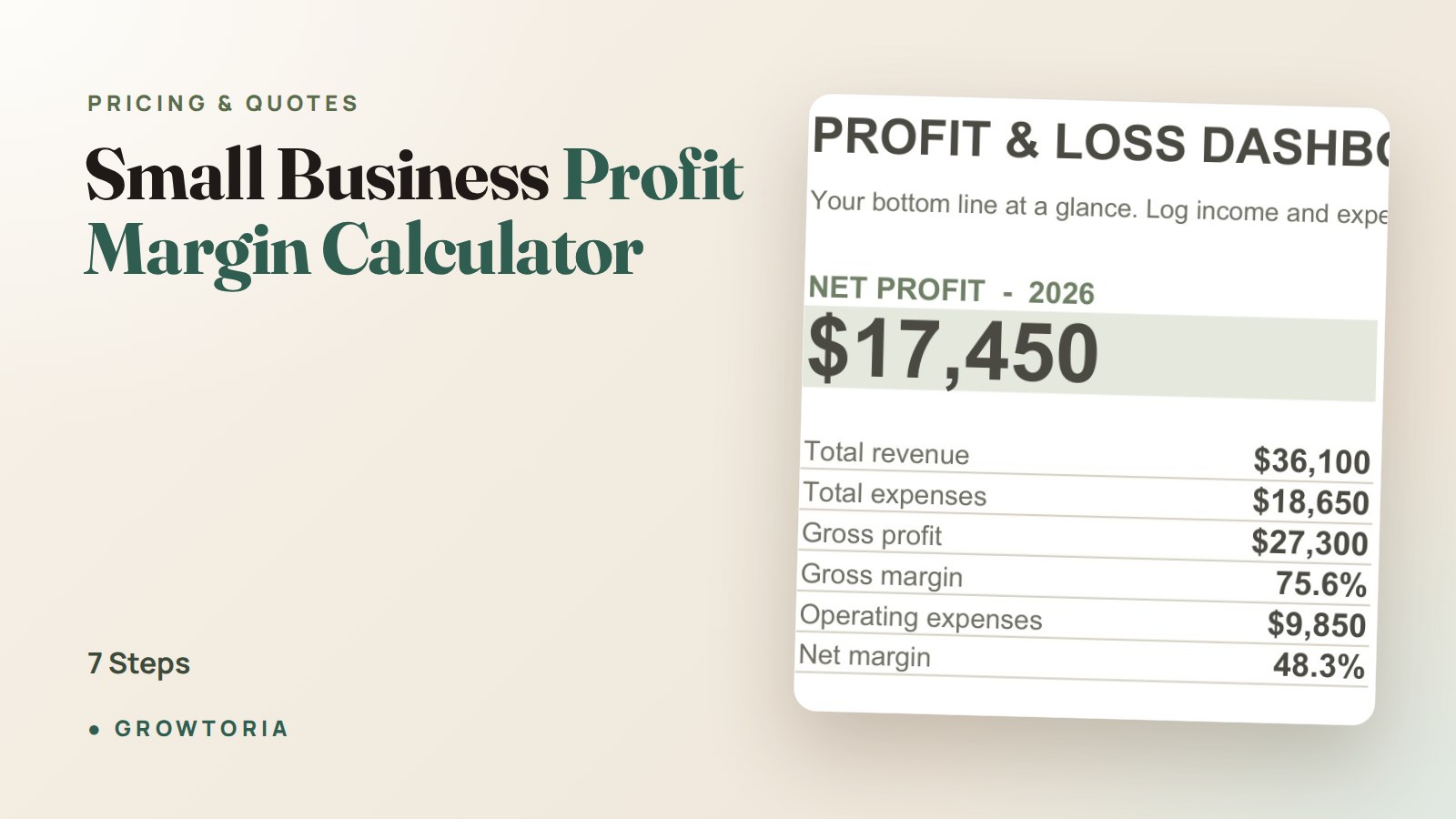
If you’d rather not build the formulas from scratch, our Small Business Profit & Loss Statement does the heavy lifting — enter income and expenses, and it shows your gross, operating, and net margins automatically each month.
Selling physical or handmade goods? The Product Pricing Calculator works backward from your target margin to the exact price you should charge. You can grab either one here or on our Etsy shop if that’s where you prefer to buy.
Tools speed you up — but the seven steps above are the part that changes decisions. Run them once and you’ll never guess at a price again.
Frequently asked questions
What is the difference between gross and net profit margin?
Gross profit margin measures profit after only direct costs (materials, labor, shipping). Net profit margin measures profit after every expense, including rent, software, marketing, interest, and tax. Gross is your ceiling; net is what you actually keep.
How do I calculate profit margin percentage?
Divide your profit by your revenue and multiply by 100. For example, $30 profit on a $100 sale is 30 ÷ 100 × 100 = 30%. Use gross profit for gross margin and net profit for net margin.
Is a 20% profit margin good for a small business?
Yes — a 20% net profit margin is strong for most small businesses and above the roughly 10% many owners average. Service and digital businesses can exceed it; food and retail often run lower, so always compare within your own industry.
What profit margin should I use to set my prices?
Work backward from a target net margin that covers your costs and pays you fairly — often 20–40% for products and higher for services. Set the price so that after all costs, that margin remains. A pricing calculator makes this a one-line calculation.
Can I calculate profit margin without accounting software?
Absolutely. All you need is total revenue and total costs for one period. A simple spreadsheet or a free profit margin calculator is enough to get an accurate, decision-ready number.
Bottom line: your small business profit margin calculator isn’t a bookkeeping chore — it’s the fastest way to find out which parts of your business pay you and which quietly cost you. Run the seven steps this week, act on one number, and price your next sale with confidence.