How to Price Handmade Products for Etsy: 7 Steps
Learning how to price handmade products for Etsy is the difference between a hobby that drains your wallet and a shop that actually pays you. Most new sellers pick a price that “feels fair,” forget to pay themselves for their time, and never account for Etsy’s fees. Then they wonder why a busy month leaves them with nothing.
This guide fixes that. You’ll get a repeatable formula, the exact Etsy fees to build in, and a worked example you can copy today.
Quick answer: To price handmade products for Etsy, add your material cost, your labor (hours × your hourly rate), and overhead to get a base cost. Multiply that base by 2 for wholesale and roughly 2x again for retail, then add ~11% to cover Etsy fees and confirm your profit margin.
Why is pricing handmade products so hard?
Pricing is hard because most makers price from emotion, not math. You compare yourself to a mass-produced item on Amazon, panic, and undercut your own work.
But you are not competing with a factory. You’re selling a one-of-a-kind product, and your price has to cover three things at least: your materials, your time, and the platform’s cut. Skip any one of them and you’re paying customers to take your work.
Here’s the mindset shift: your price is a business decision, not a self-worth test. Build it from numbers and you’ll defend it with confidence.
How to price handmade products for Etsy: the 7-step formula
Here is the core process, step by step. Work through it once for each product and save the numbers in a spreadsheet so you can update prices when costs change.
- Add up your material cost. Count every input—yarn, beads, wax, wire, clay, glaze—plus a share of consumables like glue and sandpaper.
- Pay yourself for labor. Multiply the hours a piece takes by an honest hourly rate (start at $20–$25/hour, not minimum wage).
- Add overhead and packaging. Boxes, tissue, thank-you cards, a slice of your tool and studio costs.
- Total your base cost. Materials + labor + overhead = the real cost to make one unit.
- Set your wholesale price. Multiply base cost by 2. This is your floor if you ever sell to boutiques.
- Set your retail price. Multiply wholesale by roughly 2 (so about 4× base cost for small items, less for big-ticket pieces).
- Add fees and check your margin. Build in ~11% for Etsy fees and confirm you’re keeping the profit you want.
If the 4× rule prices you out of your market, don’t slash your labor rate—lower your material cost or reduce the time per piece instead. Undervaluing your hours is the fastest way to burn out.

Etsy Seller Profit Kit: 3 spreadsheets for $19
Bookkeeping + product pricing + jewelry pricing in one kit. See your real profit per order after Etsy fees, shipping and materials. Google Sheets & Excel, one-time payment, no subscription.
What Etsy fees do I need to build into my price?
You need to build in roughly 10–11% of each sale for standard Etsy fees—and more if you use Offsite Ads. If you price at cost and forget these, Etsy quietly eats your profit.
Here’s a realistic breakdown on a $40 sale in the US, based on Etsy’s published rates. Always confirm the current numbers on Etsy’s official fees and payments policy, since they change and vary by country.
| Etsy fee | Rate | On a $40 sale |
|---|---|---|
| Listing fee | $0.20 per listing | $0.20 |
| Transaction fee | 6.5% of order total | $2.60 |
| Payment processing | ~3% + $0.25 (US) | $1.45 |
| Typical total | ~10–11% | ~$4.25 |
| Offsite Ads (if it applies) | 12–15% extra | $4.80–$6.00 |
So on a $40 order, expect to net about $35.75 before your material and labor costs—and closer to $30 if the sale came through Offsite Ads. That’s exactly why a simple “cost + a little extra” price leaves you broke.
How much should I charge for my time?
Charge an hourly rate you’d actually accept from a job—$20 to $30 an hour is a sane starting point for skilled handmade work. The classic mistake is charging $0 for labor because “I enjoy it.”
Enjoying the work doesn’t pay your rent. Time is your single biggest cost, and it’s the first thing customers can’t see, so it’s the first thing sellers cut. Don’t.
To get consistent, time yourself making three of the same item and use the average. If a scarf takes two hours and you charge $22/hour, that’s $44 of labor before a single skein of yarn is counted.
Should I lower my hourly rate to compete?
No—lower your time, not your rate. Batch your work, streamline your process, or simplify the design so each piece takes fewer minutes. Protect the hourly number; it’s the wage you’re paying yourself.
A worked example: pricing a handmade macramé wall hanging
Let’s run the formula on a real product so you can see the math end to end.
- Materials: $8 (cord, dowel, hardware)
- Labor: 2 hours × $22/hour = $44
- Overhead + packaging: $4
- Base cost: $8 + $44 + $4 = $56
Wholesale would be $112 (base × 2). For a large statement piece like this, 4× retail ($224) may be too high for the market, so drop to about 1.7× wholesale for retail: $190.
Now add ~11% for Etsy fees: $190 × 1.11 ≈ $211, which you can round to $199 or $215 depending on your positioning. At $199 you still comfortably clear your costs and pay yourself the full $44 in labor—that’s a price that works.
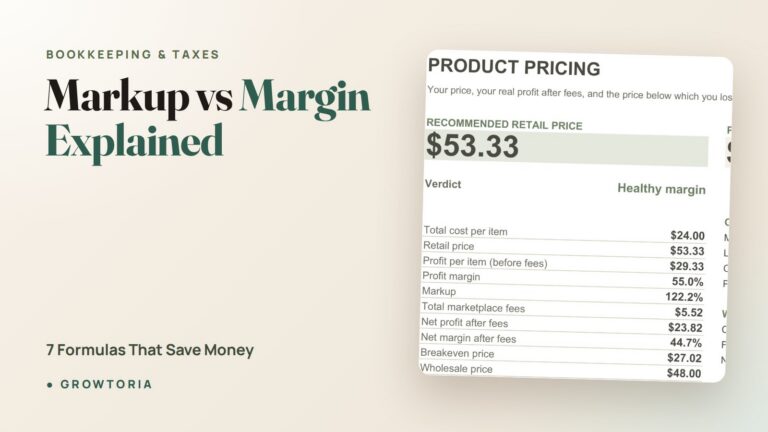
Understanding the difference between marking up and setting a margin will save you from this exact trap. Our guide on markup vs margin explained shows why a “50% markup” is not a 50% profit.
What profit margin should handmade products aim for?
Aim for a gross margin of at least 40–50% after materials and Etsy fees, with labor treated as a real cost you’ve already paid yourself. Anything thinner and one refund or a spike in shipping wipes out the whole order.
Margins vary by category, and it helps to know where your niche typically lands. See the ranges in our breakdown of the average profit margin for small business to sanity-check your numbers.
Whatever you land on, write it down and hold the line. A consistent margin is what turns a shop into a business.
The done-for-you shortcut
You can absolutely build this in a blank spreadsheet—but if you’d rather skip the formula-wrangling, our Product Pricing Calculator for makers does the math for you. Enter your materials, hours, and hourly rate, and it returns your base cost, wholesale, and retail price with your target margin baked in.
Sell specific craft categories? We also make niche versions like the Jewelry Pricing Calculator, Crochet Pricing Calculator, and Candle Making Cost Calculator. You can also grab our tools on our Etsy shop if that’s where you prefer to buy.
Want to try before you buy? Start with our free small business profit margin calculator or browse all our free tools.
Don’t forget: pricing and taxes go together
Your price also has to survive tax season. Etsy income is taxable, and in most cases the IRS treats a shop run for profit as a business, not a hobby—see the official guidance on hobby vs business.
That means tracking every sale, fee, and material cost from day one. Our Etsy Bookkeeping Spreadsheet shows your real profit after Etsy takes its cut, and the walkthrough in our Etsy shop bookkeeping spreadsheet guide gets you set up in minutes.
Frequently asked questions
How do I price handmade products for Etsy without scaring off buyers?
Price from your real costs first, then adjust presentation—not the number—to justify it. Better photos, clear listing copy, and gift-ready packaging let you hold a profitable price. If the market truly won’t bear it, reduce your material cost or time per piece rather than cutting your labor rate.
Should I include shipping in my product price?
Many top Etsy sellers offer “free shipping” by rolling the shipping cost into the item price, because Etsy’s search favors free-shipping listings. Calculate your average shipping cost per order and add it to your retail price, then set shipping to free.
What is the standard markup for handmade items?
The common maker rule is retail = base cost × 4 (materials + labor + overhead, doubled to wholesale, doubled again to retail). Use it as a starting point, not a law—lower the multiplier for large, high-cost pieces and confirm your margin covers Etsy fees.
Do I have to pay taxes on my Etsy sales?
Yes. In the US and most countries, income from selling handmade goods is taxable, and a shop run to make a profit is generally treated as a business. Track income and expenses from your first sale and set aside a portion of each sale for taxes.
How often should I review my handmade prices?
Review prices at least twice a year, and immediately whenever a key material cost jumps or Etsy changes its fees. Re-running the formula takes minutes with a pricing calculator and protects your margin from quiet cost creep.
The bottom line
Knowing how to price handmade products for Etsy comes down to one habit: build every price from materials, labor, overhead, and fees—never from what feels affordable. Pay yourself for your time, bake in Etsy’s ~11% cut, and defend your margin.
Do that on every listing and your shop stops being an expensive hobby and starts being a real business.