How to Set Consulting Rates: 7-Step 2026 Playbook
Figuring out how to set consulting rates is the single most stressful spreadsheet moment in the first year of any solo practice. Charge too little and you burn out inside twelve months. Charge too much without a story and prospects ghost before the discovery call ends. This 2026 playbook gives you a repeatable, seven-step framework — plus a comparison table, a rate-card structure, and a proposal script — so you can quote your next engagement with a straight face and a straight spine.
You will not find a magic number here. You will find the questions that produce your number.
Why pricing a consulting engagement is harder than pricing a product
Products have costs you can weigh. A consulting engagement is a promise — of judgment, of outcomes, of time you cannot recover. That means three things are true at once:
- Your rate has to cover your full cost of living, taxes, tools, and downtime.
- Your rate has to match what the market will actually pay for the outcome you deliver.
- Your rate has to be defensible in a 30-minute call to a stranger.
Miss any of those three and you either lose money, lose clients, or lose your nerve mid-proposal. The framework below fixes all three in order.
How to set consulting rates: the 7-step framework
Work through these in order. Do not skip Step 1 — the whole structure collapses without it.
Step 1: Anchor to your income floor, not the market average
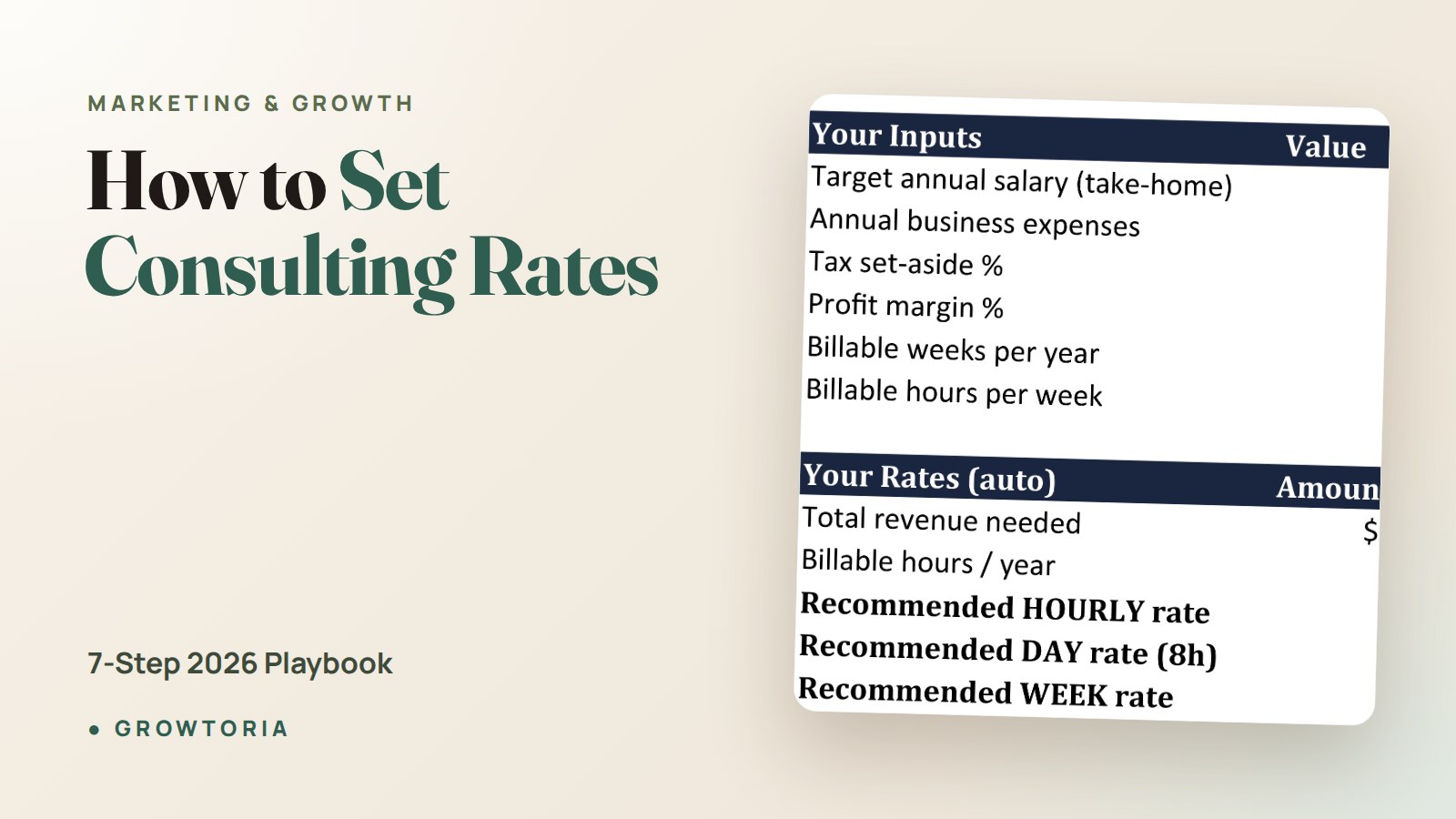
Start with the number you need to earn, not the number others charge. Write down your target take-home for the next twelve months. Add taxes (usually 25-35% for solo practitioners in most Western markets), then add business costs: software, insurance, coworking, an accountant, a laptop replacement fund.
Now divide by billable days, not calendar days. A realistic solo consultant bills 100-140 days per year after admin, sales, marketing, holidays, and sick days. That gives you a floor day rate. Anything below it is a subsidy you are paying your clients.
Our free freelance day-rate calculator does this math in about ninety seconds if you would rather not build the spreadsheet yourself.
Step 2: Choose your billing model
The unit you bill in shapes everything else — how clients perceive you, how disputes get resolved, and how much upside you keep. There are five common models, and most consultants use two of them at once.
- Hourly — safest for exploratory work, worst for scaling income.
- Day rate — the freelance standard; easy to quote, easy to compare.
- Project fee — fixed price for a defined outcome; margins improve with experience.
- Retainer — a monthly fee for reserved access; predictable revenue, predictable scope creep.
- Value-based — priced against the client’s outcome; highest ceiling, hardest to sell.
Step 3: Benchmark the market realistically
Once you have your floor, sanity-check it against public data. The U.S. Bureau of Labor Statistics publishes reliable wage data for management analysts — the government’s category for most business consultants — with median hourly wages and geographic breakdowns you can trust. Pair that with two or three trade-specific salary reports (Consulting Success and Payscale both publish annual surveys) and you will have a defensible range.
The rule of thumb: contractor rates run 2x to 3x salaried equivalent hourly rates once you back out benefits, downtime, and self-employment taxes.
Step 4: Price to your positioning, not your title
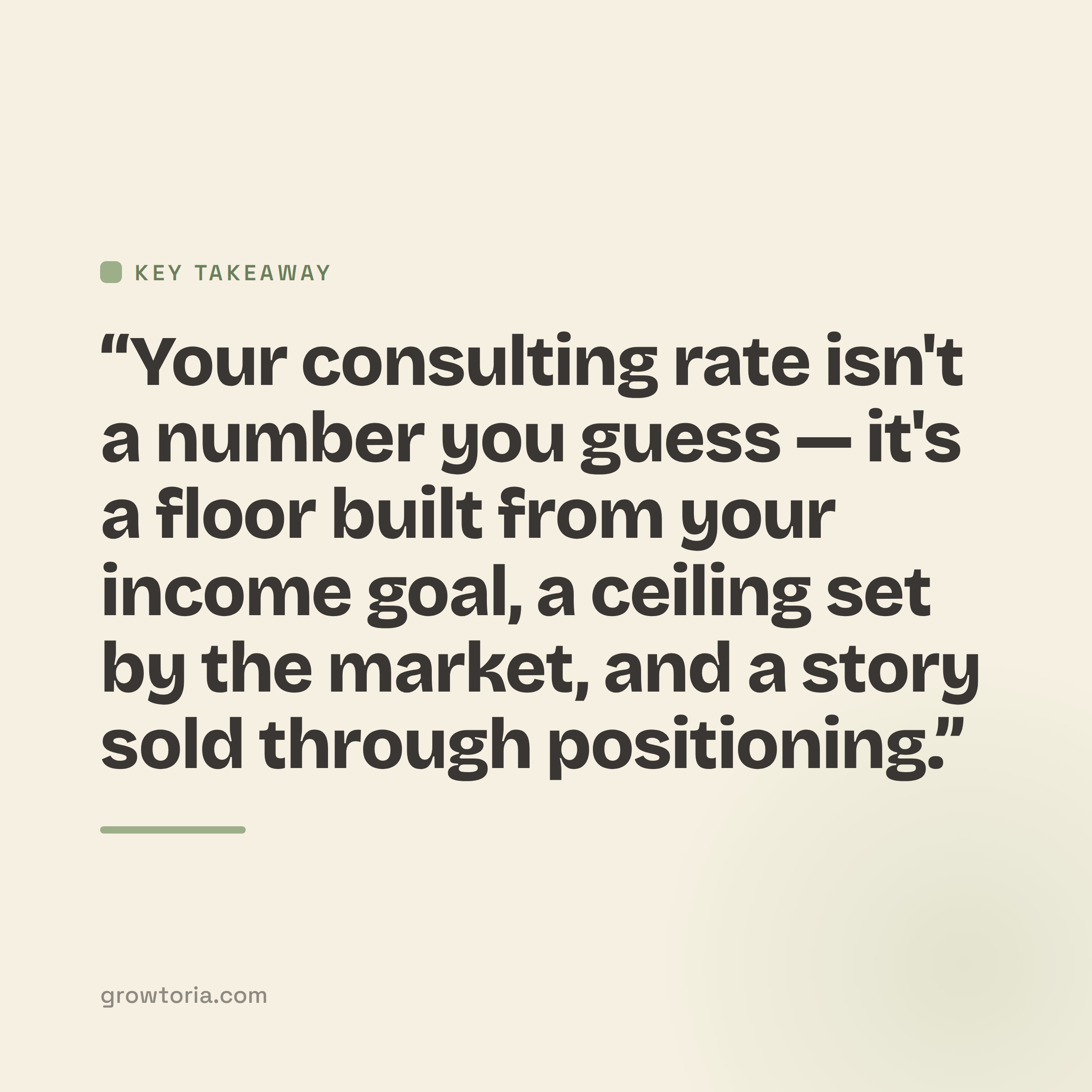
Two consultants with identical resumes can charge wildly different rates because one of them owns a category. “Marketing consultant” is a $100/hour job. “Fractional CMO for Series A SaaS” is a $300/hour job. Same person, different frame.
Before you finalize a rate, write out one sentence: who you help, what problem you solve, and what outcome you produce. If you cannot fill in the blanks, your rate ceiling is capped by the vagueness of your positioning.
Step 5: Build a rate card, not a single number
A single rate forces every conversation into a negotiation. A rate card turns pricing into a menu. At minimum, list:
- Your hourly rate for ad-hoc work (set this high — you don’t actually want ad-hoc work).
- Your day rate for workshops and audits.
- Two or three productized packages with fixed scope and fixed price.
- Your retainer tier for ongoing partnerships.
The Freelance Rate Card Calculator generates the whole card as a branded PDF you can send in proposals — or you can grab it on our Etsy shop if you prefer to buy there.
Step 6: Present the price with a proposal, not a chat message
Never quote a rate over Slack, DM, or the bottom half of an email. Always deliver pricing inside a structured proposal that reframes the conversation around outcomes.
A good proposal contains: the client’s stated problem, three package options at three price points (anchor high, land middle), your relevant proof, your terms, and a clear next step. This is where the Agency Pricing Playbook pays for itself — it walks through the exact value-based-pricing conversation, discovery questions, and options-based proposal template that gets prospects to pick the middle tier without haggling.
Step 7: Review your rates every quarter
Rates are not a one-time decision. Every quarter, look at three signals:
- Your close rate — if you’re winning more than 70% of proposals, your prices are too low.
- Your capacity — if you’re fully booked out for six weeks, raise rates on new inquiries.
- Your positioning — every case study you add is an argument for a higher number.
Consulting billing models compared
Here’s a quick side-by-side of the five common models, with typical use cases and the trap each one hides.
| Model | Best for | Client perception | Watch out for |
|---|---|---|---|
| Hourly | Ad-hoc advice, initial audits | Feels safe and controllable | Punishes you for getting faster |
| Day rate | Workshops, sprints, on-site work | Easy to compare, easy to book | Ceiling on annual income |
| Project fee | Defined-scope engagements | Feels predictable | Scope creep destroys margins |
| Retainer | Ongoing advisory, fractional roles | Feels like a partnership | Boredom and scope drift |
| Value-based | High-stakes outcomes with clear ROI | Feels aligned with outcomes | Requires deep discovery and proof |
The most common mistakes when consultants set their rates
After watching hundreds of independent consultants price their first year, the same handful of mistakes come up again and again.
- Pricing off your old salary. Your salary included health insurance, paid time off, and a computer. Your rate does not.
- Anchoring to the cheapest competitor. There is always someone cheaper. Compete on outcome, not price.
- Discounting to close. A discount without a scope reduction tells the client your original price was fiction.
- Never raising rates on existing clients. Send a 90-day notice and a short reason. Most stay.
- Quoting verbally. Always follow up with a written proposal within 24 hours.
Systemize the whole pricing motion, not just the number
Setting the right rate is only step one. The real leverage comes from making your entire pricing motion — discovery, proposal, contract, invoicing — feel effortless to the client and repeatable for you.
If you are building this from scratch, three related Growtoria guides pair naturally with this one: how to systematize your business for the operating layer, building a Notion CRM in 30 minutes for pipeline visibility, and how to start a marketing agency in 2026 if consulting is your on-ramp to a productized service.
Frequently asked questions
How much should a beginner consultant charge?
A first-year independent consultant with 3-5 years of prior salaried experience typically starts between $75 and $150 per hour, or $600-$1,200 per day, depending on niche and geography. Anchor to your income floor from Step 1 and adjust upward as case studies accumulate.
What’s the average consultant hourly rate in 2026?
Median rates for management consultants in the U.S. sit around $100-$150 per hour, with specialists (fractional CMOs, technical architects, M&A advisors) commonly billing $250-$500. In the UK the day-rate midpoint is £600-£900 for mid-senior independents; in Australia the range is A$1,200-A$1,800 per day. Verify against your local market before quoting.
Should I charge by the hour or by the project?
Charge by the hour only for ad-hoc advice or open-ended discovery. For anything with a defined outcome, quote a project fee — you keep the upside when you deliver efficiently, and clients get predictability. Move to value-based pricing once you can measurably tie your work to client revenue.
How do I raise my consulting rates without losing clients?
Give existing clients 60-90 days written notice, tie the increase to something concrete (new services, better process, expanded team), and offer a one-year rate lock if they commit to a longer engagement. In practice, fewer than 15% of good clients leave over a reasonable increase.
Do I need to give a discount for retainers?
Not necessarily. A retainer is not a bulk-purchase discount — it is a reservation of your calendar. Price it based on the capacity you’re holding, not on a percentage off your hourly. If you must discount, cap it at 10-15% and require a minimum three-month commitment.
Your next step
Open a blank document. Write down your target income, your billable days, and your minimum viable day rate. That number is your new floor. Now build the rate card around it, wrap it in a proposal template, and quote your next engagement with confidence. Pricing gets easier every time you say the number out loud — but only if you have done the math first.