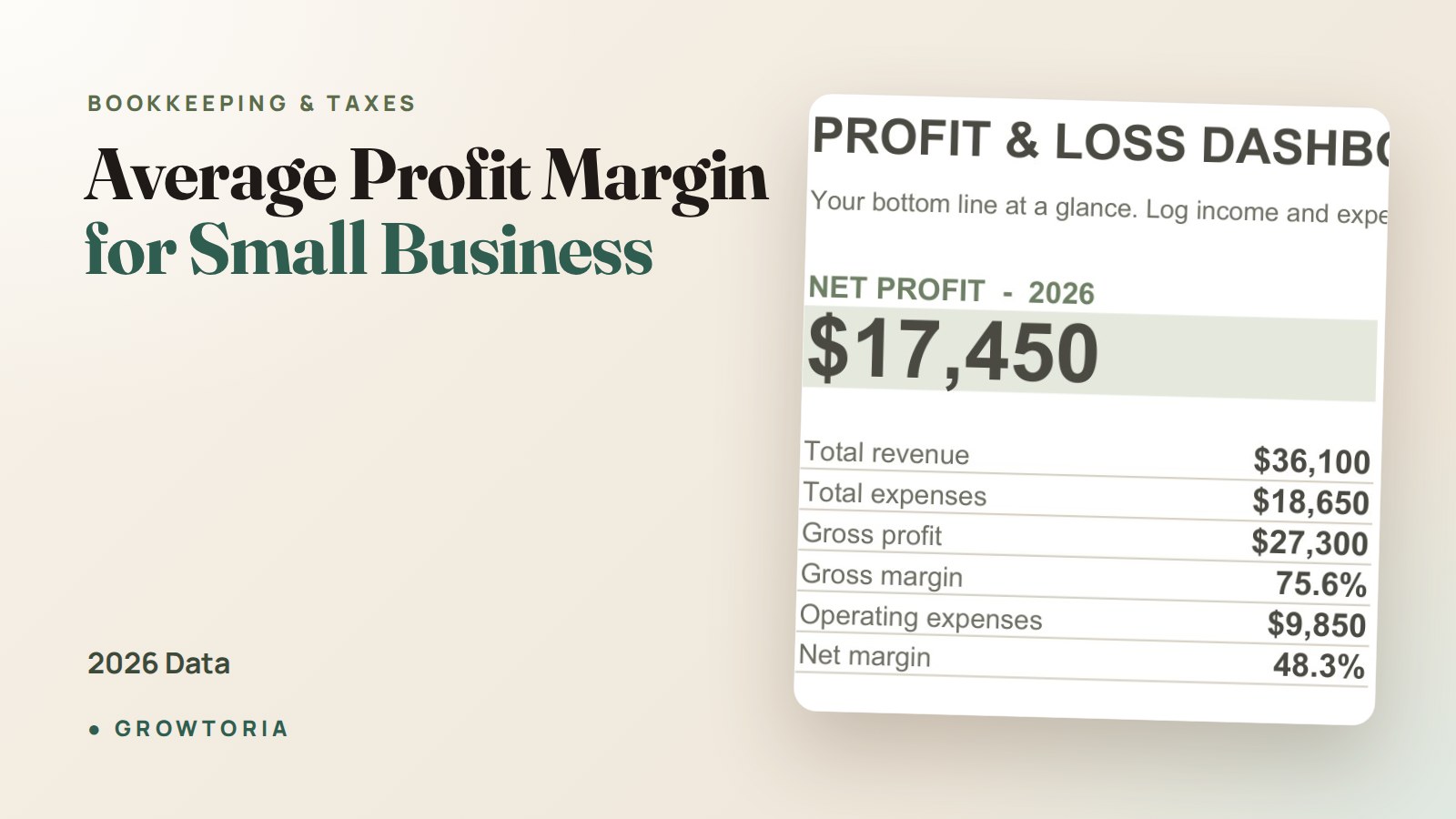
Average Profit Margin for Small Business: 2026 Data
The average profit margin for small business owners lands somewhere between 7% and 10% net in most years — but that single number hides a huge range, and comparing yourself to the wrong benchmark can quietly wreck your pricing decisions. A bakery, a law firm, and a SaaS app should never aim for the same margin.
This guide gives you the real 2026 benchmarks by industry, the two margins you must track, a simple way to calculate yours, and five concrete moves to raise it. No jargon — just numbers you can act on this week.
Quick answer: The average profit margin for a small business is roughly 7–10% net profit and 30–40% gross profit, but it varies widely by industry — service firms often net 15–25%, while restaurants and retail run on 2–6%. Under 5% net usually signals a pricing or cost problem, not a revenue one.
What is the average profit margin for small business owners in 2026?
Across industries, a typical small business nets about 7% to 10% after all expenses. That’s the number most benchmarking studies converge on, and it’s a sensible default to aim for if you’re just getting started.
But “average” is almost useless on its own. Margins are driven by your business model — how much you spend to deliver each sale. Service businesses keep more of every dollar because they carry little inventory; food and retail keep less because ingredients, stock, and waste eat the top line.
So the honest answer is: benchmark against your industry, not against a blended average. Here’s what that looks like.
Average net profit margin by industry (2026 benchmarks)
These ranges reflect widely cited margin data, including Aswath Damodaran’s annual margins-by-sector dataset at NYU Stern. Treat them as directional targets, not gospel — your local costs and scale will shift them.
| Industry | Typical gross margin | Typical net profit margin |
|---|---|---|
| Professional services / consulting | 60–80% | 15–25% |
| Software & digital products | 70–90% | 15–40% |
| Trades & construction | 25–40% | 5–10% |
| Cleaning & home services | 40–55% | 10–18% |
| Retail & e-commerce | 25–45% | 2–8% |
| Restaurants & food | 60–70% | 3–6% |
| Handmade / makers (Etsy, craft) | 40–60% | 10–20% |
Notice the pattern: high gross margin doesn’t guarantee high net margin. Restaurants have great gross margins on food but get crushed by rent, labor, and waste. That gap between gross and net is where most owners lose money without realizing it.
Why service businesses beat product businesses on margin
If you sell your time or expertise, your “cost of goods” is tiny — maybe some software and a laptop. That’s why a consultant billing $150/hour can net 20%+ while a retailer moving thousands of units nets 4%. Product businesses win on volume; service businesses win on margin. Neither is better — but knowing which lever you’re pulling changes how you price, hire, and grow.
Gross margin vs net margin: what’s the difference?
Gross margin is what’s left after the direct cost of what you sell; net margin is what’s left after everything. Confusing the two is the most common margin mistake we see.
- Gross profit margin = (Revenue − Cost of Goods Sold) ÷ Revenue. It tells you if your pricing covers direct costs.
- Net profit margin = (Revenue − all expenses) ÷ Revenue. It tells you if the whole business is actually profitable.
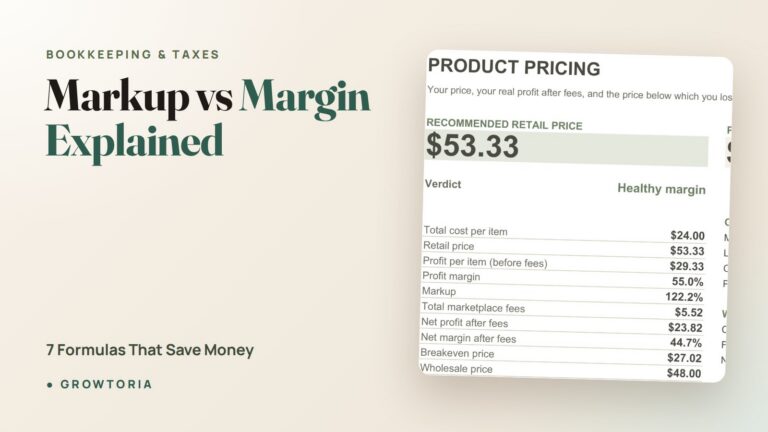
You need both. A healthy gross margin with a thin net margin means overhead is the problem. A thin gross margin means your prices or supplier costs are the problem. If you’re fuzzy on how price markups translate into margins, our markup vs margin explainer breaks down the formulas with worked examples.
There’s a third number worth watching too: operating margin, which sits between gross and net. It strips out interest and taxes so you can see how well the core operation runs before financing decisions muddy the picture. If your operating margin is healthy but net margin is thin, debt or tax structure — not operations — is your drag.
How do I calculate my profit margin?
Calculating net profit margin takes three numbers: revenue, total expenses, and a calculator. Here’s the exact process.
- Add up total revenue for the period (month, quarter, or year).
- Subtract every expense — cost of goods, labor, rent, software, fees, taxes — to get net profit.
- Divide net profit by revenue and multiply by 100. That percentage is your net profit margin.
Example: You bill $12,000 in a month and spend $10,200 running everything. Net profit is $1,800, so your margin is $1,800 ÷ $12,000 = 15%. Above average — but only because you counted every cost, including your own time.
That last part matters. Owners who forget to pay themselves a real wage report inflated margins that vanish the moment they hire a replacement. To skip the manual math, plug your numbers into our free small business profit margin calculator and get gross and net instantly.
What’s a good profit margin — and when is yours too low?
A good profit margin is one that beats your industry benchmark and leaves cash to reinvest — for most small businesses that means 10% or higher net. Anything under 5% is a warning light: you’re one slow month away from trouble.
Low margins usually trace back to one of four causes:
- Underpricing. The single most common issue. Raising prices 10% often adds more to net profit than cutting costs ever could.
- Cost creep. Subscriptions, fees, and supplier increases that stacked up unnoticed.
- Unprofitable products or clients. A few money-losers dragging the average down.
- No visibility. You can’t fix a margin you don’t measure monthly.
Here’s the trap most owners fall into: they chase more revenue to fix a margin problem. But if you net 4% and land $50,000 in new sales, you keep $2,000. Lift that margin to 12% on the revenue you already have, and the same effort throws off three times the cash — with none of the extra workload. Margin is almost always the faster lever.
5 proven ways to increase your small business profit margin
You don’t need a finance degree to move your margin. You need to pull the right lever in the right order. Start at the top of this list — the earlier items usually deliver the biggest gain for the least effort.
1. Raise prices before you cut anything
A 10% price increase drops almost entirely to the bottom line, because your costs barely move. Most owners overestimate how many customers they’ll lose — a well-communicated increase rarely triggers meaningful churn if your value is clear. Test it on new customers first if you’re nervous.
2. Fire (or fix) your unprofitable clients and products
Run the numbers on each product line or client. The bottom 20% often consumes disproportionate time and support while contributing little profit. Cutting or repricing them can lift your overall margin without adding a single sale.
3. Attack cost creep, not core costs
Audit every recurring charge quarterly: software you forgot, overlapping tools, payment-processing fees, insurance you never re-shopped. This is painless margin — you’re removing waste, not quality. Don’t gut the things that actually deliver value to customers; that shrinks revenue faster than it saves cost.
4. Bundle and upsell to lift average order value
Selling more to an existing customer costs far less than acquiring a new one, so incremental sales carry a fatter margin. Bundles, add-ons, and premium tiers raise your average transaction with almost no extra acquisition cost.
5. Track margin monthly, not annually
What gets measured gets managed. Reviewing margin once a year means you spot problems eleven months too late. A five-minute monthly check — revenue, expenses, net margin — turns pricing and cost fixes into small, timely adjustments instead of emergencies. The U.S. Small Business Administration’s finance guide is a solid, free starting point for building that habit.
Frequently asked questions
What is a healthy profit margin for a small business?
A net profit margin of 10% or higher is generally considered healthy for a small business, while 7–10% is average and anything under 5% is a warning sign. The right target depends on your industry — a consultant should aim far higher than a restaurant, so always compare against your sector benchmark rather than a blended average.
Is a 20% profit margin good?
Yes — a 20% net profit margin is strong for almost any small business and excellent for product- or food-based businesses. For high-margin service and software businesses it’s solid but achievable, so treat 20% as a healthy floor rather than a ceiling in those industries.
Why is my profit margin so low even though sales are up?
Rising sales with a shrinking margin almost always points to cost creep or underpricing — your revenue grew but your costs grew faster, or your prices never kept pace with them. Growing volume at a thin margin can actually reduce total profit. Fix the margin first, then scale the revenue.
What’s the difference between profit margin and markup?
Markup is how much you add to your cost, while margin is what percentage of the final price is profit. A 50% markup is only a 33% margin — mixing them up leads to systematic underpricing. See our markup vs margin explainer for the exact formulas.
How often should I calculate my profit margin?
Check your net profit margin at least monthly. A monthly cadence lets you catch pricing slips and cost creep while they’re still small, rather than discovering an annual shortfall when it’s too late to correct course.
The bottom line
The average profit margin for small business owners sits at 7–10% net, but that number only matters once you place it next to your own industry benchmark. Track both your gross and net margin, measure them monthly, and pull the pricing lever before the cost-cutting one. Do that consistently and you’ll spend less time chasing revenue — and keep far more of the revenue you already earn.