Do You Invoice for a Deposit? 7 Facts to Get Paid
Do you invoice for a deposit? Yes – and if you skip it, you are quietly lending money to your clients for free. A deposit invoice is a proper invoice that requests part of the total up front, before you buy materials or block out your calendar. It is the single easiest way to protect your cash flow on any job.
Quick answer: Yes, you invoice for a deposit. Send a deposit invoice once the client accepts your quote and before work begins. It should be clearly labelled, show the deposit amount, and state that the balance is due later. The deposit is a real payment – not a placeholder – so treat it like any other invoice.
Do You Invoice for a Deposit Before Starting Work?
Yes. You invoice for a deposit the moment a client says yes to your quote and before you commit any time or money. A deposit invoice turns a verbal “go ahead” into a paid, documented start – which is exactly what you want if a project stalls or a client disappears.
Think of the order of events like this:
- You send a quote or estimate (no payment requested yet).
- The client accepts.
- You send a deposit invoice for, say, 30-50% of the total.
- They pay, and only then do you start work or order materials.
- When the job is done, you send the final invoice for the remaining balance.
If you are still fuzzy on step one, our guide to the difference in quote and estimate clears it up fast. Getting that first document right makes the deposit invoice feel natural instead of pushy.
What Is a Deposit Invoice, Exactly?
A deposit invoice is an invoice that requests a partial, upfront payment against an agreed total. It is not a separate legal animal – it is a normal invoice that happens to bill for a portion of the job rather than the whole thing.
That distinction matters. Because it is a real invoice, it can be a taxable sale in most systems the moment it is paid, and it should carry a proper invoice number, your business details and clear payment terms. The UK government spells out the same basics on its official invoicing and taking payment guidance: an invoice must be clearly marked, dated and uniquely numbered.
People sometimes confuse a deposit invoice with a proforma. A proforma is a “this is what it will cost” preview that does not demand payment. A deposit invoice does demand payment. Keep them separate in your head and your accounting will thank you.
When Should You Send a Deposit Invoice?
Send a deposit invoice as soon as the quote is accepted and always before you incur costs. If you are buying tiles, fabric, ingredients or ad spend on the client’s behalf, the deposit should cover those out-of-pocket costs at a minimum.
Good triggers for asking for a deposit:
- Custom or made-to-order work – cakes, joinery, printed goods, bespoke design.
- Jobs with real material costs – trades, renovations, catering.
- New clients you haven’t worked with – a deposit filters out tyre-kickers.
- Long projects – stage payments keep cash flowing across weeks or months.
The rising theme across small businesses is simple: get money moving early. If your whole invoicing habit needs a tune-up, start with the best way to create an invoice and slot the deposit step in near the front.
How Much Deposit Should You Ask For?
A deposit of 25-50% is standard for most service and made-to-order work. Ask for enough to cover your materials and your risk, but not so much that a fair client hesitates. The right number depends on how much you spend before you finish.
Rough guidance by job type:
- Trades and construction: 30-50%, higher if materials are pricey.
- Custom makers (bakery, crafts): 50% – your ingredients and time are committed early.
- Design and freelance services: 25-50%, often a flat “kickoff” amount.
- Large multi-stage jobs: a smaller deposit plus scheduled stage payments.
Whatever you pick, write it into the quote so the deposit invoice is never a surprise. Clients accept deposits far more happily when the percentage was on the page they already said yes to.
Deposit Invoice vs Quote, Proforma and Final Invoice
Here is how the four documents you’ll juggle actually differ. Send them in this order and you rarely chase money.
| Document | What it does | Requests payment? | When to send |
|---|---|---|---|
| Quote / Estimate | States the price and scope | No | Before the client commits |
| Proforma invoice | Shows what an invoice will look like | No (preview only) | On request, before confirming |
| Deposit invoice | Bills a % of the total upfront | Yes | After acceptance, before work starts |
| Final invoice | Bills the remaining balance | Yes | When the job is complete |
Notice the final invoice should reference the deposit already paid, so the client sees exactly what’s left. A line like “Less deposit paid: -$500” removes every argument about the balance.
What to Put on a Deposit Invoice: 7 Essentials
A deposit invoice needs the same details as a normal invoice, plus a couple of specifics that make the partial payment crystal clear. Include all seven:
- The word “Invoice” and a unique invoice number.
- Your business name, address and contact.
- The client’s details and the project it relates to.
- The full agreed total, so context is obvious.
- The deposit amount and percentage being requested now.
- The remaining balance and when it becomes due.
- Payment terms and methods – due date, bank details, late-payment note.
If tax applies in your country, show it on the deposit too. For a done-for-you layout you can copy in minutes, our deposit invoice template guide walks through each field with the exact wording to use.
How to Send a Deposit Invoice and Actually Get Paid
The fastest-paid deposit invoices are specific, dated and easy to pay. Vague “please send a deposit” emails get ignored; a clean invoice with a due date and a payment link gets paid.
A few habits that move money faster:
- Set a short due date – “due within 3 days to secure your slot” creates gentle urgency.
- Attach a PDF, not a message in the body of an email.
- Offer one or two easy payment methods and put them on the invoice.
- Say work starts on receipt of the deposit, so the client knows nothing happens until they pay.
Remember that a deposit can count as taxable income the moment it lands, depending on your accounting method – the IRS covers the basics for freelancers and small firms on its small business and self-employed hub. Track it properly from day one and quarterly taxes stop being a shock.
The Done-for-You Shortcut
You do not need to build a deposit invoice from scratch every time. Our offline Invoice & Quote Generator lets you create a quote, take a deposit and convert the same job into a final invoice with the balance already worked out – all in one file, no subscription. It runs offline, exports a clean PDF and never sends your client data anywhere.
If you send a lot of these and keep losing track of who has paid, pair it with the Freelancer Invoice Tracker so no deposit or balance ever slips through the cracks. Prefer to buy through a marketplace? You can also grab our invoicing tools on our Etsy shop.
Quoting bigger jobs first? The contractor estimate template and our guide to quoting a job pair perfectly with a deposit step – quote, take the deposit, then deliver.
Frequently Asked Questions
Is a deposit invoice the same as a proforma invoice?
No. A proforma invoice is a preview that does not request payment, while a deposit invoice is a real invoice that bills for a partial upfront payment. The deposit invoice carries an invoice number and payment terms; the proforma does not.
Do you pay tax on a deposit?
Usually yes. In most systems a deposit becomes taxable income or triggers sales tax/VAT the moment it is paid, because it is a real payment against a sale. Check your local rules and record every deposit in your bookkeeping so nothing is missed at tax time.
How much deposit should a small business ask for?
Ask for 25-50% of the job total, leaning higher when your material or time costs come early. Custom makers often take 50%; service freelancers often take 25-33% as a kickoff fee. Put the exact figure in your quote so it’s agreed before the invoice arrives.
Can a customer refuse to pay a deposit?
They can decline, but you are equally free not to start work. A deposit is part of your agreed terms, so if it appears on the accepted quote, non-payment simply means the project doesn’t begin. That protects you from doing unpaid work for someone who was never committed.
What should a deposit invoice include?
Include the word “invoice”, a unique number, your and the client’s details, the full total, the deposit amount and percentage, the remaining balance with its due date, and clear payment terms. Reference the same project so the later final invoice ties back cleanly.
The Bottom Line
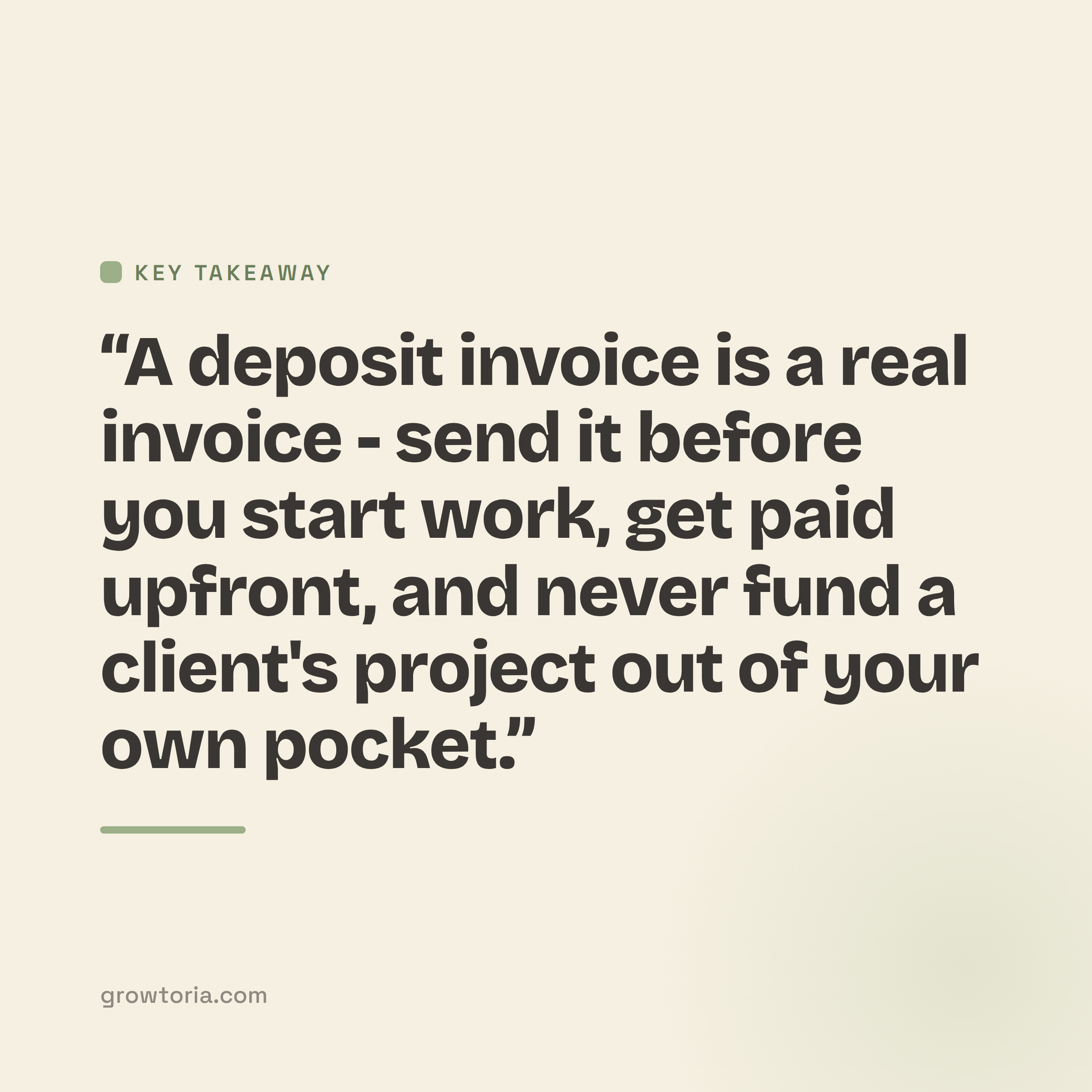
So, do you invoice for a deposit? Always – on any job with real cost or real risk. A deposit invoice is a normal invoice sent early, and it is the difference between funding your client’s project yourself and being paid to do your work.
Set the deposit in your quote, invoice for it before you start, and reconcile it on the final bill. Ready to make it effortless? Explore our free small business tools and start getting paid upfront on your very next job.