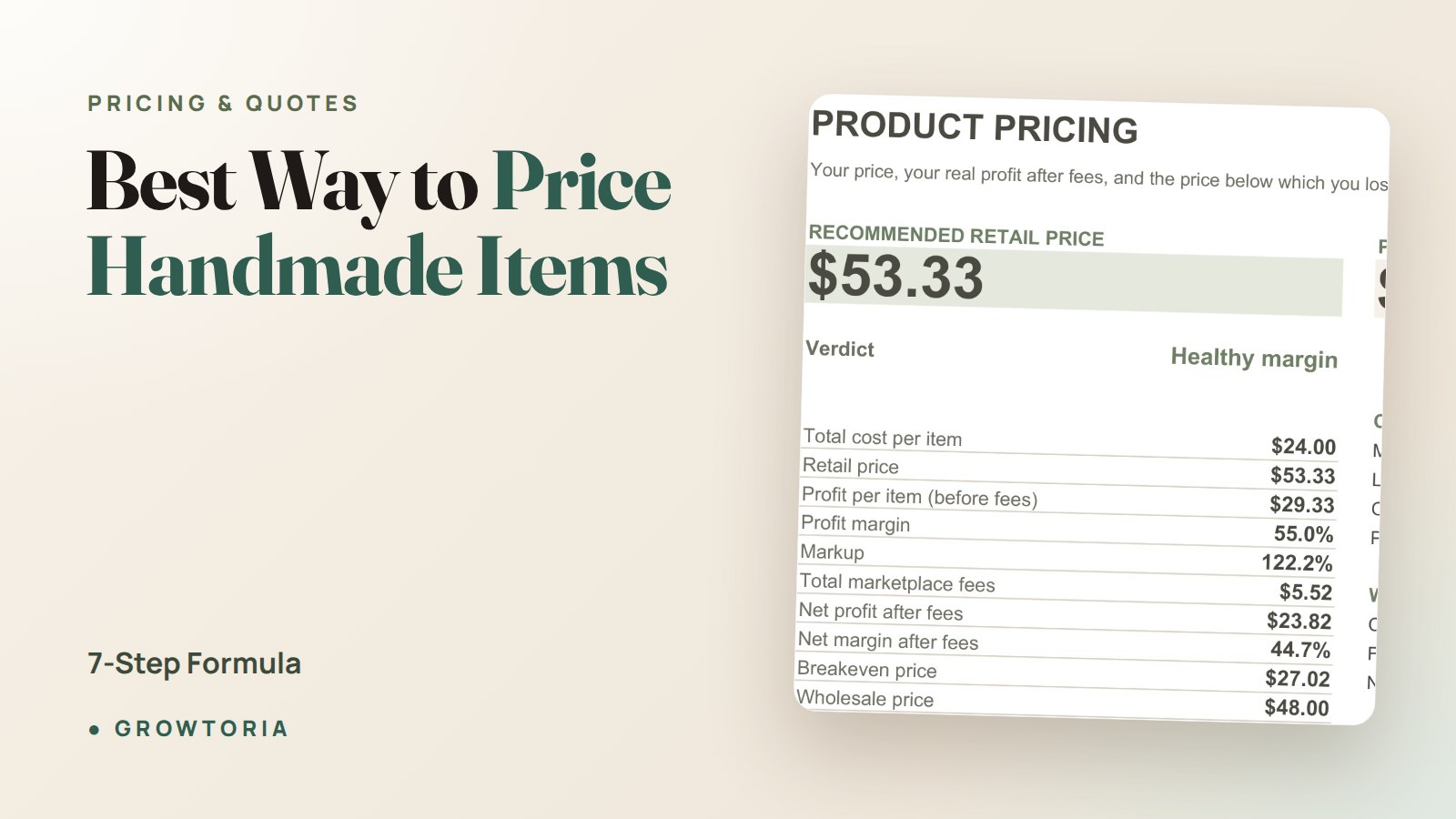
Best Way to Price Handmade Items: 7-Step Formula
The best way to price handmade items is to build your price from the ground up — materials, labor, overhead and profit — instead of guessing or copying the seller next to you. Undercharging is the number-one reason talented makers quit, and it almost always comes from skipping one of those four ingredients.
Quick answer: The best way to price handmade items is the formula (Materials + Labor + Overhead) × 2 = Wholesale price, then Wholesale × 2 = Retail price. Pay yourself a real hourly wage inside “Labor,” add packaging and fees under “Overhead,” and only then apply your profit markup.
What is the best way to price handmade items?
The best way to price handmade items is a repeatable formula, not a feeling. Every solid handmade price contains four parts: the cost of materials, a fair wage for your time, your overhead, and a profit margin on top.
Most makers price on vibes — they glance at Etsy, pick a number that “feels okay,” and quietly work for free. A formula fixes that. It turns pricing into arithmetic you can defend to any customer.
Here is the core equation the rest of this guide unpacks:
- Base cost = Materials + Labor + Overhead
- Wholesale price = Base cost × 2
- Retail price = Wholesale × 2 (also called keystone markup)
Doubling twice sounds aggressive until you realize the first markup covers your profit and the second covers the cost of selling direct — photography, listing fees, marketing and returns. If you only sell retail, you still want both markups baked in.
Step 1: Add up your true material cost
Start with every physical thing that ends up in the customer’s hands. Miss a component here and every price after it is wrong.
Count the obvious materials — yarn, wax, wicks, beads, wire, clay — but also the invisible ones:
- Packaging: boxes, tissue, labels, thank-you cards
- Consumables: glue, thread, sandpaper, a share of a paint pot
- Waste: the 5–15% of material you ruin or trim off
Divide bulk buys down to a per-item cost. A $40 bag of wax that makes 20 candles is $2 of wax per candle — not $40.
Etsy Seller Profit Kit: 3 spreadsheets for $19
Bookkeeping + product pricing + jewelry pricing in one kit. See your real profit per order after Etsy fees, shipping and materials. Google Sheets & Excel, one-time payment, no subscription.
Step 2: Pay yourself a real hourly wage
Labor is the line makers skip most, and it’s the most expensive mistake. Your time is a cost even though no invoice arrives for it.
Pick an honest hourly rate — many makers use $15–$30/hour to start — and time how long one finished item actually takes, including setup and cleanup. If a crochet blanket takes 12 hours and you value your time at $20, that’s $240 of labor before a single material dollar.
That number can be shocking, and it’s supposed to be. It’s why some handmade items simply aren’t profitable at craft-fair prices — better to know now than after 200 sales. Our guide to pricing handmade products for Etsy goes deeper on setting a wage you’ll stick to.
Step 3: Fold in your overhead
Overhead is every business cost that isn’t a specific material or your direct labor. Individually they’re small; ignored, they eat your whole margin.
Typical maker overhead includes:
- Marketplace and payment fees (Etsy charges a listing fee plus a transaction and payment-processing cut)
- Tools and equipment wearing out
- Studio rent, electricity, or a slice of your home bills
- Software, a website, or a booth fee
An easy method: total your monthly overhead, divide by the number of items you make per month, and add that flat amount to each piece. Check Etsy’s official Seller Handbook for the current fee percentages so this number stays accurate.
Step 4: Apply your markup for profit
Now add profit — the reason it’s a business and not a hobby. Markup is the multiplier you apply to your base cost, and this is where the “× 2” in the formula lives.
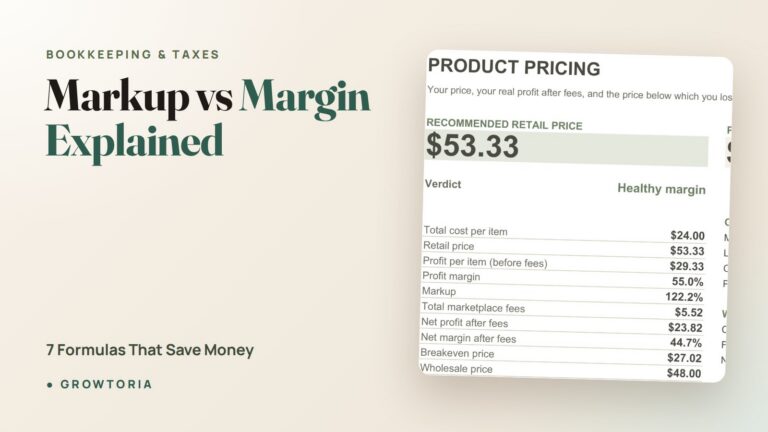
Materials + labor + overhead only gets you to break-even. Profit is what funds new supplies, growth, and actually keeping some money. If you’re fuzzy on the difference between the two words, our markup vs margin explainer clears it up with the exact formulas.
Doubling your base cost gives a 50% margin — a common, healthy target for handmade goods. Premium or highly skilled work often carries more.
Step 5: Set wholesale and retail prices separately
The best way to price handmade items is to name two prices from day one, even if you only sell retail today. Wholesale is what a shop pays; retail is what a shopper pays.
Here’s the formula applied to a single scented candle:
| Line item | Cost per candle |
|---|---|
| Materials (wax, wick, jar, fragrance, label) | $4.50 |
| Labor (0.5 hr × $20/hr) | $10.00 |
| Overhead (fees, tools, utilities) | $2.00 |
| Base cost | $16.50 |
| Wholesale price (base × 2) | $33.00 |
| Retail price (wholesale × 2) | $66.00 |
If $66 feels high for a candle, that’s the market telling you the labor line is too costly for this product — speed up production, raise perceived value, or make something with a better time-to-price ratio. The math is doing its job.
Step 6: Sanity-check against your market and break-even
A formula sets the floor; the market sets the ceiling. The best way to price handmade items is to land between the two on purpose.
Look at what comparable makers charge — not to copy them, but to understand the range buyers expect. If your formula lands far above the market, cut cost or add value; far below, raise your price to the market and keep the extra margin.
Also confirm you’re above break-even at your real sales volume. A quick pass through a break-even calculator for small business tells you how many units you must sell to cover fixed costs before profit even starts.
Step 7: Put the formula in a calculator you’ll reuse
Doing this by hand once is educational; doing it for every product is a chore. The best way to price handmade items long-term is to plug the formula into a spreadsheet so a new price takes 30 seconds.
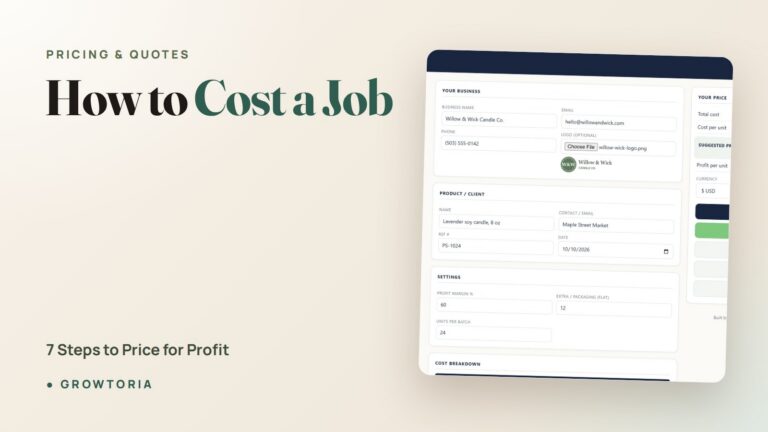
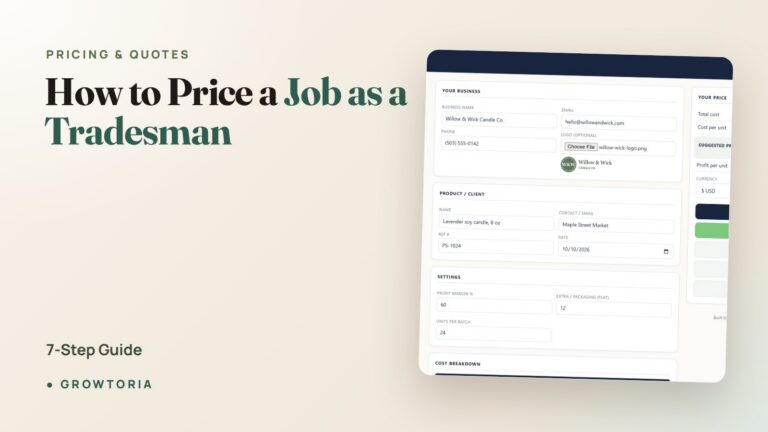
You can build your own, or use a done-for-you tool. Our Product Pricing Calculator for makers already has materials, labor, overhead and margin wired together — change one input and wholesale and retail update instantly. Prefer to buy it there? You can also grab it on our Etsy shop.
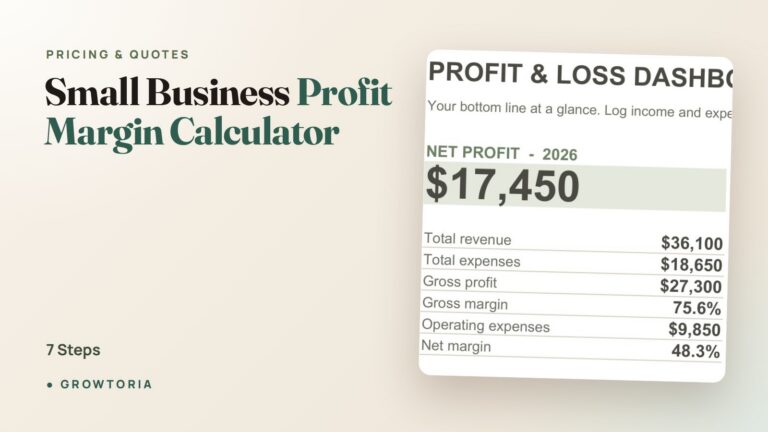
Niche makers can go straight to a purpose-built version — there’s a candle making cost calculator, a jewelry pricing calculator, and a crochet pricing calculator, each tuned to that craft’s cost lines. Want to test the concept free first? Try our free profit margin calculator and see your margin the second you enter a price.
Common handmade pricing mistakes to avoid
Even with the formula, a few habits quietly destroy margins. Watch for these:
- Working for free. Leaving labor out is the classic error — fix it in Step 2.
- Pricing to “be competitive.” Racing to the bottom just means everyone loses money slower.
- Forgetting fees and taxes. Marketplace cuts and sales tax are real costs; track them in your bookkeeping categories from day one.
- Never raising prices. Material costs climb every year — revisit your formula each season.
Frequently asked questions
What is the formula for pricing handmade items?
The standard formula is (Materials + Labor + Overhead) × 2 = Wholesale price, then Wholesale × 2 = Retail price. Materials cover everything physical, Labor pays your hourly wage, and Overhead captures fees, tools and utilities. The two doublings build in profit and the cost of selling direct.
How much should I charge per hour for handmade work?
Most makers start between $15 and $30 per hour and raise it as their skill and demand grow. Choose a rate you’d accept for skilled work, not minimum wage. If your finished prices then feel too high, the issue is usually a slow, low-value product — not your wage.
Why are my handmade prices too high after using the formula?
A high formula price usually means labor is eating the product. Speed up production, batch your work, use less costly materials, or switch to items with a better time-to-price ratio. Sometimes the honest answer is that a particular product can’t be profitable at handmade wages.
Should I price handmade items for wholesale and retail differently?
Yes. Wholesale is base cost × 2 — the price a shop pays to resell your work. Retail is wholesale × 2 — what a shopper pays you directly. Setting both from the start means a store order never accidentally costs you money.
Do I have to include taxes and fees in my handmade price?
Absolutely. Marketplace fees, payment processing and your own tax liability are real business costs and belong in the overhead line. Skipping them turns a “profitable” price into a break-even one. Track every fee so your margin stays honest.
The bottom line
The best way to price handmade items is to stop guessing and run every product through the same four-part formula: materials, labor, overhead, profit. Do it once by hand to understand it, then let a calculator do it forever.
Price for the maker you want to be — one who gets paid for real skill — not the one apologizing for charging what the work is worth. If you’d like the pricing done for you, our Product Pricing Calculator and its free companion tools get you there in minutes.