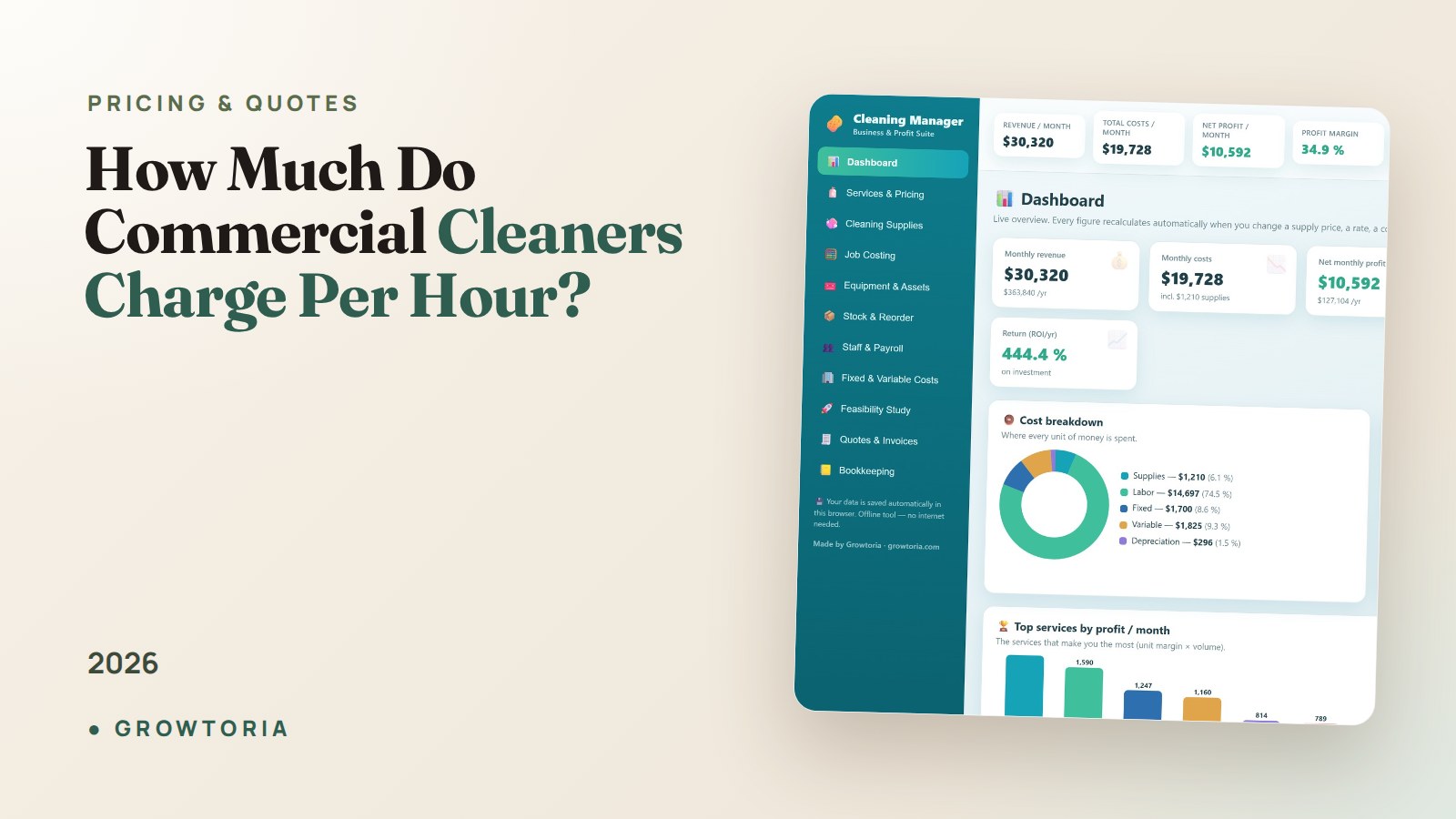
How Much Do Commercial Cleaners Charge Per Hour? 2026
If you run a cleaning company, the first thing you need to nail down is exactly how much do commercial cleaners charge per hour — because that single number decides whether every job you take makes money or quietly loses it. Charge too little and you burn out working for free; quote too high without a reason and you lose the bid. This guide gives you real 2026 hourly ranges by region, the costs your rate has to cover, and a repeatable way to set your own number.
Quick answer: Commercial cleaners typically charge $25 to $50 per hour in the US in 2026, with most contracts landing between $30 and $45. Solo or newer cleaners sit at the low end; teams, specialty work, and after-hours jobs command more. Your rate must cover labor, supplies, travel, overhead and profit — not just wages.
How much do commercial cleaners charge per hour in 2026?
Commercial cleaners charge roughly $25–$50 per hour in the United States, but the honest answer depends on where you work and what the job involves. Rates track local wages, competition, and how specialized the cleaning is. General office cleaning sits lower; medical, industrial, and post-construction work pushes higher.
Here’s a snapshot of typical per-hour commercial cleaning rates by region for 2026. Treat these as starting ranges for a single cleaner, before specialty premiums:
| Region | Typical hourly rate | Common range |
|---|---|---|
| United States | $35 / hr | $25–$50 |
| Canada | C$32 / hr | C$25–$45 |
| United Kingdom | £18 / hr | £15–£28 |
| Australia | A$40 / hr | A$35–$55 |
| New Zealand | NZ$38 / hr | NZ$32–$50 |
These are billing rates to the client, not what you pay staff. For context on the wage side, the U.S. Bureau of Labor Statistics tracks pay for janitors and building cleaners, and your billable rate needs to sit well above that number to survive.
If you want to price by area instead of time, our step-by-step guide to calculating commercial cleaning rates and the rates-per-square-foot calculator convert one method into the other.
What’s actually included in a commercial cleaning hourly rate?
A profitable hourly rate is never just the wage you pay a cleaner. It bundles every cost of showing up plus a margin. If your number only reflects labor, you are subsidizing the job out of your own pocket.
Your rate needs to absorb all of the following:
- Labor — the cleaner’s wage, plus payroll taxes and any insurance loading (often 1.2–1.4× the base wage).
- Supplies & equipment — chemicals, cloths, bags, and wear on vacuums and machines.
- Travel & drive time — fuel and the unpaid minutes between sites.
- Overhead — insurance, licensing, admin, software, and marketing.
- Profit — the reason you own a business instead of holding a job.
A useful rule of thumb: your billable rate should be roughly 2 to 3 times the wage you pay the cleaner. Pay $15/hr, bill $35–$45/hr. That gap is not greed — it is what keeps the lights on between contracts.
What factors change how much commercial cleaners charge per hour?
Two cleaners in the same city can quote wildly different hourly rates and both be right. The rate flexes with the job’s difficulty and the client’s expectations. Knowing the levers lets you justify a higher number instead of apologizing for it.
Type of facility
Standard offices are the baseline. Medical and dental clinics, gyms, restaurants, and industrial sites carry higher rates because of biohazard protocols, grease, or heavy soiling. Post-construction cleanup is the highest, often $40–$75+ per hour.
Frequency of service
Daily or weekly recurring contracts earn a lower per-hour rate in exchange for guaranteed income. A one-time deep clean should always cost more per hour than a recurring route — you lose the efficiency of routine.
Scope and add-ons
Carpet extraction, floor stripping and waxing, window work, and high-dusting are specialty tasks. Price them as premiums on top of the base rate, never bundled in silently.
Timing
After-hours, overnight, and weekend work commands a 10–25% premium. Most offices want cleaning done when staff are gone, so build that into the quote.
Should you charge per hour or per square foot?
Charge per hour when the scope is unpredictable or the space is unusually cluttered; charge per square foot once you know the site and can estimate the time confidently. Most established cleaners quote clients a flat monthly price but calculate it from an hourly rate behind the scenes.
Here’s the trade-off in plain terms:
- Per hour protects you on messy, one-off, or first-time jobs. The risk is capped — you’re paid for time spent.
- Per square foot (typically $0.05–$0.25/sq ft for offices) rewards speed. If you clean fast, you earn more per hour effectively.
- Flat rate is what clients prefer to see. You build it from your hourly rate × estimated hours, then commit to a number.
The smart move is to master your true hourly cost first, then translate it into whatever format the client wants. If you’re weighing quotes versus estimates, our breakdown of the difference between a quote and an estimate keeps you from over-committing.
How to calculate your own commercial cleaning hourly rate
Don’t copy a competitor’s number — build your rate from your real costs. Here is the exact sequence I use with cleaning-business owners:
- Start with the wage. Decide what you pay a cleaner per hour (say $16).
- Add labor burden. Multiply by 1.3 for taxes and insurance → $20.80.
- Add supplies & equipment. Estimate cost per hour of work (often $2–$4) → $23.80.
- Add overhead. Divide monthly fixed costs by your billable hours; add per hour (say $5) → $28.80.
- Add profit margin. Apply a 25–40% markup → about $36–$40 per hour.
That final figure is your floor, not your ceiling. Never quote below it. To sanity-check your margin on any job, run the numbers through a small business profit margin calculator before you send the price.
If tracking supplies, labor and drive-time by hand feels like a second job, the Cleaning Business Manager App does the math for you — cost each job, protect your margin, and generate invoices in one place, offline with no subscription. Prefer to browse first? You can also grab our cleaning tools on our Etsy shop.
How to quote a commercial job so your hourly rate protects profit
Walk the site before you quote — always. A rate looks fine on paper and collapses the moment you meet a filthy break room or a warehouse of hard floors. Convert your hourly rate into a confident, itemized quote instead of a vague guess.
Do these five things every time:
- Time the walkthrough. Estimate how many labor-hours the space really needs, room by room.
- Multiply by your true rate. Hours × your calculated hourly rate = the base price.
- List specialty work separately. Floors, carpets, and windows get their own line items.
- Set clear scope. Spell out what’s included so “can you also…” requests become paid add-ons.
- Present a flat monthly figure. Clients buy certainty; keep your hourly math on your side of the desk.
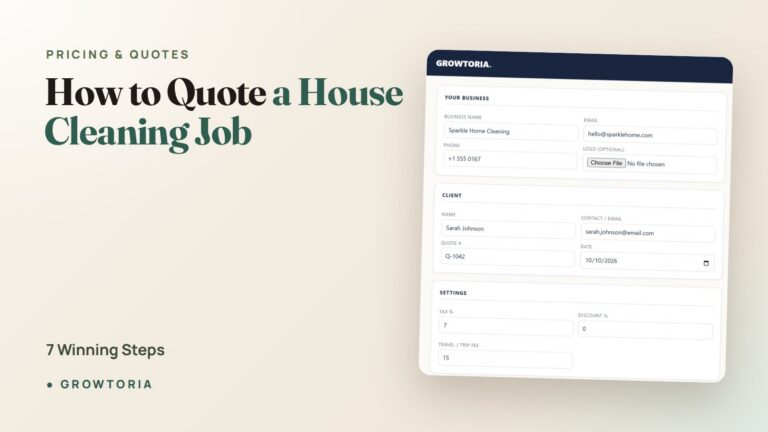
A clean, itemized quote wins more work than a lowball guess. The Cleaning Service Quote Builder turns your rate into a professional PDF quote in minutes. For the walkthrough itself, our guide on how to quote a cleaning job and the cleaning business price list give you ready benchmarks.
Once your pricing is solid, the next lever is volume — our playbook on how to grow a cleaning business covers winning contracts without slashing your rate.
Frequently asked questions
How much do commercial cleaners charge per hour in 2026?
Most commercial cleaners charge $25–$50 per hour in the US, with $30–$45 being typical for standard office work. Specialty jobs like medical or post-construction cleaning run $40–$75+ per hour. Rates in the UK sit around £15–£28, and Australia around A$35–$55.
Is it better to charge per hour or per square foot?
Charge per hour for unpredictable or first-time jobs to cap your risk, and per square foot ($0.05–$0.25 for offices) once you know the space and can clean it efficiently. Experienced cleaners usually quote a flat price built from an hourly calculation.
How many square feet can one cleaner clean per hour?
A single commercial cleaner typically covers 2,500–4,000 square feet of standard office space per hour. Cluttered spaces, restrooms, and detailed work slow that down, so always adjust your estimate after an in-person walkthrough.
What is a good profit margin for a commercial cleaning business?
A healthy commercial cleaning business targets a 25–40% net profit margin after labor, supplies, and overhead. If your margin dips below 20%, your hourly rate is too low or your labor and supply costs are running higher than you planned.
How much should I pay my commercial cleaning staff per hour?
Cleaning staff wages commonly range from $14–$20 per hour depending on region and experience. Whatever you pay, your billable client rate should be roughly 2–3× that wage to cover burden, overhead, and profit.
Set your rate once, then price with confidence
Knowing how much commercial cleaners charge per hour is only half the job — the win is building your rate from real costs and quoting it without flinching. Start with the calculation above, walk every site, and let your tools do the math so your margin survives contact with the real world.
Ready to price faster? Explore our free tools for small business owners, or put the whole workflow on autopilot with the Cleaning Business Manager App.