How to Price a Job as a Tradesman: 7-Step Guide
Learning how to price a job as a tradesman is the single skill that decides whether you build a business or just buy yourself a stressful job. Charge too little and you work weekends for nothing; charge blindly and you lose the bid. The good news: pricing is a formula, not a guess.
This guide walks through the exact 7-step method electricians, plumbers, builders and other trades use to quote work that actually turns a profit — with a worked example and a pricing-method comparison you can copy today.
Quick answer: To price a job as a tradesman, add your material costs (plus a 10–20% markup), your labour hours at a rate that covers your true hourly cost, and a share of your overhead. Then add a profit margin of 15–30% on top. Never quote labour at the wage you want to earn — quote it at what the business needs to survive.
What does it really cost you to work an hour?
Before you can price a job, you need your true hourly cost — not your take-home wage. Your true cost includes van payments, fuel, insurance, tools, phone, accounting, unpaid admin time and the days you can’t bill because you’re quoting or sick.
Here’s the honest maths most tradesmen skip. If you want to earn £45,000 (or $60,000) a year, you can’t just divide by 2,080 hours. You don’t bill 40 hours a week — you bill maybe 25 to 30 after travel, quotes and downtime.
- Target income: what you want in your pocket.
- Overhead: every business cost that isn’t materials for a specific job.
- Billable hours: realistically 1,200–1,500 a year, not 2,080.
Add income plus overhead, divide by real billable hours, and you get the rate the job must carry. It’s almost always higher than people expect — and that gap is exactly why so many trades quietly go broke while looking busy.
How to price a job as a tradesman in 7 steps
Follow these steps in order for every quote and you’ll stop leaving money on the table. This is the core of how to price a job as a tradesman that pays.
- Scope the job precisely. Walk the site. List every task, material and access issue. Vague scope is the number-one cause of jobs that lose money.
- Price the materials. Get real supplier prices, then add a 10–20% materials markup to cover collection time, waste and price rises.
- Estimate labour hours honestly. Use past jobs, not optimism. Then add a buffer — jobs almost never go faster than planned.
- Apply your true hourly rate. Multiply hours by the rate you calculated above, not your “wage.”
- Add overhead if it isn’t already baked in. If your hourly rate already covers overhead, skip. If not, add a percentage here.
- Add profit on top. Profit is separate from your wage. Aim for 15–30% so the business can grow, replace tools and weather slow months.
- Round and present cleanly. Deliver one clear number (or two or three optioned tiers) on a professional quote — not a scribble on the back of an invoice.
If you want the calculation done for you, our offline pricing calculator app turns your costs and target margin into the exact price in seconds — no spreadsheet formulas to build. Prefer to shop elsewhere? You can also grab our tools on our Etsy shop.
Which pricing method should a tradesman use?
There’s no single “right” way to price — the best method depends on the job’s certainty. Predictable jobs suit fixed pricing; unknown or open-ended work suits hourly or day rates. Here’s how the four common methods compare.
| Method | Best for | Upside | Watch out for |
|---|---|---|---|
| Hourly rate | Small repairs, unknown scope, call-outs | You’re paid for every hour worked | Customers fear open-ended bills; caps your daily earning |
| Day rate | Multi-day jobs, labour-only work | Simple to quote and schedule | Slow days still cost you; must estimate days accurately |
| Fixed / per-job | Well-defined jobs you’ve done before | Rewards speed and efficiency; customers love certainty | Underestimate the scope and you eat the loss |
| Cost-plus | Large, material-heavy or custom builds | Protects margin as costs move | Requires transparent records; less appealing to some clients |
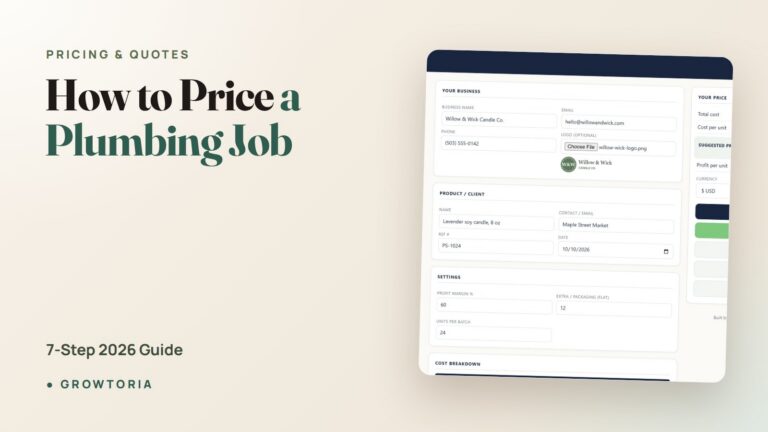
Most established tradesmen use fixed pricing for familiar jobs and switch to hourly or day rates when the scope is genuinely unknown. If you want a deeper walkthrough for a specific trade, see our step-by-step guide on how to price a plumbing job — the logic transfers to any trade.
Markup or margin — which one are you actually adding?
This trips up more tradesmen than any other number. Markup and margin are not the same thing, and confusing them quietly erodes your profit on every job.
Markup is the percentage you add on top of your cost. Margin is the percentage of the final price that is profit. A 25% markup does not give you a 25% margin — it gives you roughly a 20% margin.
- Cost £100 + 25% markup = £125 price. Profit £25 = 20% margin.
- To hit a 25% margin, you’d need to charge about £133.
If you consistently want a 30% margin but only add 30% markup, you’re underpricing every job. Our full breakdown on markup vs margin gives the exact formulas, and you can sanity-check any quote with the free small business profit margin calculator.
How much should you charge? Anchoring to real data
Your price is set by your costs first, but it helps to know what the wider trade earns. The U.S. Bureau of Labor Statistics Occupational Outlook Handbook publishes median pay for electricians, plumbers and other trades — a useful sanity check that your rate isn’t wildly below the market.
But remember: those are wage figures for employees. As a self-employed tradesman, your charge-out rate must be significantly higher than any employee wage because it also funds your overhead, downtime and profit. If your quoted rate merely matches an employee’s hourly pay, you’re losing money.
Don’t forget these hidden costs
Jobs bleed profit through the costs people forget to quote. Build these into every price:
- Travel and fuel — especially for jobs outside your usual radius.
- Waste disposal and tip runs.
- Consumables — fixings, tape, blades, sealant.
- Payment fees and late payers — chase them fast with a late payment reminder email.
- Warranty and callbacks — a small buffer for putting problems right.
How to present the quote so it wins the job
A confident, professional quote wins work even when you’re not the cheapest. Price is only half the battle — presentation is the other half.
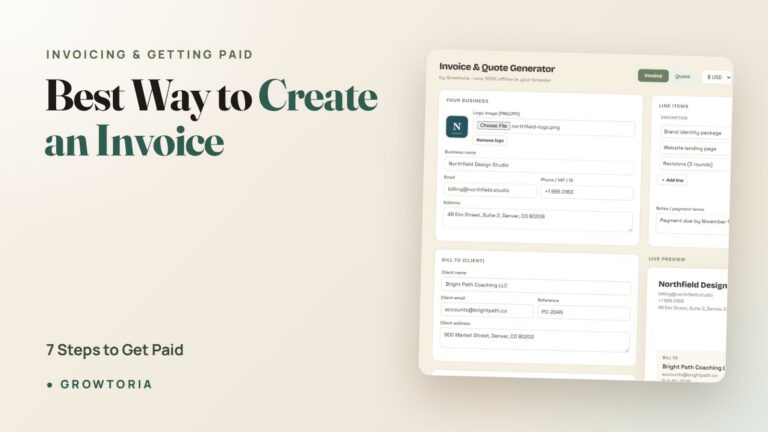
Send a clean, itemised quote the same day where possible, with a clear total, what’s included, what’s excluded, and your payment terms. Speed and clarity signal that you run a real business.
Our Quote & Estimate Generator app builds professional quotes with auto-tax and PDF export offline, then turns any accepted quote into an invoice — so you look sharp without the admin. If you’d rather run your whole trade offline, browse our offline small business software.
Offer options, not just a price
Where you can, quote two or three tiers — good, better, best. Optioned quotes shift the customer’s question from “yes or no?” to “which one?”, and they routinely lift the average job value.
A worked example
Say you’re an electrician quoting a consumer unit upgrade:
- Materials: £320, plus 15% markup = £368
- Labour: 7 hours at your true rate of £55 = £385
- Subtotal: £753
- Profit margin 20% = £904 (round to £900)
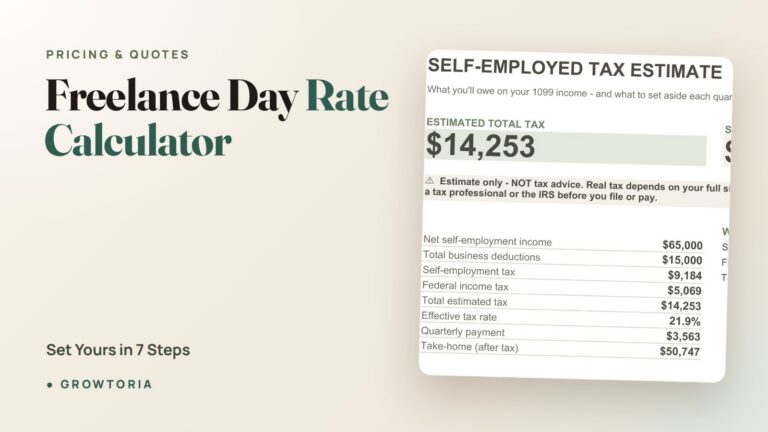
Notice the labour rate of £55 isn’t your wage — it’s the rate that covers your wage plus overhead. That’s the difference between a busy tradesman and a profitable one. For rate-setting that follows the same logic, our guides on the freelance day rate calculator and how to set consulting rates are worth a read.
Frequently asked questions
How do I price a job when I’m just starting out?
Start by calculating your true hourly cost, then price the first few jobs slightly leaner to build reviews — but never below cost. Track your actual hours against your estimates on every job. Within a few weeks you’ll have real data to price accurately and raise your rates with confidence.
Should I charge for quotes and call-outs?
Charge a call-out fee for diagnostic or emergency visits — your time and travel have real value. Detailed quotes for large jobs can carry a fee that’s credited against the work if you’re hired. Free quoting is fine for quick, standard jobs, but it’s a cost you must recover in your pricing.
What profit margin should a tradesman aim for?
Aim for a net profit margin of 15–30% on top of a labour rate that already pays you fairly. Below 10% leaves no room for slow months, tool replacement or growth. Remember margin is separate from your wage — if you’re only covering wages, the business itself isn’t profitable.
How do I stop underquoting?
Underquoting almost always comes from optimistic labour estimates and forgotten costs. Always add a time buffer, list every consumable, and run the final number through a break-even calculator so you know the floor you can’t drop below. If a job won’t clear that floor, walk away.
Price with confidence from today
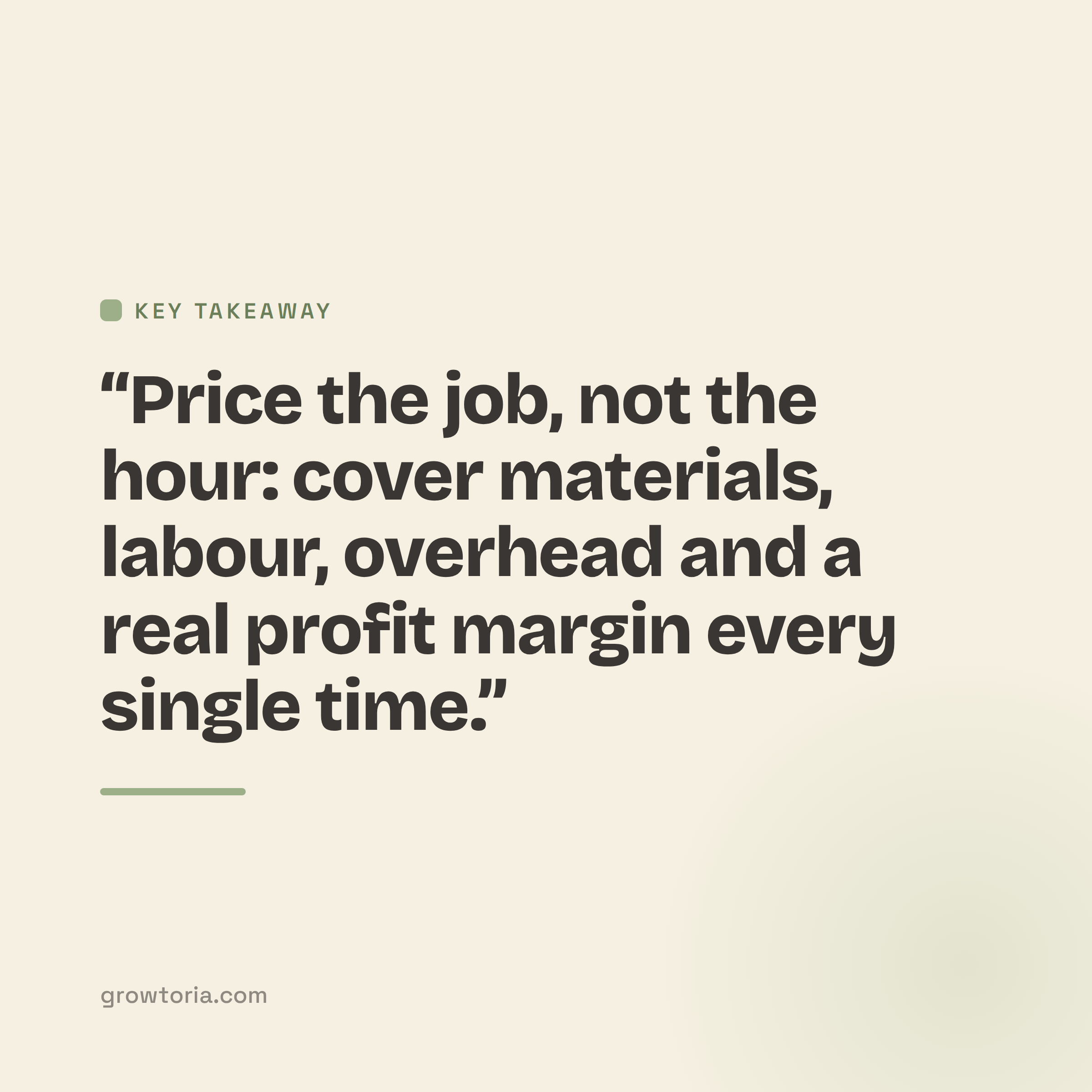
Knowing how to price a job as a tradesman comes down to one habit: cover materials, labour, overhead and profit — every single time, without shortcuts. Do the maths once, build it into a repeatable system, and quoting stops being stressful guesswork.
Grab a done-for-you pricing calculator or explore our free tools to lock in your numbers — then go win the job at a price that actually pays you.