Consultant Day Rate Calculator: 7 Steps to Price Right
A consultant day rate calculator turns your income target, business costs and tax into a single daily fee you can quote without flinching. Most consultants pick a number that “sounds about right,” then quietly resent it a year later. This guide shows you the exact maths behind a defensible rate—and the seven steps to set yours today.
Quick answer: A consultant day rate calculator works out your fee by adding your target income and business costs, then dividing by the number of days you can actually bill. For example, needing $140,000 a year across 160 billable days gives a day rate of about $875. Utilisation—not your salary dream—decides the number.
What is a consultant day rate calculator?
A consultant day rate calculator is a simple tool that converts what you want to earn into what you must charge per day. It accounts for the days you genuinely sell, not the 365 on the calendar.
The trap is thinking in salary terms. An employee on $120,000 also gets paid holiday, sick days, a pension and zero sales time. You don’t. Your rate has to absorb all of that before it pays you a penny.
That’s why two consultants “earning” the same headline rate can take home wildly different amounts. The difference is almost always utilisation—the share of working days you actually invoice.
How do you calculate a consultant day rate?
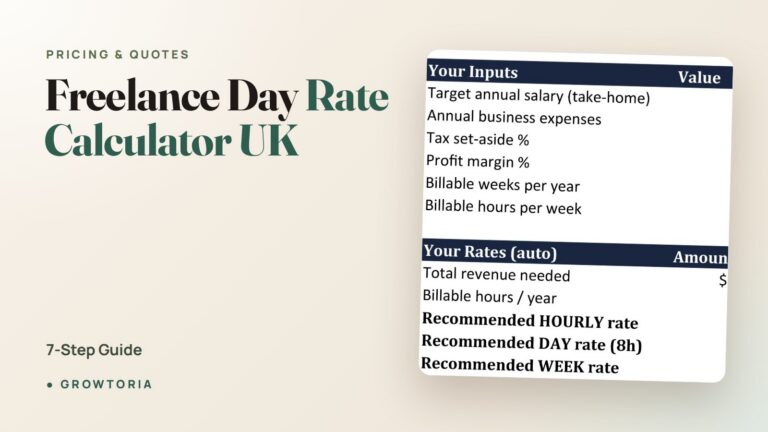
You calculate a consultant day rate in seven steps: set your income goal, add costs and tax, subtract non-billable days, then divide. Here’s the full method with real numbers.
1. Set your target take-home income
Start with the number you want in your pocket after tax. Say $90,000. Be honest—this is the figure your rate exists to protect.
2. Add your business costs
Software, insurance, a laptop, accountancy, coworking, marketing. For a lean solo consultant that’s often $8,000–$20,000 a year. Add it on top: $90,000 + $12,000 = $102,000.
3. Gross up for tax
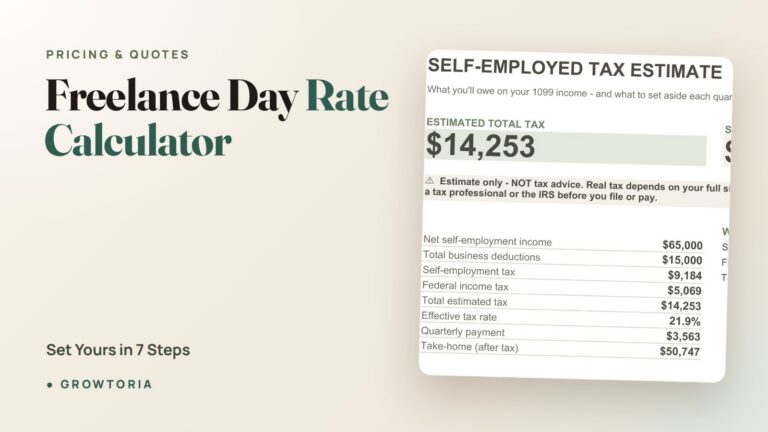
Self-employment tax, income tax and (in the US) Social Security and Medicare all take a cut before you keep anything. Build this in rather than getting surprised each quarter. The IRS explains the structure of self-employment tax and why you pay estimated taxes four times a year. If roughly 27% goes to tax, you need about $140,000 in revenue to net your targets.
4. Count your real working days
A calendar year has about 253 weekdays. Take off holiday, public holidays and a buffer for sick days—say 25 days. That leaves roughly 228 working days.
5. Apply a realistic utilisation rate
Here’s the step most people skip. You can’t bill all 228 days—some go to sales, admin, invoicing and proposals. Independent consultants typically bill 55%–75% of their working days. At 70% utilisation, 228 days becomes ~160 billable days.
6. Divide to get your day rate
Now the simple part: revenue needed ÷ billable days. $140,000 ÷ 160 = $875 per day. That is a consultant day rate calculator doing its one job—protecting the income you decided on in step one.
7. Benchmark, then add margin
Check your number against the market and your positioning, then add a margin for risk and profit. A rate with no buffer leaves nothing for slow months or a client that pays late.
Why utilisation decides your consultant day rate
The single biggest lever on your day rate is how many days you can actually sell. Drop from 80% to 50% utilisation and your required rate nearly doubles—for the exact same take-home pay.
The table below shows the day rate needed to hit $140,000 in revenue at different utilisation levels, assuming 228 working days a year.
| Utilisation | Billable days/year | Day rate needed |
|---|---|---|
| 50% | 114 days | $1,228 |
| 60% | 137 days | $1,022 |
| 70% | 160 days | $875 |
| 80% | 182 days | $769 |
Two takeaways. First, if you’re new and winning few days, your rate must be higher, not lower, to survive. Second, every hour you claw back from admin into billable work quietly lowers the rate you need to charge.
How much should a consultant charge per day?
Most independent consultants in developed markets charge between $600 and $2,000 per day, depending on niche, seniority and the value of the outcome. Specialists in high-stakes areas—legal, finance, technical architecture—sit at the top of that range.
But a market range is a sanity check, not your answer. Your number comes from your own costs and billable days. Use the benchmark only to spot when you’re wildly under or over, then adjust.
It also helps to anchor your figure to real occupational pay data. The U.S. Bureau of Labor Statistics publishes median earnings for management analysts (consultants), which you can convert to an equivalent day rate to check you’re not pricing below a salaried peer with none of your risk.
If you’re pricing project work instead of straight days, read our guide on how to cost a job and the best way to quote a job so your estimate still protects that day rate underneath. It helps to know the difference between a quote and an estimate before you send anything a client treats as fixed.
Day rate vs hourly rate vs value-based pricing
A day rate is clean to quote and easy for clients to budget, but it isn’t your only option—and it quietly caps your income at hours worked.
Hourly rates suit short, interruptible tasks and support retainers, but they punish you for being fast and invite clients to watch the clock. Value-based pricing ties the fee to the outcome—a 10% conversion lift, a passed audit—and can pay far more than any day rate, but it demands a clear, measurable result and real negotiation nerve.
A practical path: use your day rate as the floor that guarantees you never lose money, then move high-leverage engagements to value-based fees once you can prove the outcome. The calculator gives you that floor.
Common day rate mistakes to avoid
A few errors quietly cost consultants thousands every year. Watch for these:
- Pricing off a salary. Dividing a $120k salary by 260 days ignores tax, costs and non-billable time. You’ll undercharge by 40%+.
- Assuming 100% utilisation. Nobody bills every working day. Plan for 60–70% and your rate survives a slow quarter.
- Forgetting tax until it’s due. Set aside roughly a quarter to a third of every invoice the day it lands, not in April.
- Never reviewing the number. Costs, demand and your experience change. Re-run the calculator at least once a year.
- Discounting instead of reducing scope. If a client can’t afford your rate, cut the deliverables, not the daily fee—your rate is the one thing that protects everything else.
Frequently asked questions
What is a good utilisation rate for a consultant?
For established independents, 60–75% is healthy and sustainable. Push above 80% and sales, admin and rest all get squeezed; sit below 50% and your day rate has to climb steeply to compensate. Aim for 70% as a planning default, then measure your actual billable days quarterly and adjust.
Should my day rate include expenses?
Keep your core day rate separate from pass-through expenses like travel, accommodation and third-party software bought for the client. Bill those at cost on top, and state it clearly in your proposal. Baking them into the rate makes you look expensive and leaves you out of pocket when a project needs more travel than planned.
How often should I raise my day rate?
Review it at least once a year, and whenever your pipeline is consistently full or your costs jump. A 5–10% rise with existing clients at a natural project boundary rarely gets pushback. New clients should simply meet the new number from day one.
Is a day rate the same as 8 hours?
Not necessarily. Define what a “day” means in your contract—most consultants treat it as up to 8 working hours of focused delivery. Spell out overtime, half-day rules and what happens if a session overruns, so nobody assumes they’ve bought unlimited access.
Do I charge a lower day rate for longer contracts?
You can offer a modest discount for a guaranteed block of days because it lifts your utilisation and reduces sales effort. Keep it small—5–10%—and tie it to committed, pre-booked days. Never discount so deeply that a long contract pays less per day than you’d net from scattered one-off work.
Put your consultant day rate calculator to work
Run the seven steps once with honest numbers and you’ll have a rate you can defend in any pricing conversation. Start from the income you actually want, add costs and tax, strip out the days you can’t sell, then divide. The figure that falls out isn’t a guess—it’s the minimum your business needs to work. Quote it without apology, review it yearly, and let utilisation, not wishful thinking, set the number.