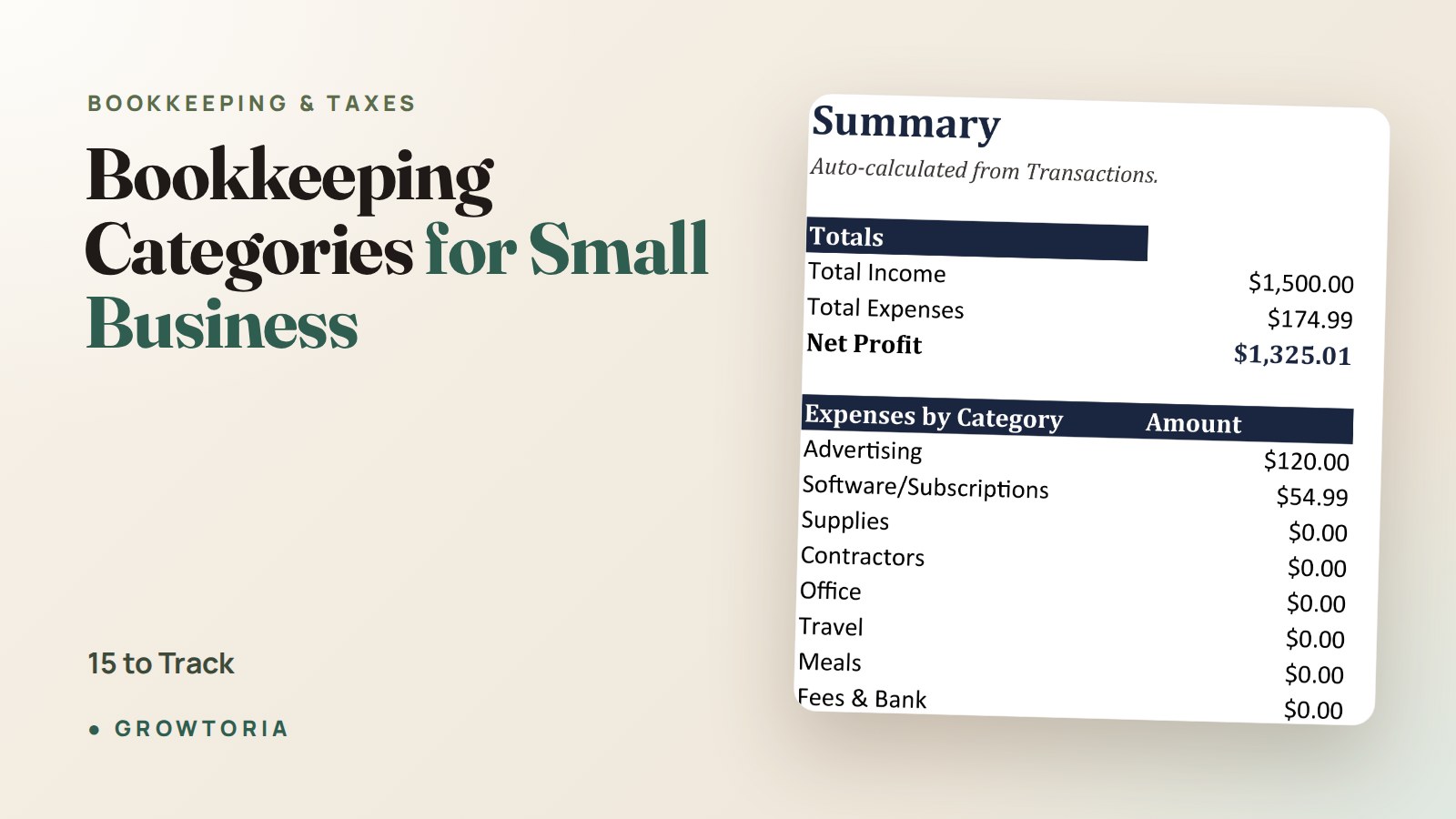
Bookkeeping Categories for Small Business: 15 to Track
Choosing the right bookkeeping categories for small business accounts is the single fastest way to make your books usable at tax time instead of a shoebox of guesses. Most owners don’t need 60 accounts — they need about 15 clear ones that map to how the IRS already wants you to report. Get those right and everything downstream (taxes, pricing, cash flow) gets easier.
Quick answer: The essential bookkeeping categories for a small business are income, cost of goods sold, advertising, contractors, software, office supplies, rent, utilities, travel, meals, vehicle/mileage, insurance, professional fees, bank/merchant fees, and taxes/licenses. Match them to IRS Schedule C lines, apply them consistently, and reconcile monthly.
What are bookkeeping categories for a small business?
Bookkeeping categories are the labeled buckets you sort every dollar into — money coming in (income) and money going out (expenses). Think of them as the tabs on a filing cabinet for your finances.
Each transaction gets exactly one category, so at any point you can answer “how much did I spend on software this year?” in five seconds. Good categories aren’t about being fancy. They’re about being consistent and matching the way you’ll eventually file taxes.
The gold standard to copy is the IRS Schedule C (Form 1040), which is the form most sole proprietors and single-member LLCs use. Its expense lines are, effectively, a pre-approved chart of accounts — so mirroring them saves you a translation step in April.
Why do bookkeeping categories matter?
They matter because vague books cost you real money — in missed deductions, mispriced work, and hours of cleanup. Here’s what clean categories unlock:
- Bigger tax deductions: Every properly categorized expense is a deduction you can defend. Uncategorized spending gets forgotten.
- Honest pricing: When you can see true costs, you can check your markup versus margin instead of guessing.
- Faster tax prep: Your accountant bills by the hour. Sorted books cut that bill.
- Real decisions: You spot the “$40/month app I forgot I pay for” only when software is its own line.
Sloppy categories do the opposite — they hide profit leaks and turn tax season into a scramble.
The 15 essential bookkeeping categories for small business owners
Below are the 15 categories that cover the vast majority of small businesses, what belongs in each, and the rough tax treatment. Start here, then add a category only when you have a recurring expense that doesn’t fit.
| Category | What goes in it | Typical tax note |
|---|---|---|
| Income / Sales | All revenue from products and services | Reported gross; track by stream if possible |
| Cost of Goods Sold | Materials, inventory, direct production costs | Schedule C Part III |
| Advertising & Marketing | Ads, design, sponsorships, promo | Fully deductible |
| Contractors / Freelancers | 1099 labor, subcontractors, VAs | Issue 1099-NEC over $600 |
| Software & Subscriptions | SaaS, hosting, apps, tools | Deductible; watch for unused ones |
| Office Supplies | Printer ink, paper, small equipment | Deductible |
| Rent / Lease | Office, studio, equipment rental | Deductible; home office is separate |
| Utilities | Business internet, phone, electricity | Deductible (business portion) |
| Travel | Flights, lodging, business trips | Deductible with documentation |
| Meals | Business meals with clients/team | Usually 50% deductible |
| Vehicle / Mileage | Business driving, fuel, parking | Standard mileage or actual cost |
| Insurance | Liability, professional, property | Deductible |
| Professional Fees | Accountant, lawyer, consultants | Deductible |
| Bank & Merchant Fees | Stripe, PayPal, card and bank fees | Deductible; adds up fast |
| Taxes & Licenses | Permits, business license, sales tax remitted | Deductible (not income tax) |
Tax rules change and your situation is unique, so confirm specifics with a professional — but this structure is what most owners actually need. If you sell online, note that platform costs (like Etsy or Shopify fees) belong under bank/merchant fees or their own sub-line.
Income categories vs expense categories: what’s the difference?
Income categories track money in; expense categories track money out. Keeping them cleanly separated is what lets you calculate profit at a glance.
Most owners only need a few income buckets — for example “Product Sales,” “Service Revenue,” and “Other Income.” Splitting revenue by stream shows you which part of the business actually pays the bills.
Expenses are where the detail lives, which is why 12 of our 15 categories are outflows. If you want a plain-English walkthrough of turning these buckets into a working sheet, our guide on how to make a budget spreadsheet uses the same logic.
How do I set up bookkeeping categories? (5 steps)
Set up your categories in one short sitting, then let consistency do the work. Here’s the exact order:
- Start from your tax form. Open Schedule C (or your entity’s equivalent) and copy its expense lines. This guarantees your books already speak the tax filer’s language.
- Add category-specific lines you actually use. An Etsy seller adds “Platform Fees”; a contractor adds “Tools & Equipment.” Don’t add buckets you’ll never fill.
- Separate business and personal. Use a dedicated business bank account. Mixed accounts are the number-one cause of messy books.
- Categorize weekly, not yearly. Ten minutes every Friday beats 10 hours every April. Attach or photograph receipts as you go.
- Reconcile monthly. Match your sheet to your bank statement so nothing slips through. This is when errors are cheap to fix.
You can build this by hand, but a ready-made system removes the guesswork. Our Small Business Expense Tracker comes pre-loaded with these categories and calculates your profit automatically in Google Sheets or Excel — or grab it on our Etsy shop. If you sell on Etsy specifically, the Etsy Bookkeeping Spreadsheet already accounts for platform fees so you see real profit after Etsy takes its cut.
What bookkeeping categories are commonly missed?
The most-missed categories are the small, recurring, or invisible ones — and they’re often the most deductible. Watch for these:
- Merchant and processing fees. A 2.9% cut on every sale is a real, deductible expense most people never record.
- Home office and utilities. A portion of internet, phone, and rent may qualify — but only if you track it.
- Mileage. Business driving is easy to forget and adds up to hundreds of dollars in deductions.
- Software you forgot about. Categorizing subscriptions surfaces the tools you’re paying for and not using.
- Education and courses. Books, courses, and industry memberships tied to your work are often deductible.
For a fuller sweep of write-offs to check against your categories, keep our small business tax deductions checklist open while you set up. And if you’re an online seller, the step-by-step Etsy shop bookkeeping setup pairs perfectly with these categories.
Do I need accounting software or is a spreadsheet enough?
For most small businesses under six figures, a well-built spreadsheet is genuinely enough. Software becomes worthwhile once you have inventory, payroll, or high transaction volume.
A spreadsheet is cheaper, works offline, and forces you to understand your own numbers — which is the whole point. If you’d rather run everything without a monthly subscription, we round up options in our guide to small business software that works 100% offline. You can also start with a free tool from our free tools library.
Frequently asked questions
How many bookkeeping categories should a small business have?
Most small businesses need 12 to 18 categories — enough to be useful, few enough to stay consistent. Start with the 15 essentials above and add a new bucket only when a recurring expense genuinely doesn’t fit an existing one. Too many categories creates decision fatigue and inconsistent sorting, which defeats the purpose.
What are the main categories in bookkeeping?
The five big buckets are income (or revenue), cost of goods sold, operating expenses, assets, and liabilities. For day-to-day small business bookkeeping, you’ll spend nearly all your time in income and operating expenses — the detailed sub-categories like advertising, software, and travel all live under operating expenses.
Should sales tax be its own bookkeeping category?
Yes. Sales tax you collect isn’t your money — it’s owed to the state — so track it in a separate liability category, not as income. Mixing it into revenue inflates your sales and can lead to overpaying income tax on money you have to hand back. Keep collected sales tax clearly separated and remit it on schedule.
What’s the difference between a category and an account in bookkeeping?
In practice they’re often used interchangeably for small businesses. Technically, “accounts” make up your chart of accounts (the formal list), while “categories” is the everyday label you assign transactions to. If you use a spreadsheet, your category list is your chart of accounts — no need to overthink the terminology.
Can I change my bookkeeping categories mid-year?
You can, but do it deliberately and document the change. If you split or rename a category, re-sort earlier transactions so your yearly totals stay accurate and comparable. The bigger risk isn’t changing categories — it’s changing them casually and ending up with the same expense in two different buckets.
Bottom line: Pick around 15 clear bookkeeping categories that mirror your tax form, sort every transaction the same way each week, and reconcile monthly. Do that consistently and your books go from a source of dread to a genuine business tool.