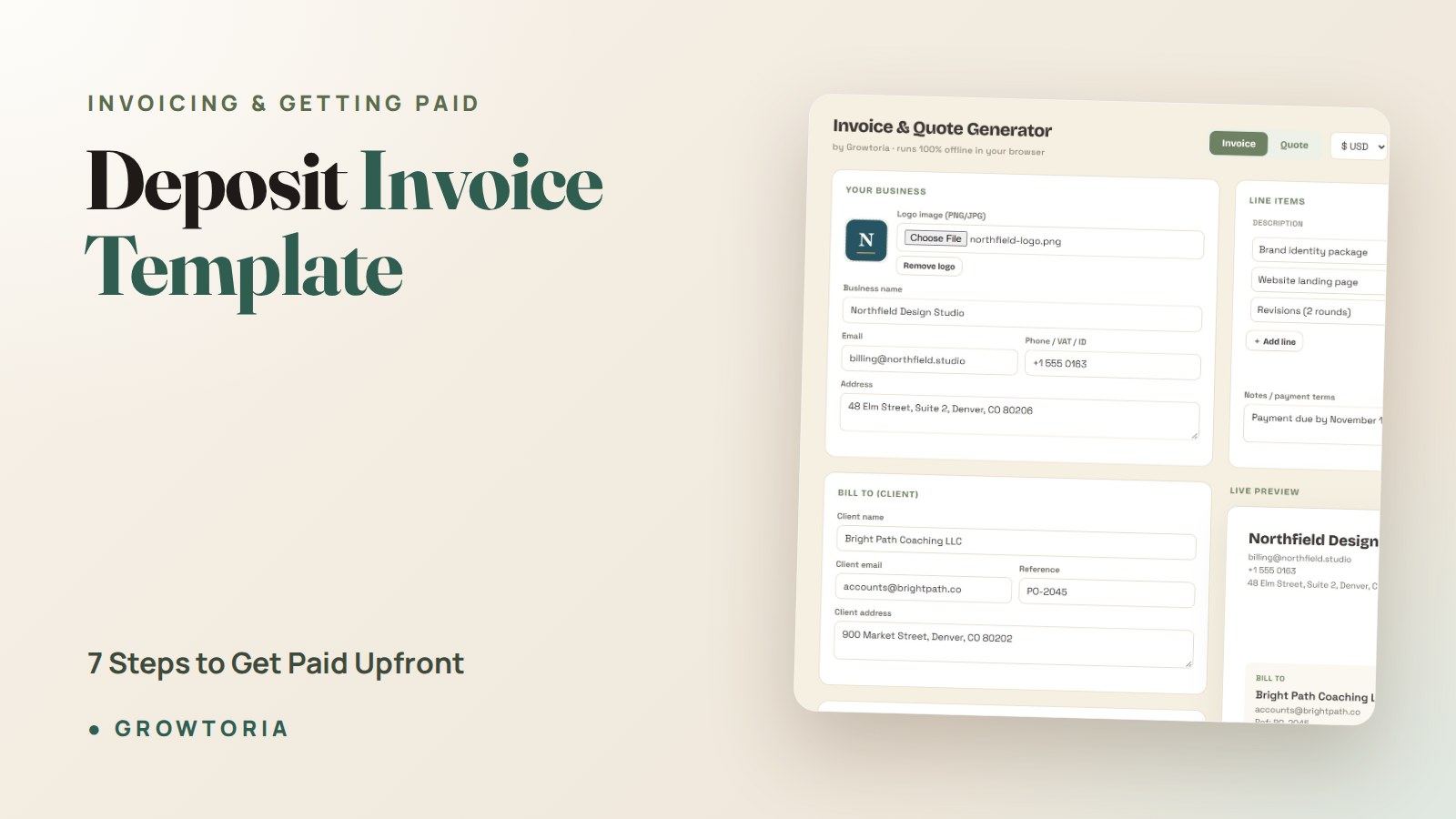
Deposit Invoice Template: 7 Steps to Get Paid Upfront
A deposit invoice template is the fastest way to get paid before you lift a finger on a job — and it’s the single document that separates freelancers who chase money from the ones who never do. If you’ve ever finished a project only to spend three weeks emailing a client for payment, this is the fix. A deposit invoice collects part (or all) of your fee upfront, so the money is in your account before the risk starts.
Below you’ll get the exact fields to include, a 7-step build, typical deposit percentages by industry, and a few honest mistakes to avoid. Let’s make sure the next job pays you first.
Quick answer: A deposit invoice template is a billing document that requests an upfront payment — usually 25–50% of the total — before work begins. It lists your business details, the client, the deposit amount, the remaining balance, due date, and payment terms, then deducts the deposit from the final invoice.
What is a deposit invoice template?
A deposit invoice template is a reusable form that bills a client for a partial payment before a project starts. Instead of invoicing the full amount at the end, you split payment into an upfront deposit and a final balance.
It looks almost identical to a standard invoice, with three key differences:
- It clearly labels the amount as a deposit (or “advance payment”).
- It shows the total project value and the remaining balance due later.
- It states what the deposit secures — a booking date, materials, or your slot in the schedule.
Think of it as a commitment device. The client proves they’re serious with money, and you protect yourself against no-shows, scope creep, and ghosting.
When should you send a deposit invoice?
Send a deposit invoice whenever a project carries real risk of wasted time or upfront costs. The deposit invoice should go out after the client accepts your quote but before you buy materials or block out time.
Deposits make the most sense when:
- You buy materials or supplies to start (contractors, makers, caterers).
- The job books a fixed date you can’t resell (events, photography, cleaning slots).
- The project runs weeks or months (design, development, consulting retainers).
- You’re working with a brand-new client and have no payment history.
If you send estimates first, a deposit invoice is the natural follow-up. Our contractor estimate template guide and how to quote a painting job walkthrough both end at the exact moment you’d fire off a deposit invoice.
What to include on a deposit invoice template
A deposit invoice needs every field a normal invoice has, plus a clear breakdown of what’s paid now versus later. Missing fields are the top reason deposits get disputed or delayed.
Include these, in this order:
- Your business name, logo, address, and contact.
- Client name and billing details.
- A unique invoice number (e.g., DEP-2026-014) and issue date.
- A line labeled “Deposit” with the amount and percentage.
- The total project value and the remaining balance.
- The deposit due date (and when work starts once paid).
- Payment methods — bank transfer, card, PayPal, etc.
- Applicable tax (charge it on the deposit if your jurisdiction requires it).
- Terms — refundable or non-refundable, and cancellation policy.
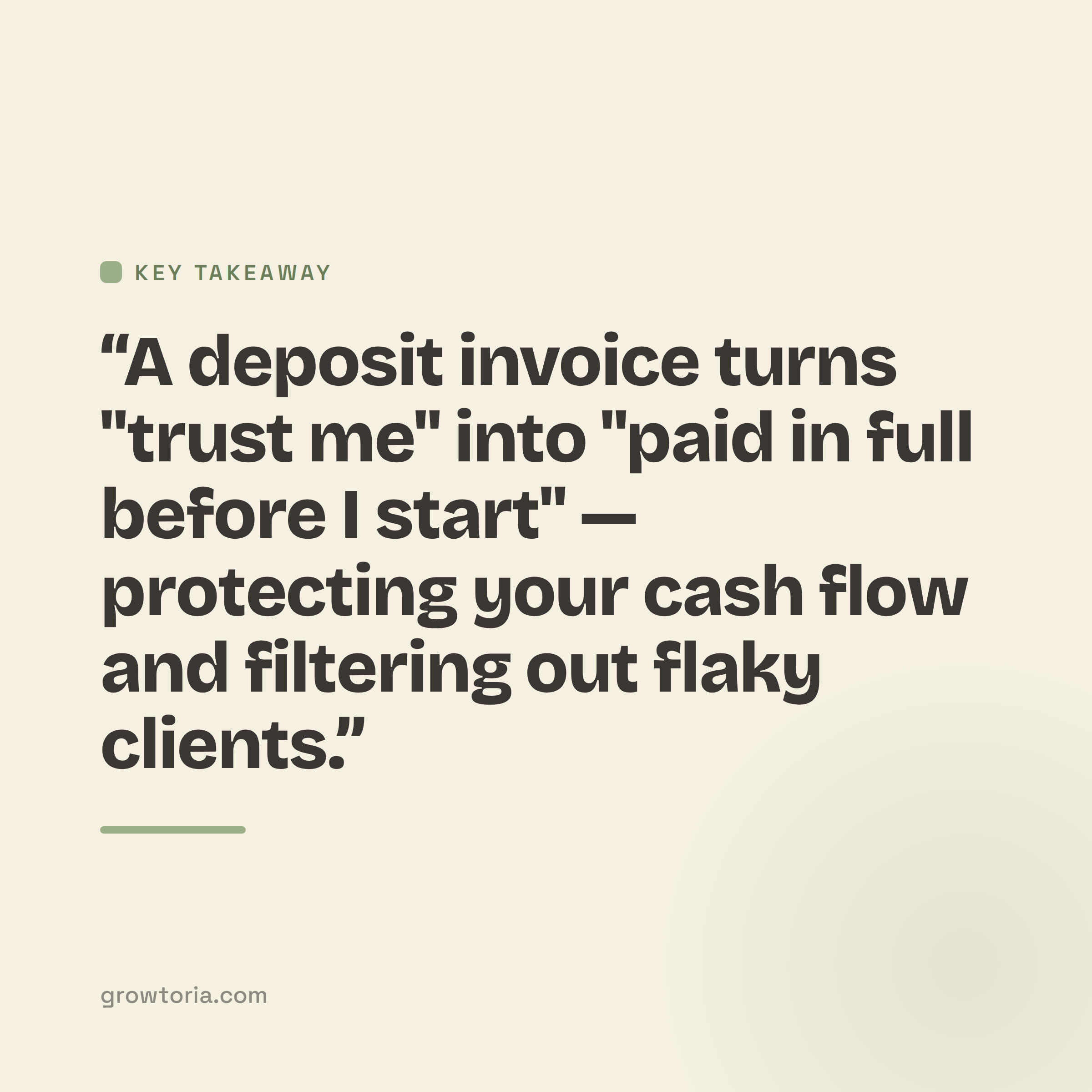
That last line matters more than people think. State plainly whether the deposit is refundable. “A 40% deposit secures your booking and is non-refundable within 14 days of the scheduled date” prevents 90% of arguments.
How to create a deposit invoice template in 7 steps
You can build a reusable deposit invoice template in under 15 minutes. Do it once, save it, and every future job takes 60 seconds to bill.
- Start from your standard invoice. Duplicate it so branding and contact info are already set.
- Add a deposit line. Label it clearly: “Deposit (40% of total)”.
- Show the full total and remaining balance. Transparency builds trust and prevents “wait, I thought that was the whole price” moments.
- Set the deposit due date. Shorter is better — 7 days keeps momentum.
- Write your terms once. Refund policy, what the deposit secures, and when work begins.
- Add payment instructions. Make paying effortless — one link or one account number.
- Save it as a template and create a matching “final balance” invoice that subtracts the deposit already paid.
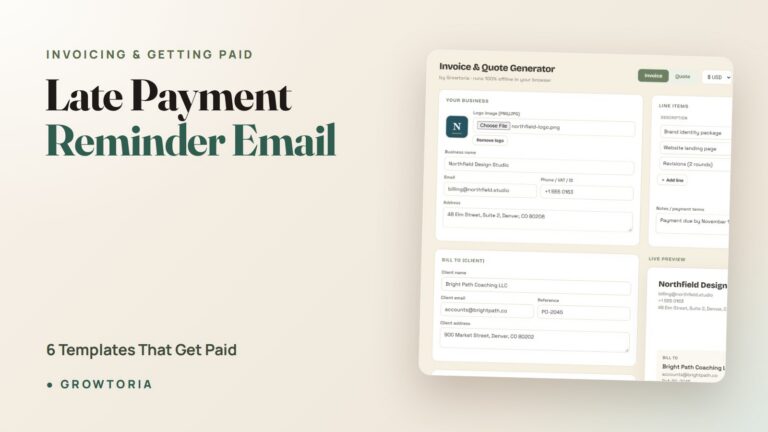
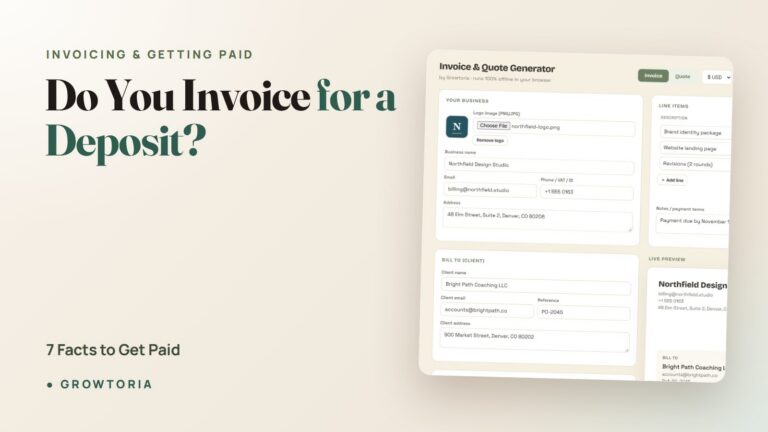
If you’d rather skip the spreadsheet fiddling, the done-for-you shortcut is the Offline Invoice & Quote Generator — a single-file app that creates deposit invoices, applies tax automatically, and exports a clean PDF, with no subscription. It pairs neatly with the Quote & Estimate Generator App, which turns any accepted quote straight into a deposit invoice. You can also grab our invoicing tools on our Etsy shop if that’s where you prefer to buy.
How much should a deposit be?
Most deposits land between 25% and 50% of the total, depending on your industry and upfront costs. The rule of thumb: your deposit should at least cover your out-of-pocket costs to start the job, so you never lose money if a client walks.
Here’s what’s typical across common Growtoria niches:
| Industry / job type | Typical deposit | Why |
|---|---|---|
| Contractors & trades | 30–50% | Covers materials bought upfront |
| Catering & events | 25–50% | Secures a fixed, un-resellable date |
| Cleaning services | 25–30% | Protects the booked time slot |
| Freelance design/dev | 30–50% | Filters serious clients, funds the start |
| Consulting retainers | 50–100% | Advance covers the month’s capacity |
| Handmade / custom orders | 50% | Materials + custom work can’t be resold |
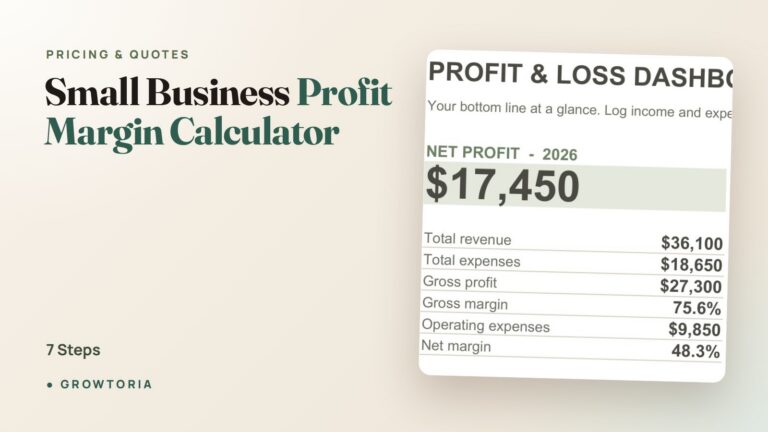
For pricing the total before you deposit against it, our guides on how to set consulting rates and the freelance day rate calculator will get your number right first. You can also run the math free with our small business profit margin calculator.
Deposit invoice vs. proforma invoice vs. quote
These three documents get confused constantly, but they do different jobs. A quote proposes a price, a proforma estimates a bill, and a deposit invoice actually demands payment.
- Quote/estimate: “Here’s what it’ll cost.” Not a request for money.
- Proforma invoice: A preliminary bill sent before goods/services are finalized — often used for customs or approvals. Not always a payment demand.
- Deposit invoice: A legally billable request for an upfront portion of the total, recorded in your books as income when paid.
The U.S. Small Business Administration has solid, plain-English guidance on managing your finances and cash flow, and Investopedia’s breakdown of invoices is a good reference on how each document type is treated.
Common deposit invoice mistakes to avoid
The deposit invoice only protects you if it’s airtight. These are the errors that cost freelancers money.
- Not stating the refund policy. Silence gets interpreted in the client’s favor.
- Forgetting to deduct the deposit on the final invoice — you’ll either overcharge or eat the loss.
- Starting work before the deposit clears. “It’s on the way” is not payment.
- Vague line items. “Deposit — $500” invites questions. Show the percentage and the total.
- No follow-up system. Track which deposits are outstanding so nothing slips.
To stay on top of what’s paid and what’s owed, a Freelancer Invoice Tracker keeps every deposit and balance in one view. And when a payment does run late, steal the wording from our late payment reminder email templates — they get people to pay without torching the relationship.
Frequently asked questions
Is a deposit invoice legally binding?
Yes — once a client pays a deposit invoice, it’s a recorded transaction and evidence of an agreement. To make it fully enforceable, pair it with clear written terms stating what the deposit secures and whether it’s refundable. The clearer your terms, the stronger your position if a dispute ever arises.
Do I charge tax on a deposit invoice?
In most jurisdictions, yes — if the sale is taxable, tax generally applies when the deposit is paid. Rules vary by country and state, so confirm with your local tax authority or accountant. A good invoicing tool applies the correct tax automatically so you don’t have to calculate it by hand each time.
How do I turn a deposit invoice into a final invoice?
Create a final invoice showing the full project total, then add a line that subtracts the deposit already paid. The remaining balance is what the client owes at completion. Keep the same invoice numbering sequence so both documents are easy to match in your bookkeeping.
Should a deposit be refundable or non-refundable?
Non-refundable deposits protect you against last-minute cancellations, especially for booked dates or custom materials. Refundable deposits feel safer to nervous new clients. A common middle ground: refundable up to a cutoff date, non-refundable after. Whatever you choose, state it on the deposit invoice template in plain language.
What percentage deposit should a freelancer ask for?
Most freelancers charge 30–50% upfront. The deposit should at least cover your costs to start and enough of your time that a cancellation doesn’t leave you out of pocket. For long or high-risk projects, milestone deposits (e.g., 33% at start, mid, and delivery) spread the risk further.
Ready to bill your next job the smart way? Build your deposit invoice template once, save it, and let it quietly protect your cash flow on every project from here on out.