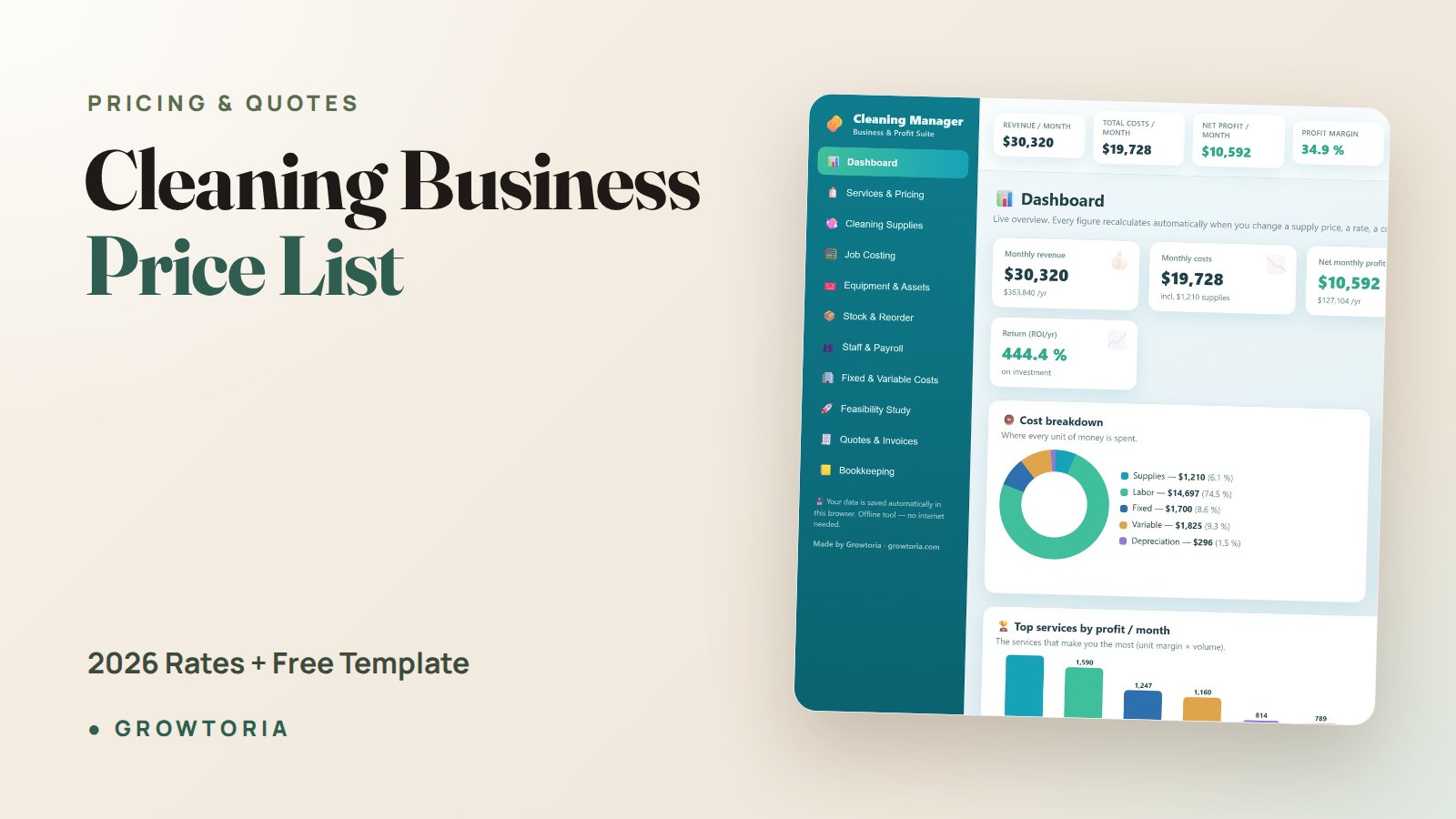
Cleaning Business Price List: 2026 Rates + Free Template
A clear cleaning business price list is the difference between a cleaning business that grows and one that quietly loses money on every job. Charge too little and you burn out; guess too high and you lose the bid. This guide gives you real 2026 rate ranges by service type, a simple formula to set your own numbers, and a ready-to-send price sheet you can adapt today.
Quick answer: Most cleaning businesses in 2026 charge $30–$50 per hour per cleaner, $0.10–$0.25 per square foot, or $120–$250 for a standard home clean. Deep cleans run 1.5–2.5× a standard clean. Build your price list from your true hourly cost plus a 30–50% profit margin, not from competitor guesses.
What should a cleaning business price list include?
A good cleaning business price list shows the service, what’s included, the unit you charge by, and a clear price range. Customers want to know what they get before they book, and you want to stop re-quoting every job from scratch.
At minimum, your price list should cover:
- Service type — standard, deep, move-in/move-out, recurring, commercial/office.
- Pricing unit — per hour, per square foot, per room, or flat rate.
- What’s included — so “deep clean” means the same thing to you and the client.
- Add-ons — inside oven, inside fridge, windows, laundry, baseboards.
- Minimum charge — the smallest job you’ll take (protects you on tiny bookings).
Keep it short and skimmable. A one-page price sheet converts far better than a wall of fine print. If a client has to email you three times to understand what a “deep clean” costs, half of them won’t bother.
Cleaning business price list: 2026 rates by service type
Here is a realistic cleaning business price list for 2026, based on typical U.S. residential and light-commercial rates. Treat these as starting ranges — your local market, cost of supplies, and travel time will shift the numbers.
| Service | Typical unit | 2026 price range | Notes |
|---|---|---|---|
| Standard house clean | Flat / per visit | $120–$250 | 2–3 bed home, surfaces, floors, bathrooms, kitchen |
| Deep clean | Flat / per visit | $200–$450 | 1.5–2.5× a standard clean; baseboards, buildup, detail |
| Move-in / move-out | Flat / per visit | $250–$600 | Empty home, inside cabinets, appliances, walls |
| Recurring (weekly/biweekly) | Per visit | $90–$180 | Discount vs. one-off; predictable revenue |
| Hourly (team member) | Per hour | $30–$50 | Good for odd jobs and unclear scope |
| Per square foot | Per sq ft | $0.10–$0.25 | Common for larger homes and offices |
| Office / commercial | Per visit / monthly | $0.05–$0.20 /sq ft | Volume pricing; often nightly contracts |
| Add-on: inside oven | Flat | $25–$40 | Priced separately, every time |
| Add-on: interior windows | Per window | $4–$8 | Scope creep killer if not listed |
Notice the wide bands. That’s intentional — a deep clean of a lived-in 4-bedroom with pets is a different job than a tidy 2-bed apartment. Your price list gives the range; your quote pins the number.
Why deep cleans cost 1.5–2.5× a standard clean
New cleaners lose money most often on deep cleans, because they quote them like a slightly bigger standard clean. They aren’t. A deep clean touches everything a standard visit skips: baseboards, blinds, inside the oven and fridge, grout, light fixtures, cabinet fronts, and built-up grease. That’s not 20% more time — it’s often double. Price it that way and time your first three deep cleans with a stopwatch so you stop guessing.
Why recurring clients get a discount
A biweekly client is worth far more than a one-time booking, so it’s fair to reward them. Recurring homes stay cleaner between visits, which means less time per job, and they give you predictable revenue you can staff around. A 10–20% discount off your one-off rate is standard — just make sure the discounted price still clears your true cost, which we’ll calculate next.
How do you calculate cleaning prices for profit?
Set your prices from your true hourly cost plus your target margin — never from a competitor’s flyer. Copy their number and you inherit their mistakes.
Here’s the four-step formula I use with service businesses:
- Find your real hourly cost. Add wages (including your own time), payroll taxes, supplies, insurance, and travel, then divide by billable hours. Cleaners rarely bill 40 of 40 hours — 25–30 billable is realistic.
- Estimate hours for the job. A standard 2-bed clean is often 2–3 hours; a deep clean, 4–6. Time your first few jobs honestly.
- Add your target margin. Aim for a 30–50% net margin. If your loaded cost is $22/hour, price the job so you keep meaningfully more than that.
- Round to a clean flat rate. Clients prefer “$180 for the visit” over “$37.50/hour × 4.8 hours.” Quote the outcome, not the timesheet.
A worked example: Say your loaded cost is $24/hour and a standard 2-bed clean takes 2.5 hours. Your cost for that job is $60. To hit a 40% margin, you’d price it at roughly $100 ($60 ÷ 0.60). Round up to $110 to cover the odd slow day, and that’s your flat rate. Do the same math on a 5-hour deep clean and you land near $200–$220 — right inside the table’s range, but grounded in your numbers instead of a competitor’s.
For context on labor cost, the U.S. Bureau of Labor Statistics reports wage data for maids and housekeeping cleaners — a useful benchmark when you set what you pay staff and, in turn, what you must charge. The U.S. Small Business Administration’s pricing guidance is worth a read too, especially its point that your price has to cover overhead and profit, not just labor.
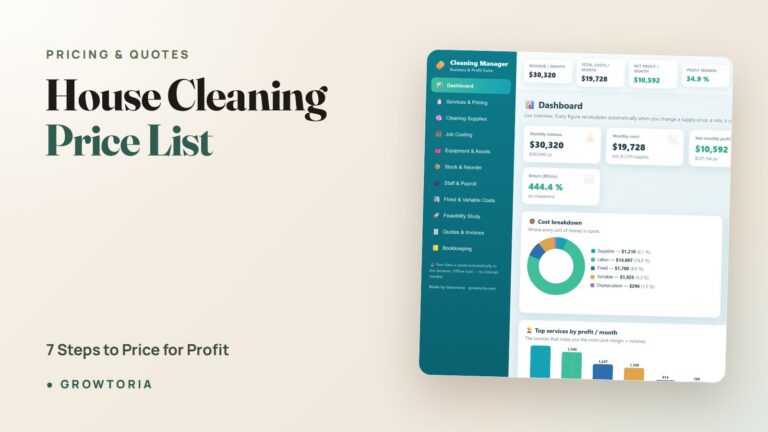
Want the math done for you? Our free small business profit margin calculator and free break-even calculator show you the exact price that clears your costs. If you’d rather price whole jobs, build quotes, and track profit in one place, the Cleaning Business Manager App costs each job by supplies, labor, and drive-time, then builds the invoice — or grab it on our Etsy shop.
Flat rate vs. hourly vs. per square foot: which should you use?
Use flat-rate pricing for repeatable jobs, hourly for unclear scope, and per-square-foot for larger spaces where you can’t easily eyeball the work. Each model fits a different situation, and mature cleaning businesses usually use all three.
- Flat rate is best for standard and recurring homes you can scope on sight. Clients love the certainty, and once you’re fast, every minute you save is pure margin. The risk is under-quoting a messier-than-expected home — so pad your estimate and inspect before you commit.
- Hourly protects you when the scope is genuinely unknown: hoarder situations, post-construction, or “just do what you can in three hours.” State a minimum and, ideally, a not-to-exceed cap so the client isn’t nervous about an open meter.
- Per square foot shines for offices and large homes. It scales cleanly and is easy to defend in a bid, but always attach a minimum charge — $0.12/sq ft on a tiny 400 sq ft studio is a job you’d lose money driving to.
The practical answer: quote flat-rate whenever you can see the space, fall back to hourly when you can’t, and reserve per-square-foot for commercial bids and big homes.
How to present your price list so it actually books jobs
Your pricing can be perfect and still lose the sale if it’s presented badly. A few things that consistently convert better:
- Lead with the outcome, not the rate. “Move-in ready from $250” reads better than a bare hourly figure.
- Show three tiers. Standard, deep, and move-out side by side lets clients self-select — most land on the middle option.
- Name your add-ons and price them. Listed add-ons turn scope creep into extra revenue instead of unpaid work.
- State your minimum up front. It filters out tiny jobs before they waste anyone’s time.
- Put it on one page. A clean, skimmable sheet beats a PDF novel every time.
Send the same one-page sheet to every lead. Consistency builds trust, and it stops you from quietly discounting yourself on the phone.
Frequently asked questions
How much should I charge for house cleaning in 2026?
Most cleaning businesses charge $120–$250 for a standard 2–3 bedroom home, $30–$50 per hour per cleaner, or $0.10–$0.25 per square foot. Start from those ranges, then adjust to your true hourly cost and local market. High-cost metro areas run at the top of every band; rural markets sit lower.
Should I charge hourly or flat rate for cleaning?
Charge flat rate whenever you can see and scope the space — clients prefer the certainty and you keep the upside when you work fast. Use hourly only when the scope is unclear, and pair it with a minimum charge so small jobs still cover your drive time and setup.
How much more should a deep clean cost than a standard clean?
Price a deep clean at 1.5–2.5× your standard rate. It covers everything a routine visit skips — baseboards, inside appliances, grout, blinds, and built-up grime — and typically takes close to double the time. Timing your first few deep cleans is the only reliable way to nail the multiplier for your team.
What profit margin should a cleaning business aim for?
Target a 30–50% net margin after wages, supplies, insurance, travel, and taxes. If you’re consistently below 30%, you’re either under-pricing or under-billing your hours. Run the numbers on each service type — some, like recurring cleans, carry thinner margins but far more volume.
Do I need to list my prices publicly?
Publishing at least a starting-from range builds trust and pre-qualifies leads, so you spend less time quoting jobs that were never a fit. You don’t have to publish exact numbers for every scenario — a clear range plus “final quote after a quick walkthrough” is enough to convert without boxing you in.
Put your price list to work
A cleaning business price list isn’t a one-and-done document — revisit it every 6–12 months as wages, supplies, and demand shift. Start from the 2026 ranges above, ground each price in your real hourly cost and target margin, and present it as one clean page. Do that, and you’ll stop guessing on quotes, stop leaving money on the table, and win the jobs that are actually worth your time.
Cleaning tools that do the pricing for you
Setting rates by hand works, but if you want the maths, the quote and the invoice handled for you, these are built for exactly that:
- Cleaning Business Manager App — job pricing, cost & profit calculator and invoices in one offline app, no subscription.
- Cleaning Service Quote Builder — turn your price list into a professional PDF quote in minutes.
- Free ADHD Cleaning Schedule Maker — printable, no signup, for organising the cleans themselves.
Cleaning pricing FAQ
How much should a cleaning business charge per hour?
Solo cleaners typically charge $25–$50 per hour and teams $50–$90, but hourly is only a sanity check. Price the job: estimate the hours, multiply by the rate you need, then add supplies, travel and a profit margin. Charging a flat per-job price protects you when a house takes longer than expected.
How do you price a house cleaning job?
Base it on three things: size (square footage or number of rooms/bathrooms), condition (lightly maintained vs. neglected), and type (standard, deep, or move-out). Build the price from a real cost stack — labour at your rate, supplies, drive time and payment fees — then add margin. Don’t copy a competitor’s number blindly; their costs aren’t yours.
What is the average rate for a deep clean?
A deep clean usually runs 1.5–2.5× a standard clean because it adds baseboards, inside appliances, grout and detail work. If a standard clean is $120, a deep clean is often $180–$300 for the same home. Always quote deep cleans separately — they’re where under-pricing hurts most.
How much do commercial cleaning contracts pay?
Commercial work is usually priced per square foot per visit (often $0.05–$0.20/sq ft depending on frequency and scope) or as a flat per-visit rate. Recurring contracts trade a lower per-visit price for guaranteed volume, so quote them on total monthly hours, not a single clean.
How do you write a cleaning quote?
List the exact scope (rooms and tasks), the frequency (one-off, weekly, monthly), and one clear price. Ambiguity is what causes disputes and scope creep. A simple itemised PDF quote wins more jobs and sets expectations — our Cleaning Service Quote Builder turns your price list into one in minutes.
Tools for your cleaning business
- Cleaning Business Manager App — job pricing, profit and invoices, offline, no subscription.
- Cleaning Service Quote Builder — a professional PDF quote in minutes.
- 2026 Cleaning Business Price List — real rates and a free template.