Freelance Day Rate Calculator: Set Yours in 7 Steps
A freelance day rate calculator turns your income goal into the exact price you should charge for a full day of work — after taxes, business costs, and the days you can’t bill. Most freelancers skip this math and just double their old hourly wage, then wonder why they’re broke at year-end. This guide fixes that.
Below you’ll get the real formula, the billable-days math nobody explains, a worked example you can copy, a side-by-side comparison of pricing models, and answers to the questions that trip people up.
Quick answer: To calculate a freelance day rate, add your target take-home pay, taxes, and yearly business costs to get your revenue target. Then divide that number by your realistic billable days — usually 130 to 160 per year, not 260. That figure, rounded up, is your day rate.
What is a freelance day rate calculator?
A freelance day rate calculator is a simple tool that converts your annual income target into a single daily price. It accounts for the money you never see as a freelancer: self-employment tax, software, insurance, and the unpaid days spent on admin, marketing, and rest.
The core equation is short:
- Revenue target ÷ billable days = day rate
Everything else is just building those two numbers correctly. Get the inputs right and the output is a rate you can defend without flinching in a client call.
Why doubling your old salary doesn’t work
Here’s the trap. An employee on $70,000 assumes they should bill roughly $70,000 as a freelancer too. But an employer quietly pays for a lot more than salary.
As a freelancer, you now cover:
- Self-employment tax — an extra ~15.3% on top of income tax in the US (see the IRS self-employment tax guidance).
- Zero paid time off — every holiday, sick day, and vacation day is unpaid.
- Business costs — tools, insurance, equipment, and accounting fees.
- Non-billable time — pitching, invoicing, and chasing late payers.
Add it up and a $70,000 salary lifestyle can easily need $95,000–$110,000 in freelance revenue. That gap is exactly what a proper freelance day rate calculator exposes.
How do you calculate a freelance day rate? (7 steps)
Follow these seven steps in order. Each one feeds the next, and by the end you’ll have a rate backed by real numbers instead of a gut guess.
1. Set your target take-home pay
Start with the money you actually want in your pocket for the year. Be honest — include rent, food, savings, and a little breathing room. Say $60,000.
2. Add your yearly business costs
List every recurring cost of running your freelance business: design or dev software, cloud storage, a laptop fund, liability insurance, and accounting. A solo freelancer often lands around $8,000–$12,000. We’ll use $10,000.
3. Add a tax buffer
Taxes come out of revenue, not out of thin air. Set aside roughly 25–30% of your gross for federal, state, and self-employment tax. Verify your bracket with a self-employed tax calculator so you’re not surprised in April.
4. Total your revenue target
Combine the pieces. Take-home + costs, then gross up for tax. In our example: ($60,000 + $10,000) grossed up for ~28% tax lands near a $97,000 revenue target. Round it to a clean number you can aim at.
5. Count your realistic billable days
This is where most freelancers go wrong. The year has 260 weekdays, but you cannot bill all of them.
- Start with 260 weekdays.
- Subtract ~10 public holidays and ~20 vacation/sick days → ~230 working days.
- Now subtract non-billable time. Only about 60–65% of working days are billable once you factor in sales, admin, and learning.
That leaves roughly 140–150 billable days a year. Use 145. If you’re new and still building a pipeline, be more conservative — 120 is realistic in year one.
6. Divide and round up
Revenue target ÷ billable days. $97,000 ÷ 145 ≈ $669. Round up to a confident $700/day. That’s your floor, not your ceiling.
7. Sanity-check against your market
Compare your number to what others in your niche and region charge. If $700 is wildly above or below market, revisit your billable-days assumption or your positioning — not just the price tag. Rate benchmarks published by the Freelancers Union are a useful reality check by field.
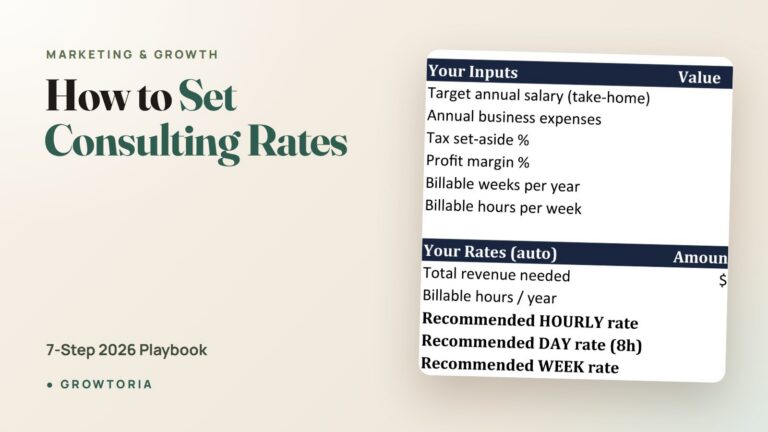
Want to skip the spreadsheet? Our free freelance day rate calculator runs this exact math for you in under a minute.
A worked example you can copy
Here’s the full build-up so you can plug in your own figures:
- Target take-home pay: $60,000
- Yearly business costs: $10,000
- Tax buffer (~28%): +$27,000
- Revenue target: $97,000
- Billable days per year: 145
- Day rate ($97,000 ÷ 145): $669 → rounded to $700
Notice the day rate is more than 2.5× what a naive “$60k ÷ 260 days = $230” guess would give you. That difference is the money that keeps you solvent through slow months, tax season, and the two weeks you take off without guilt.
Day rate vs hourly vs project pricing
A day rate is one of three common ways to charge, and each fits a different kind of work. Hourly pricing rewards slow work and punishes you for getting faster. Project (fixed) pricing rewards speed and expertise but carries scope-creep risk. A day rate sits in the middle: it’s easy for clients to budget and it protects your time without endless timesheets.
Use the table to pick the model that matches the job in front of you.
| Factor | Day rate | Hourly | Project (fixed) |
|---|---|---|---|
| Best for | Multi-day engagements, retainers, on-site work | Open-ended or unpredictable tasks | Well-defined deliverables with clear scope |
| Income predictability | High | Medium | High (if scope holds) |
| Admin overhead | Low — one line per day | High — track every hour | Low — one price up front |
| Rewards efficiency? | Yes | No — faster work earns less | Yes — strongly |
| Main risk | Client questions a “half day” | Fee caps and hour disputes | Scope creep eats your margin |
| Client budgeting | Easy | Hard — total is unknown | Easy |
Many established freelancers quote a day rate for booked blocks of work and a project price for tightly scoped deliverables — then keep hourly only for small, unpredictable add-ons.
How to raise your day rate without losing clients
Your first calculated rate is a floor, not a life sentence. Once your calendar fills, raising the number is how you earn more without working more days.
Raise it on new clients first
The lowest-friction move is to quote the higher rate to every new lead while leaving current clients untouched for now. Within a few months your average rate climbs and nobody feels a jolt.
Anchor to outcomes, not hours
Clients pay more happily when they see the result they’re buying. “This day of work ships your checkout redesign” lands better than “eight hours of design.” Talk in deliverables and deadlines, not clock time.
Give existing clients notice
For long-term clients, a short, warm email 30–60 days ahead works: state the new rate, the date it starts, and thank them. Most stay. The few who leave were usually your lowest-margin work anyway.
Common mistakes that wreck your day rate
- Using 260 billable days. The single biggest error. It halves your real rate.
- Forgetting the tax buffer. Revenue is not take-home. Gross up before you divide.
- Ignoring non-billable time. Sales, admin, and learning are real hours that clients don’t pay for directly.
- Quoting per-hour out of habit. It caps your income and invites nickel-and-diming.
- Never revisiting the number. Recalculate every 6–12 months as your costs, skills, and demand change.
Frequently asked questions
What is a good freelance day rate?
There’s no universal figure — a good day rate is one that hits your revenue target across your realistic billable days and holds up against your market. For many skilled solo freelancers in the US and UK that lands somewhere between $500 and $1,200 per day, but a specialist in a high-demand niche can charge well beyond that. Run the 7-step calculation first, then benchmark.
How many billable days are in a freelance year?
Plan for roughly 130–160, not the 260 weekdays on the calendar. After holidays, time off, and the unpaid hours you spend on marketing, admin, and learning, only about 60–65% of your working days actually earn revenue. New freelancers should budget closer to 120 in year one.
Should I tell clients my hourly rate if I charge a day rate?
No — quote the day rate and stop there. Revealing an implied hourly figure invites clients to negotiate “half days” or question how you spend each hour. If someone asks, offer a half-day rate (usually 55–60% of a full day, not 50%) rather than an hourly breakdown.
How often should I recalculate my day rate?
Review it every 6 to 12 months, and any time your costs, tax situation, or demand shifts noticeably. Rising software prices, a fuller calendar, or a new specialized skill are all signals to run the numbers again and nudge the rate up.
Does a day rate include revisions and meetings?
Define it in your contract. Most freelancers count meetings, calls, and reasonable revisions as part of a booked day, but cap major scope changes as separate paid work. Spell out what a “day” covers up front so a full day of meetings doesn’t quietly become unpaid.
Put your number to work
The whole point of a freelance day rate calculator is to replace guesswork with a rate you can say out loud without flinching. Build your revenue target, divide by realistic billable days, round up, and check it against your market. Then quote it with confidence — and revisit it before it goes stale.