Manufacturing SOP Template for Shop-Floor Teams (2026)
A manufacturing SOP template gives every procedure on your shop floor the same structure, so a machine setup, a changeover or a quality check gets done the same way on every shift. Without one, procedures live in a supervisor’s head, on sticky notes on the machine, or in a 40-page binder nobody opens. This guide covers the sections a production SOP needs, shows a filled-in example, and explains how to write steps operators will follow.
Quick answer: A manufacturing SOP template is a fixed document structure for writing shop-floor procedures. It should include a header with document number and revision, scope, safety and PPE, required tools and materials, numbered steps with tolerances and photos, quality checkpoints, a nonconformance path, and sign-off records. Keep it to one process per SOP.
What is a manufacturing SOP template?
A manufacturing SOP template is a reusable layout for standard operating procedures that run production: machine setups, changeovers, assembly, inspection, cleaning and maintenance. You fill in the same fields for every process, so operators always know where to find the safety warnings, the tolerances and the sign-off box.
It’s different from an office SOP in three ways:
- Safety comes before the steps. Lockout/tagout, PPE and pinch points go at the top, not in a footnote.
- The numbers have tolerances. “Tighten the clamp” isn’t a spec. “Torque to 25 Nm ±2” is.
- Records matter. Customers and auditors will ask who did the work, against which revision, and what the result was.
If you’re documenting admin or service work instead, our small business SOP guide is the better starting point. This article is only about the production floor.
What should a manufacturing SOP template include?
A solid manufacturing SOP template has about ten fixed sections. Leave one out and it usually shows up later as a scrapped batch, an audit finding or a near-miss. The table shows what goes in each section, with a real shop-floor example.
| Section | What to write | Shop-floor example |
|---|---|---|
| Header | Title, SOP number, revision, effective date, owner | SOP-PRD-014 Rev C, owner: Production Lead |
| Purpose & scope | What the procedure covers and what it doesn’t | Changeover on Line 2 press brake, part families A and B only |
| Safety & PPE | Hazards, lockout points, required PPE | Isolate main disconnect, cut-resistant gloves, safety glasses |
| Roles | Who does it, who verifies it | Operator performs, Shift Lead signs first-piece approval |
| Tools & materials | Exact tools, gauges, consumables, part numbers | Die set D-22, torque wrench 10-60 Nm, calibrated caliper |
| Procedure steps | Numbered, one action per step, with photos | Step 6: Seat upper die until the locating pin clicks |
| Critical parameters | Settings and tolerances | Bend angle 90° ±0.5°, back gauge 42.0 mm |
| Quality checkpoints | What to measure, how often, pass/fail criteria | First 3 pieces measured; reject if any angle is out of tolerance |
| Nonconformance | What to do when a check fails | Stop, tag parts red, quarantine, notify Shift Lead |
| Records & revision log | Sign-off sheet, change history | Rev C: added gauge photo after a mis-set in March |
Which sections do small shops skip most often?
Nonconformance and the revision log. Most procedures explain what to do when things go right. Far fewer say what to do when a check fails, so operators improvise, and suspect parts end up mixed in with good ones.
For machine-specific safety and maintenance content, our equipment SOP template guide goes deeper on lockout, cleaning and PM intervals.
Manufacturing SOP template example: a machine changeover
Here’s a shortened changeover SOP written in the template. Notice how short each step is and that the quality check gives a clear yes or no.
- Header: SOP-PRD-014 Rev C | Press Brake Changeover, Line 2 | Effective 2026-10-01 | Owner: Production Lead.
- Scope: Switching from part family A to B. Doesn’t cover die maintenance (see SOP-MNT-006).
- Safety: Lock out the main disconnect and confirm zero energy by pressing Start. Wear cut-resistant gloves and safety glasses.
- Tools: Die set D-22, torque wrench, calibrated caliper (check the calibration sticker date).
- Steps:
- Remove upper die A. Place it on the die cart, top shelf.
- Clean the die seat with a lint-free cloth. No compressed air.
- Seat upper die D-22 until the locating pin clicks.
- Torque the clamps to 25 Nm ±2 in a cross pattern.
- Set the back gauge to 42.0 mm. Check it against the photo on the panel.
- Remove the lockout and run 3 trial pieces.
- Quality check: Measure all 3 pieces. Pass = every angle within 90° ±0.5°. If any piece fails, follow the nonconformance section and don’t adjust the program yourself.
- Sign-off: Operator initials, Shift Lead initials, time, first-piece result.
That fits on a single laminated page. If your SOP needs three pages, it’s probably two procedures.
How do you write a manufacturing SOP that operators actually follow?
Write it at the machine with the person who runs it, keep one action per step, and test it on someone who has never done the job. Most SOPs fail because a manager writes them at a desk from memory.
1. Draft it at the machine, not at your desk
Stand at the machine while your best operator does the job. Write down every action, including the small ones they no longer notice, like wiping the die seat or checking the caliper sticker. Take photos as you go.
2. Use one action and one verb per step
Start each step with a verb: remove, clean, seat, torque, measure. If a step contains “and then,” split it in two. Short steps are also easier to translate when your team speaks more than one language.
3. Explain the “why” only on critical steps
Most steps don’t need a reason. The two or three that cause scrap or injury do. “No compressed air (it pushes chips under the die seat and throws off the angle)” gets followed. “No compressed air” on its own gets skipped when someone’s in a hurry.
4. Make every quality check binary
Avoid wording like “check that the part looks good.” Give a measurement, a tolerance and a pass/fail rule. If the operator has to make a judgment call, the SOP is incomplete.
5. Test it with the newest person on the floor
Hand the draft to someone who has never done the task. Watch them work without helping. Every point where they hesitate or ask a question is a gap in the document.
How detailed should a manufacturing SOP be?
Make it detailed enough that a trained operator who has never run this specific process can do it right the first time. Don’t go further than that. Teaching basic machine skills belongs in training material, not in every SOP.
A practical rule of thumb:
- 5-15 steps: ideal for one changeover, setup or inspection.
- 15-25 steps: acceptable, but break it into labeled phases (Prep, Setup, Verify).
- More than 25 steps: split it into separate SOPs and link them by number.
Format matters as much as length. A checklist works for routine checks, while numbered steps with photos suit setups. Our breakdown of the best SOP format covers when to use each.
How do you control SOP revisions and stay audit-ready?
Give each SOP a unique number, a revision letter and an owner. Keep exactly one current version at the point of use, and log every change with a reason. That’s the core of document control, and auditors check it first.
If you’re working toward certification, ISO 9001:2015 requires controlled “documented information” (clause 7.5) and production under controlled conditions (clause 8.5.1). A consistent manufacturing SOP template covers most of that groundwork.
Safety procedures carry legal weight too. In the US, OSHA’s control of hazardous energy standard (lockout/tagout) requires employers to document energy control procedures for servicing and maintenance. That’s why the safety section sits at the top of the template.
A simple document control routine for small shops
- Store the master copies in one shared folder. Name each file by SOP number and revision, for example SOP-PRD-014_RevC.
- When you release a new revision, collect and destroy every old printed copy on the same day.
- Review each SOP at least once a year, and also after any defect, near-miss or equipment change.
- Retrain the affected operators and keep their signed acknowledgment.
Common manufacturing SOP mistakes to avoid
- Writing for auditors instead of operators. Dense paragraphs might satisfy a checklist, but nobody on the floor reads them.
- No photos. One photo of a correct gauge setting beats three sentences describing it.
- Several versions in circulation. An outdated printout taped to a machine is worse than having no SOP at all.
- Vague tolerances. “About,” “roughly” and “snug” are signs a step isn’t finished.
- No owner. An SOP with no owner never gets updated, and it drifts away from how the job is really done.
The done-for-you shortcut: an editable SOP template
You can build all of this from scratch in a word processor. In practice, most small manufacturers lose a weekend just deciding on the layout, then end up with ten SOPs in ten different formats.
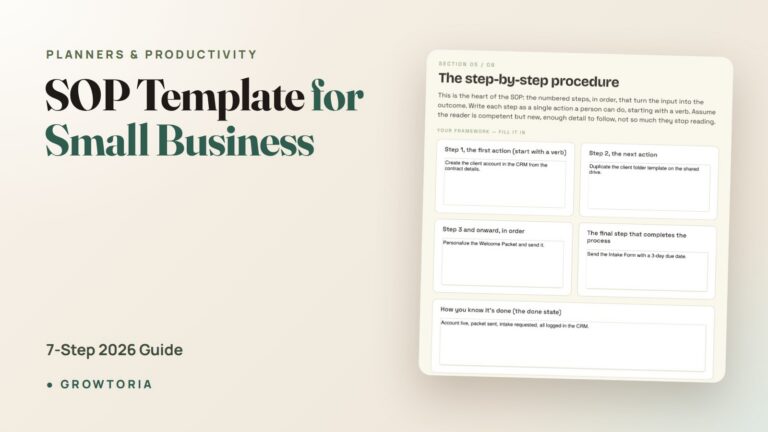
The Growtoria SOP Template for small business gives you an editable structure out of the box: header and revision block, scope, roles, numbered steps, checkpoints and a change log. To adapt it for production, add your safety/PPE block and tolerance fields from the table above, save it as your master manufacturing SOP template, and copy it for every new process.
Prefer to buy through Etsy? You can also grab it on our Etsy shop.
Frequently asked questions
What is the difference between an SOP and a work instruction in manufacturing?
An SOP describes a process at the level of what gets done, who does it and when. A work instruction gives the detailed, step-by-step how for one task at one workstation. Many small shops combine the two into a single document, which is fine as long as the steps stay specific.
Can I use one manufacturing SOP template for every process?
Yes, and you should. One template keeps the structure consistent across setups, inspections and maintenance, so operators always know where to find safety warnings and pass/fail criteria. The content changes from process to process, but the layout stays the same.
Who should write manufacturing SOPs?
The operator who does the job best should help write it, with a supervisor or quality lead editing and approving the result. Operators know the real sequence and shortcuts, and the approver makes sure it matches specs and safety rules.
How often should manufacturing SOPs be reviewed?
Review each SOP at least once a year. Also review it right away after a defect, a safety incident, an equipment change or a customer complaint linked to that process. Record every review in the revision log, even when nothing changes.
Start with the one process that causes the most scrap or the most questions on your floor. Write it with the template, test it on your newest operator, and laminate it at the machine. Once that one works, document the next process the same way.