Notion CRM for Founders: Build One in 30 Minutes
Every founder eventually hits the same wall: 40 leads in a spreadsheet, 12 conversations in Gmail, three warm intros in DMs, and no idea who to follow up with today. This is the exact moment a Notion CRM for founders stops being a nice-to-have and becomes the reason you close — or lose — your next five deals.
HubSpot is overkill. Attio and Folk are great tools, but you’ll pay $30–$80 per seat before you have any pipeline worth managing. A bare spreadsheet won’t survive contact with a real deal — you’ll lose context by week two. What you actually need is a lean, founder-grade Notion CRM that lives where you already work.
This guide walks you through the exact setup built and refined for solo founders and lean teams: the schema, the views, the automations, and the honest “stop using this” line.
Why a Notion CRM for founders beats HubSpot at <$1M ARR
You don’t have a sales team. You are the sales team. Which means your CRM needs to serve a fundamentally different use case than enterprise software is designed for. Most CRM platforms — as Wikipedia’s overview of customer relationship management explains — were architected around multi-person handoff chains: SDR to AE to CS manager. That’s not a solo founder’s reality.
Founders need:
- Context, not dashboards.
- Speed, not workflow builders.
- One place — the same place product notes, docs, and roadmaps already live.
HubSpot, Salesforce, and even Pipedrive are built for those handoffs. The friction of context-switching between five tools is what actually costs you deals. A well-configured Notion CRM for founders wins for one reason: it’s already where you think. Adding a CRM to the same workspace as your OKRs and product docs means you close a tab, not open a new one.
What a Notion CRM for founders should actually do
Strip it down. A founder-grade CRM has four jobs — and only four:
- Remember who — every person and company you’ve talked to, with enough context that “cold” never means starting from scratch.
- Remind you when — nudges for follow-ups so no warm lead goes silent for three weeks.
- Show what’s live — a pipeline view so you always know your top five deals this week.
- Log what happened — enough breadcrumbs to see what’s working (channel, message, offer) without over-engineering.
Anything beyond that — attribution reports, lead scoring, MEDDIC forms — is premature. Build it when you have a rep to hire, not before. The power of a Notion CRM for founders is ruthless simplicity: four databases, five views, and nothing you won’t actually fill in.
The database schema (build this first)
Four linked databases. Do not collapse them into one big “leads” table — you’ll regret it in month two when the same company sends three different people. Notion’s official guide to databases covers the mechanics if this is your first time.
1. Companies
- Name (title)
- Website (URL)
- Industry (select)
- Employee count (select: 1, 2–10, 11–50, 51–200, 200+)
- Source (select: outbound, inbound, referral, community, other)
- Status (select: prospect, in convo, customer, lost, dormant)
- Relation → Contacts
- Relation → Deals
- Notes (text)
2. Contacts
- Name (title)
- Role (text)
- Email (email)
- LinkedIn (URL)
- Relation → Company (add a rollup showing company status)
- Relation → Deals
- Last contact (date)
- Next action (text — one sentence)
- Next action date (date)
3. Deals
- Deal name (title — e.g. “Acme — annual plan”)
- Stage (select: new, discovery, proposal, negotiation, closed-won, closed-lost)
- Value (number, currency format)
- Close date (date)
- Relation → Company
- Relation → Contacts
- Loss reason (select — only filled if closed-lost)
4. Activity log
One row per meaningful touch — call, email sent, demo, proposal shared.
- Summary (title)
- Type (select: call, email, meeting, demo, DM, in-person)
- Date (date, defaults to today)
- Relation → Contact
- Relation → Deal
- Outcome (text)
That’s it. Countless articles will tell you to add 30 more properties. Don’t. Every extra field is another thing you won’t fill in, which turns every view into a half-empty, half-useless report. The best Notion CRM for founders is the one you actually open every morning — not the prettiest one on Twitter.
The five views you actually use
Views are where a Notion CRM stops being a database and starts being a workflow. Build these five and nothing else.
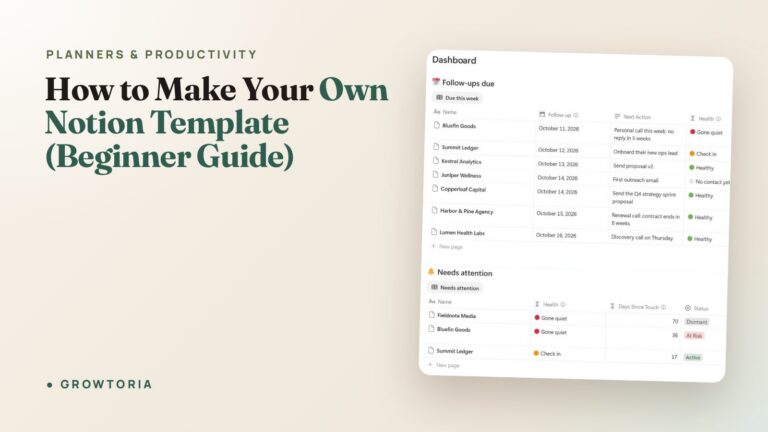
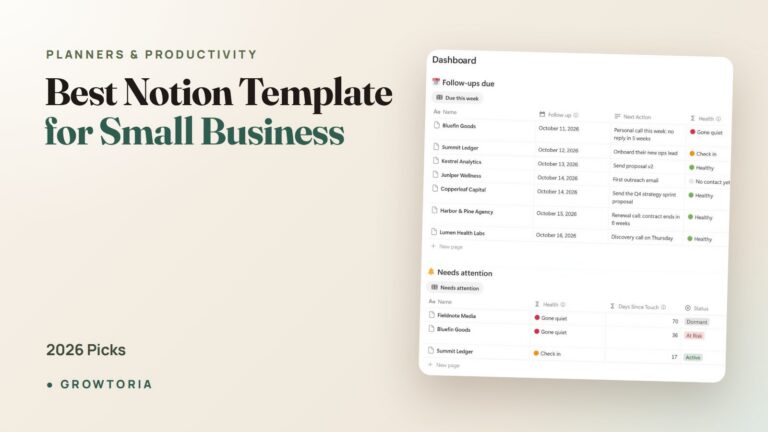
1. This week’s follow-ups (on Contacts)
Filter: Next action date is on or before today. Sort by date ascending. This is your morning tab. If it’s empty, you’re not prospecting enough.
2. Pipeline board (on Deals)
Board view, grouped by Stage. Hide columns for closed-won and closed-lost. Your at-a-glance view of everything live.
3. Top 5 this week (on Deals)
Table view, filter: Stage is proposal OR negotiation. Sort by Value descending, limit five. This is what you obsess over on Monday morning.
4. Dormant leads (on Contacts)
Filter: Last contact older than 30 days AND company status is “in convo”. Every Friday you either re-engage or archive. No middle ground.
5. Closed-lost postmortem (on Deals)
Filter: Stage = closed-lost. Group by Loss reason. Every quarter, spend 20 minutes here. This is where your ICP gets sharper and your pitch gets tighter. It’s the most underused view in any Notion CRM for founders setup — and the most valuable one over a 12-month horizon.
Notion CRM vs. dedicated CRM tools: an honest comparison
Here’s the market as it actually is in 2026, without the vendor spin. A Notion CRM for founders won’t win every category — but for the first $500K of ARR, it wins the only category that matters: consistent daily use by a founder who has seventeen other things competing for attention.
| Tool | Starts at | Best for | Setup time | Main weakness |
|---|---|---|---|---|
| Notion CRM (this guide) | $0 (Free plan works) | Solo founders, <$500k ARR | 30–60 min | No native email sync |
| HubSpot CRM | Free; paid from ~$20/seat/mo | Teams of 3+ needing reports | 4–8 hours | Bloat & upsell pressure |
| Attio | ~$34/seat/mo | VC-backed startups scaling sales | 2–4 hours | Overkill for solo |
| Folk | ~$25/seat/mo | Relationship-led founders | 1–2 hours | Weaker deal pipeline |
| Airtable | Free; paid from ~$20/seat/mo | Data-heavy operators | 1–3 hours | No docs alongside |
Every one of these tools is better than Notion at some job. None is better at all of them for a founder who’s also writing product docs, drafting a landing page, and building a hiring plan in the same afternoon.
Automations that make it feel alive
A static Notion CRM for founders is just a pretty spreadsheet. These four automations turn it into a system that actively surfaces what needs your attention — without you having to remember to look.
1. Auto-update “Last contact”
When a new row is created in Activity Log, push today’s date into the linked Contact’s Last contact field. Native Notion automations handle this on the Plus plan; on Free, use Make or Zapier. Build it once — it runs forever.
2. Email → Notion via Make
Trigger: new Gmail thread with the label “crm”. Action: create a row in Activity Log, match to Contact by email address, log the subject line into Outcome. Takes 15 minutes to build. Runs forever after that.
3. Slack alert when a deal moves to proposal
Post to your #wins channel (even if it’s just you). This is a deliberate dopamine loop — cheap and effective. Founders who celebrate small progress ship more of it.
4. Weekly pipeline digest
Every Monday at 8am, run a Make scenario that sums pipeline value by stage and posts it to Slack or your inbox. If you can’t see your pipeline on your phone, you don’t have a pipeline — you have a spreadsheet you avoid opening.
What to log (and what to skip)
Log these:
- First meaningful conversation with a lead
- Any demo, proposal, or pricing conversation
- Objections you heard (verbatim in the Outcome field — these are gold)
- Referrals given or received
- The specific reason a deal died
Skip these:
- Every email open
- Automated newsletter clicks
- LinkedIn profile views
- Every touchpoint from a nurture sequence
Founders don’t die from missing data. They die from data noise that hides the two conversations that actually matter. Keep your Notion CRM for founders signal-heavy and noise-free — that discipline is what separates a system you trust from one you eventually stop opening.
How to fill the pipeline (so the CRM has something to do)
A CRM without leads is a to-do list wearing a suit. If you’re staring at empty databases, the fix is upstream — you need consistent outbound and inbound motion. That’s a separate craft, and if you’d rather have someone else run it, our done-for-you lead generation pushes qualified conversations straight into your inbox — and, if you want, straight into this Notion setup.
When to graduate to a dedicated CRM
This Notion CRM for founders setup is not forever. Move off it when:
- You’ve hired a second person doing sales full-time. Notion’s permission model gets awkward for shared pipelines.
- You need multi-step email cadences with reply detection built in.
- You’re closing more than 30 net-new deals per month and manual logging is the bottleneck.
- Investors start asking for pipeline forecasts in a specific, structured format.
Before those triggers hit, a well-designed Notion CRM will outperform a half-configured HubSpot every single week — because adoption beats features at this stage of company building.
Where this fits in the Founder OS
The CRM databases above are one module inside Founder OS — the connected Notion workspace we ship to founders who want the entire operating system (CRM, content, GTM, product, hiring) working together from day one, with a library of AI prompts wired into each module. If you’d rather build the CRM standalone from this post, do it — the schema above is complete.
The one-hour build plan
If you want to actually ship this today, not “someday”:
- Minutes 0–15: Build the four databases with the properties above.
- Minutes 15–30: Create the five views. Don’t decorate — you’re not making a Dribbble shot.
- Minutes 30–45: Import your existing leads (CSV or manual for the top 20).
- Minutes 45–60: Log every conversation from the last 14 days into the Activity Log. This is the moment your Notion CRM for founders stops being empty theatre and starts being useful.
Do it today. Not tomorrow. The reason most CRMs fail isn’t tooling — it’s the two-week gap between “I set it up” and “I actually use it.” Close that gap now.
Frequently Asked Questions
Is Notion actually good enough as a CRM for founders?
For a solo founder or a team of two to three doing consultative sales, yes — comfortably. A Notion CRM for founders falls short if you need automated email sequences, dialer integrations, or board-ready forecasting reports. Below ~$1M ARR, “good enough and used daily” beats “perfect but abandoned in month two” every single time.
How do I sync email and calendar with my Notion CRM?
Notion doesn’t do it natively. Use Make or Zapier — trigger on a new Gmail thread or new calendar event, create a row in your Activity Log, and match to a Contact via email address. Budget 20 minutes to build. Runs forever after that. On the Notion Plus plan, native automations handle some of this without a third-party tool.
Can my whole team use this Notion CRM for founders?
Yes, with two caveats. First, you need at least the Notion Plus plan to get proper permission controls and database automations. Second, share the CRM at the workspace level, not the page level — otherwise new databases you add later won’t inherit access and you’ll field “why can’t I see this?” questions every week.
How is this standalone CRM different from Founder OS?
This post gives you the CRM in isolation. Founder OS gives you a CRM connected to your content pipeline, GTM plan, hiring tracker, and product roadmap — with AI prompts sitting on top of each module, so writing a proposal or a follow-up email is a two-click job, not a blank-page one.
If you’d rather skip the build entirely and start from a ready-made template with wired-in AI prompts, grab Founder OS, or book a strategy call and we’ll match the setup to your specific sales motion.