Cash Flow Issues for Small Businesses: Causes and Fixes
Cash flow issues for small businesses rarely start with a bad month. They start with a gap: the gap between when you pay for materials, wages and rent, and when your customers finally pay you. That is why a business can look profitable on paper and still struggle to make payroll on Friday.
This guide skips the theory. You will find the eight causes we see most often, the early warning signs for each, two simple numbers to track, and a 30-day plan to free up cash fast.
Quick answer: Most cash flow issues for small businesses come from timing, not profit: customers pay late, costs hit before revenue, growth ties up cash in stock or labor, and owners lack a forward forecast. Fix them by invoicing faster, shortening payment terms, building a cash buffer, and forecasting 13 weeks ahead.
What causes cash flow issues for small businesses?
The root cause is almost always a mismatch between cash going out and cash coming in. Uneven cash flow consistently ranks among the top financial challenges owners report in the Federal Reserve’s Small Business Credit Survey, ahead of many issues that get far more attention. Here are the eight patterns behind it.
1. Customers pay late (or slower than your terms)
Your invoice says net-30, but the average customer actually pays on day 50. Meanwhile, your own bills arrive on time. Every late invoice is effectively an interest-free loan you are giving your client.
2. Profit is not the same as cash
Your profit and loss statement records a sale the day you invoice it. Your bank account records it the day the money lands. In addition, loan principal, equipment purchases and owner draws reduce cash without showing up as expenses, so a “profitable” month can still drain the account.
3. Growing faster than your cash can support
Growth is expensive before it is profitable. A new contract means hiring, buying stock or materials, and working for weeks before the first payment arrives. Accountants call this overtrading, and it sinks healthy businesses every year.
4. Seasonal swings
Landscapers, retailers, tax preparers and wedding vendors all earn most of their revenue in a few months. However, rent, insurance and software subscriptions are due every month of the year. Without a plan, the slow season eats the busy season’s profit.
5. Lumpy annual and quarterly bills
Annual insurance premiums, software renewals, license fees and quarterly estimated taxes are easy to forget because they do not hit every month. When three of them land in the same week, the account suddenly runs dry.
6. Prices that are too low
Thin margins leave no room for a single late payment. If you are not sure what you keep from each sale, run your numbers through our free small business profit margin calculator, then check how many sales you need each month with the free break-even calculator.
7. Personal and business money mixed together
When the owner pays personal bills from the business account (or vice versa), nobody knows the real cash position. As a result, decisions get made on a balance that is not actually available.
8. No forward-looking forecast
Most owners look at the bank balance, which tells you about the past. A forecast tells you about the next 90 days. Without one, a shortfall is only visible when it has already happened.
Cash flow problems at a glance: signs and first fixes
Use this table as a quick diagnostic. Find the warning sign you recognise, then start with the first fix in the same row.
| Cause | Early warning sign | First fix | Typical time to impact |
|---|---|---|---|
| Late-paying customers | Receivables growing faster than sales | Same-day invoicing, deposits, card payments | 1-3 weeks |
| Profit is not cash | Profitable P&L, shrinking bank balance | Reconcile monthly, track cash separately from profit | 1 month |
| Growing too fast | Big new orders, borrowing to fund them | Upfront deposits, staged billing on large jobs | Next contract |
| Seasonality | Same months tight every year | Set aside a % of peak revenue in a reserve account | 1 season |
| Lumpy annual bills | “Surprise” bills you have paid before | Switch to monthly billing or accrue monthly | 1-2 months |
| Underpricing | Busy all month, little left over | Raise prices on new work, add minimum charges | 1-3 months |
| Mixed finances | You cannot state your cash position quickly | Separate accounts, fixed owner pay | 1 week |
| No forecast | Shortfalls discovered on the due date | Build a rolling 13-week forecast | Immediate visibility |
How do you know if your business has a cash flow problem?
You have a cash flow problem if you regularly delay your own bills, skip your pay, or move money around to cover payroll. To catch it earlier, track two numbers every month.
Days sales outstanding (DSO)
DSO tells you how long, on average, customers take to pay. The formula is simple:
- DSO = (accounts receivable ÷ revenue for the period) × days in the period
For example, if you have $40,000 unpaid and billed $60,000 over the last 90 days, your DSO is 60 days. If your terms are net-30, customers are paying twice as slowly as agreed, and that gap is your cash problem.
Cash buffer days
Buffer days tell you how long you could keep operating if no money came in. Divide your cash balance by your average daily outgoings. For context, a widely cited JPMorgan Chase Institute study found the median small business held only about 27 days of cash buffer. Therefore, a single late client can push many firms into a crisis.
Other red flags
- You check the bank balance before approving every purchase.
- Your overdraft or credit card balance never returns to zero.
- You offer discounts just to get paid sooner.
- Estimated tax payments feel like an emergency each quarter.
How to fix cash flow issues for small businesses in 30 days
The fastest fixes speed up money coming in; the slower ones reshape money going out. Work through this plan one week at a time rather than trying everything at once.
Week 1: Collect what you are already owed
- List every unpaid invoice with its age (0-30, 31-60, 61+ days).
- Call, do not just email, every customer more than 30 days late.
- Invoice new work the same day it is done. Our free invoice template for small business walks through what to include so invoices do not bounce back.
- Add a clear due date, not just “net-30”, to every invoice.
Week 2: Change your payment terms
- Ask for a 30-50% deposit on any job over a set amount.
- Bill large projects in stages (start, midpoint, completion).
- Move new customers to net-14 or due-on-receipt.
- Accept card and bank transfer; the processing fee is usually cheaper than waiting 40 extra days.
- State a late fee in your contract, and actually apply it.
Week 3: Reshape your outgoings
- List every annual or quarterly bill and its due month.
- Ask suppliers for net-45 or net-60 terms; many say yes to reliable payers.
- Cancel subscriptions nobody opened in the last 60 days.
- Open a separate tax account and move a fixed percentage of every payment into it.
- Pay yourself a fixed amount on a fixed date instead of ad-hoc draws.
Week 4: Build a forecast and a buffer
Next, set up a rolling 13-week cash forecast: opening balance, expected receipts by week, expected payments by week, closing balance. Then set a buffer target. A practical starting point is one full payroll cycle plus one month of fixed costs, growing toward three months over time.
The U.S. Small Business Administration’s finance guide is a useful companion if you also need to separate accounts or understand the basic statements.
Should you borrow to fix a cash flow problem?
Borrow only to cover a timing gap, never to cover ongoing losses. A business line of credit works well when you know exactly when the money is coming back, for example a confirmed contract paying in 45 days or a predictable seasonal peak.
However, if the forecast shows you spending more than you earn month after month, debt only delays the problem and adds interest. In that case, the fix is pricing, costs or volume, not financing.
Quick decision rule
- Short gap, known repayment date: a line of credit or invoice financing can make sense.
- Recurring monthly deficit: fix margins first; revisit your prices and fixed costs.
- One-off large purchase: match the loan term to the asset’s useful life.
How a 12-month forecast prevents the next cash crunch
A forecast turns cash flow from a surprise into a schedule. Once you can see that March and August are tight, you can collect deposits earlier, delay a purchase, or arrange credit months before you need it, which is when lenders say yes most easily.
If you would rather not build the formulas yourself, our 12-Month Cash Flow Forecast Spreadsheet is the done-for-you shortcut. It works in Google Sheets and Excel: you enter expected income and expenses by month, and it shows your projected closing balance and runway so the lean months stand out immediately. You can also grab it on our Etsy shop if you prefer to buy there.
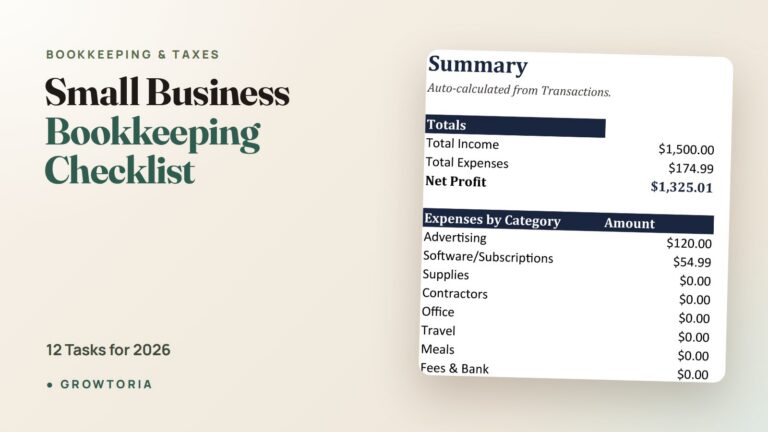
For a step-by-step walkthrough of setting up the sheet itself, read our small business cash flow template guide. Keep in mind that any forecast is only as accurate as the books behind it, so pair it with the routine in our small business bookkeeping checklist or the lighter 30-minute weekly DIY bookkeeping method.
Frequently asked questions
What is the most common cash flow problem for small businesses?
Late customer payments are the most common problem. When customers take 50-60 days to pay on 30-day terms, you end up funding their business with your cash. Deposits, staged billing and same-day invoicing are the quickest ways to close that gap.
Can a profitable business run out of cash?
Yes, and it happens often. Profit counts sales when they are invoiced, while cash counts them when they are paid. Fast growth, slow-paying clients, loan repayments and stock purchases can all drain cash from a business that is profitable on paper.
How much cash should a small business keep on hand?
Aim for at least one payroll cycle plus one month of fixed costs, then build toward three to six months of operating expenses. Seasonal businesses should hold more, sized to cover the longest slow stretch in their year.
How often should I update my cash flow forecast?
Update it weekly while cash is tight and monthly once things stabilise. Each update, replace forecast figures with actual results, then roll the forecast forward so you always see at least the next 13 weeks.
Start with the gap, not the balance
Cash flow issues for small businesses are rarely solved by working harder. Instead, they are solved by shrinking the gap between paying out and getting paid, and by seeing shortfalls before they arrive. Start this week: list your receivables, call the late ones, and put your next 12 months into the cash flow forecast spreadsheet so the next tight month is a line on a sheet, not a surprise.