How Much Does Small Business Bookkeeping Cost in 2026?
How much does small business bookkeeping cost? It depends on who does the work. You can spend almost nothing doing it yourself, or a few thousand dollars a month on a full-service firm. Most small businesses end up somewhere in between. This guide gives you realistic 2026 price ranges, explains what pushes your quote up or down, and walks you through estimating your own number in about ten minutes.
Quick answer: Most small businesses pay $0–$100 a month doing their own bookkeeping with a spreadsheet or software, $200–$600 a month for a freelance bookkeeper, and $300–$2,500+ a month for an online service or local firm. Catch-up work on books that have fallen behind usually costs $500–$5,000 as a one-off.
How much does small business bookkeeping cost in 2026?
For a typical small business with under 200 transactions a month, expect to pay roughly $250–$600 a month to outsource it. If you do it yourself, the cost is mostly your time. The table below compares the main options side by side.
| Option | Typical cost (2026) | Your time per month | Best for |
|---|---|---|---|
| DIY with a spreadsheet or one-time-purchase app | $0–$50 one-time | 2–4 hours | Sole traders, freelancers, side businesses |
| DIY with subscription accounting software | About $20–$100+ per month | 2–4 hours | Businesses that want bank feeds and automation |
| Freelance bookkeeper | $25–$75 per hour, often $200–$600 per month | 30–60 minutes | Growing businesses with steady volume |
| Online bookkeeping service | About $300–$800 per month | 30–60 minutes | Owners who want a fixed monthly fee |
| Local bookkeeping or CPA firm | About $500–$2,500+ per month | Under 30 minutes | Payroll, inventory, multiple entities |
| Catch-up or clean-up bookkeeping | $500–$5,000+ one-off | A few hours of handover | Books that are months behind |
For context, the U.S. Bureau of Labor Statistics puts the median pay for bookkeeping, accounting and auditing clerks at a little over $23 an hour. Freelancers and firms charge more than that because their rate also covers overhead, software, insurance and profit.
What makes bookkeeping cost more or less?
Volume and complexity drive the price. Two businesses with the same revenue can get very different quotes depending on how many transactions they have and how tidy their records are.
Number of transactions
Most bookkeepers price by monthly transaction count. A business with 50 transactions a month might pay $200. One with 400 might pay $600 or more. Before you ask for quotes, count last month’s bank and card transactions.
Number of accounts
Every bank account, credit card, PayPal, Stripe or Square account needs reconciling each month. Each extra account adds time, and often adds $25–$75 a month to the quote.
Payroll, inventory and sales tax
These are the three biggest add-ons:
- Payroll: often billed per employee, or as a separate monthly fee.
- Inventory: tracking cost of goods sold takes much more work than service-only books.
- Sales tax or VAT filings: selling in several states or countries adds recurring compliance work.
The state of your books
Messy books cost money twice. First you pay for catch-up work to get everything up to date. Then a disorganised business usually pays a higher monthly rate too, because every month takes longer.
Hourly, monthly or per-transaction: which pricing model is best?
A fixed monthly fee is usually best for steady businesses, and hourly suits low or seasonal volume. Here is how each model works in practice:
- Hourly ($25–$75+): common with freelancers. It’s fair when volume is low, but your bill can creep up if your records arrive late or incomplete.
- Fixed monthly package: common with online services and firms. You can budget for it, but read the transaction cap carefully, because going over it often triggers an upgrade.
- Per-transaction or tiered: the price is tied to volume bands such as 0–100, 101–250 and 251–500. It’s predictable as long as you know your volume.
Whichever model you pick, ask exactly what’s included. Does the fee cover month-end reconciliation, a profit and loss report, sales tax prep and year-end handover to your accountant? “Bookkeeping” means different things to different providers.
How to estimate your own bookkeeping cost
You can estimate your number before talking to anyone. Grab last month’s bank statements and work through these steps:
- Count transactions. Add up every line across all business bank, card and payment-processor accounts.
- Estimate time. An experienced bookkeeper categorises and reconciles roughly 60–100 clean transactions an hour. Budget more time if your receipts are scattered.
- Add month-end work. Allow 1–2 hours for reconciliation and reports.
- Multiply by a rate. Use $40–$60 an hour as a realistic mid-market rate.
- Add extras. Include payroll, sales tax and any catch-up work.
Worked example: a cleaning business with 150 transactions a month across two accounts. That’s about 2 hours of categorising plus 1.5 hours of month-end work, so 3.5 hours × $50 = $175 a month. A firm with a $300 minimum would charge $300 instead. Doing it yourself would take about 4 hours of your own time.
What does DIY bookkeeping really cost you?
DIY bookkeeping is cheap in cash and expensive in time. Expect 2–4 hours a month if you keep up with it weekly, and much more if you leave it until tax season.
To decide honestly, put a price on your own hours. If you bill clients $60 an hour and bookkeeping takes you 4 hours, DIY “costs” $240 a month in lost income. That only counts if you would actually fill those hours with paid work, though. Many owners do their books in the evening, when the real cost is close to zero.
There’s also the cost of mistakes. Common examples are missed deductions, wrongly categorised expenses and unreconciled accounts. The IRS recordkeeping guidance is clear that you need records that support every income and deduction figure you report. If you go the DIY route, follow a routine. Our small business bookkeeping checklist lays out exactly which tasks to do and when.
When is DIY bookkeeping the smarter choice?
DIY makes sense when you have fewer than about 100 transactions a month, no employees, little or no inventory, and one or two accounts. Most freelancers, makers and new service businesses fit that description.
The trick is to cut the software bill along with the bookkeeper’s fee. Subscription accounting tools can add up to $300–$1,200 a year, and the price usually rises as you add features. Here are three options that do the job without a monthly fee:
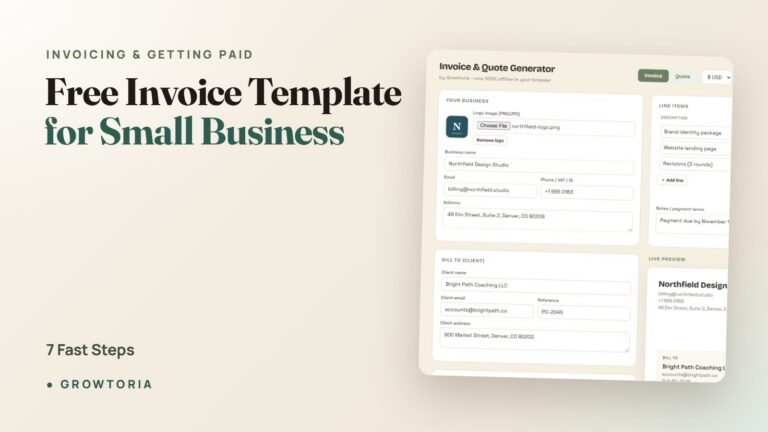
- All-in-one: the Growtoria Business Suite combines invoices, quotes, accounting, payroll, VAT and a simple CRM in one offline app with no subscription. It suits owners who would otherwise pay for three or four separate tools.
- Expense and income tracking: the Small Business Expense Tracker is a connected Google Sheets and Excel file that sorts your spending into categories and builds a tax-ready summary as you go.
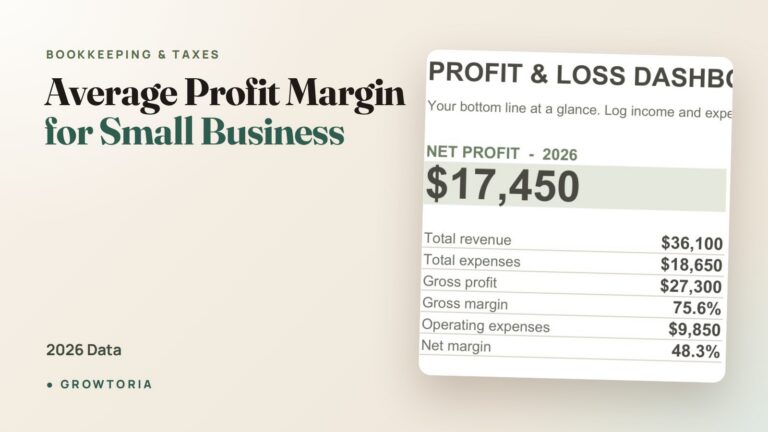
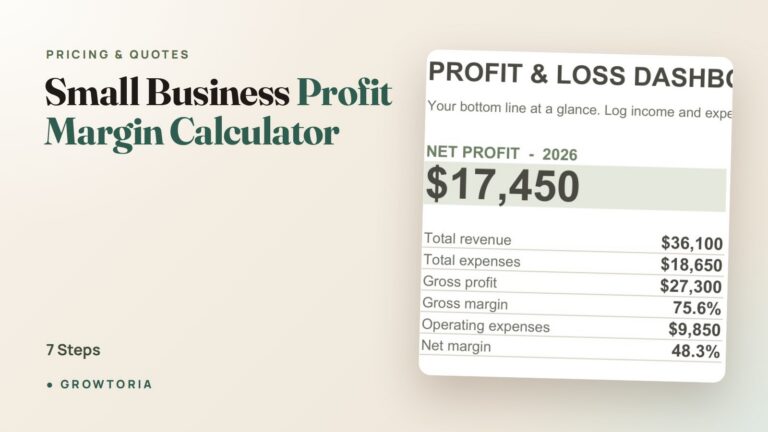
- Monthly results: the Small Business Profit Loss Statement spreadsheet shows whether you actually made money each month. It’s the one report every bookkeeper would hand you anyway.
If you prefer buying templates there, you can also grab them on our Etsy shop. Want to see how offline tools compare with cloud subscriptions? Read our breakdown of small business software that works offline. For the weekly routine itself, see DIY bookkeeping for small business in 30 minutes a week.
When should you pay for a bookkeeper?
Pay for help when bookkeeping time starts costing more than the bookkeeper would, or when mistakes start to get expensive. Watch for these signs:
- You’re regularly more than a month behind on reconciliation.
- You’ve hired your first employee and need to run payroll.
- You hold inventory or sell across several platforms and states.
- Your accountant charges you extra at tax time to clean up your records.
- You’re applying for a loan or lease and need lender-ready financials.
A hybrid setup often works best. You record transactions yourself in a tidy system, and a bookkeeper reviews and reconciles them quarterly. That can bring a $400 monthly bill down to around $150–$250 a quarter.
How can you lower your bookkeeping costs?
Clean inputs are the fastest way to a lower bill. Bookkeepers charge for time, and most of that time goes into chasing missing information. These habits keep it down:
- Separate business and personal accounts. Mixed accounts are the single biggest time sink.
- Use consistent categories. Agree on a fixed list up front. Our guide to bookkeeping categories for small business covers the 15 to track.
- Capture receipts weekly. Photograph them and file them by month.
- Close fewer accounts each month. Combine payment processors where you can.
- Negotiate on volume, not price. Ask what it would take to move down a pricing tier.
Frequently asked questions
How much does a bookkeeper charge per hour?
Most freelance bookkeepers in the US charge $25–$75 an hour. Certified or highly experienced bookkeepers in large cities can charge $80–$100 or more. Firms usually quote monthly packages rather than hourly rates.
Is $500 a month too much for bookkeeping?
Not if you have 200+ transactions a month, payroll, or inventory. In that case $500 is a normal market rate. For a solo service business with 50 transactions and no staff, it’s on the high side, and DIY or a part-time freelancer will usually cost far less.
Can I do my own small business bookkeeping?
Yes. Many small business owners do their own books successfully, especially with low transaction volume and simple finances. You need a consistent weekly routine, a reliable expense and income tracker, and a monthly profit and loss review. Most owners still hire an accountant for the tax return itself.
Is bookkeeping a tax-deductible expense?
Generally, yes. Bookkeeping fees and the software you use to run your business are usually deductible as ordinary and necessary business expenses. Rules vary by country and business structure, so confirm the details with your tax professional.
How much does small business bookkeeping cost compared with an accountant?
Bookkeeping is the cheaper, recurring part of the job: $200–$600 a month for most small businesses. Accountants and CPAs usually charge more per hour and focus on tax returns, planning and advice. Many businesses use a bookkeeper monthly and an accountant once or twice a year.
The bottom line
Your bookkeeping cost comes down to three things: transaction volume, complexity, and what your time is worth. Run the five-step estimate above, compare the result with two or three real quotes, and pick the cheapest option that keeps your records accurate every month.
If DIY wins for now, start with a system you own outright, like the Growtoria Business Suite. When your volume grows, hand over clean books, and you’ll pay a bookkeeper far less to take them on.