DIY Bookkeeping for Small Business: 30 Minutes a Week
DIY bookkeeping for small business comes down to one habit: recording every dollar in and out, in the same place, on the same day each week. You don’t need an accounting degree or a $90-a-month subscription. What you need is a simple system you will actually stick to, and a clear point where you hand the hard parts to a professional.
This guide covers that system. It includes the tools to choose, the weekly 30-minute routine, what doing it yourself really costs, and the warning signs that it’s time to get help.
Quick answer: DIY bookkeeping for small business means tracking your own income and expenses instead of paying a bookkeeper. Open a separate business bank account, log every transaction weekly in a spreadsheet or offline app, sort each one into a category, reconcile against your bank statement monthly, and review a profit and loss report each month.
Is DIY bookkeeping for small business actually a good idea?
Yes, for most businesses with simple finances. That usually means one owner, no employees or only a few contractors, under a few hundred transactions a month, and no inventory to count. In that case, doing it yourself saves a few hundred dollars a month. It also teaches you where your money really goes.
However, it stops being a good idea when your time is worth more than the fee, or when mistakes start costing more than help would. Payroll, sales tax across several states, and inventory accounting are the three areas where DIY owners most often get into trouble.
Who DIY bookkeeping works best for
- Freelancers and consultants who invoice a handful of clients a month.
- Service businesses such as cleaners, lawn care, detailers and tutors, with mostly simple expenses.
- Makers and online sellers in their first year or two, before inventory gets complicated.
- Side businesses where the owner wants clean records for tax time and nothing more.
Who should hire help sooner
- Businesses that run payroll for W-2 employees.
- Anyone collecting sales tax in more than one state.
- Businesses with loans, investors or a lender asking for accrual-basis financial statements.
What do you need before you start doing your own books?
You need four things: a separate business bank account, a place to record transactions, a list of categories, and a way to store receipts. Set these up once and the weekly work becomes routine.
- A separate business account. This is the single biggest time-saver. Mixing personal and business spending is what turns a 30-minute task into a weekend of detective work.
- One place to record everything. That can be a spreadsheet, an offline app or cloud software. Pick one and don’t spread records across three tools.
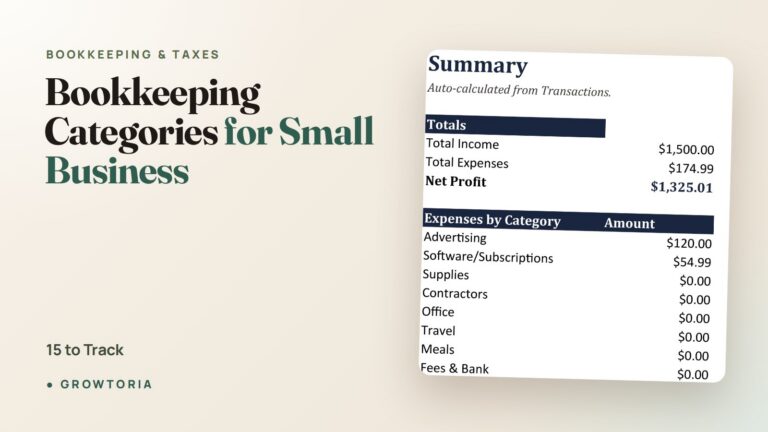
- A fixed category list. Use categories that match your tax return, so year-end is a copy-and-paste job. Our guide to bookkeeping categories for small business lists the 15 most owners need.
- A receipt folder. A phone scan saved to a dated cloud folder is enough. The IRS explains what counts as proof in its official recordkeeping guidance.
Which tool should you use for DIY bookkeeping?
Use the simplest tool that covers your transactions. For most solo owners that means a well-built spreadsheet or an offline app. Subscription accounting software only pays for itself once you need bank feeds, payroll or a shared login with an accountant.
Here’s how the main options compare for someone doing the work themselves:
| Option | Typical cost | Weekly time | Best for | Main trade-off |
|---|---|---|---|---|
| Spreadsheet (Google Sheets / Excel) | One-time template cost, or free if you build it | 20–40 min | Freelancers, side businesses, under ~150 transactions/month | Manual entry; no bank sync |
| Offline all-in-one app | One-time purchase, no subscription | 20–30 min | Service businesses that also send invoices and quotes | No automatic bank feed |
| Cloud accounting software | Roughly $30–$100+ per month, depending on plan | 15–30 min | Higher volume, payroll, accountant access | Ongoing cost; feature creep |
| Part-time bookkeeper | Often $300–$800+ per month | 5–10 min (sending documents) | Payroll, multi-state tax, inventory | Highest cost; you still need to review the numbers |
When a spreadsheet is enough
A spreadsheet is enough when you can type in a week’s transactions in a single sitting. If you’d rather not build the formulas yourself, the Small Business Expense Tracker is a ready-made Google Sheets file. It logs income and expenses by category and shows your running totals, so you can start recording on day one.
When an all-in-one app makes more sense
If you also send invoices and quotes, keeping them in one tool and your books in another means typing everything twice. The Growtoria Business Suite handles invoices, quotes, accounting, payroll, VAT and a client list in one offline file, with no monthly fee. We explain why offline tools are worth considering in small business software that works 100% offline.
How do you do DIY bookkeeping for small business each week?
Block 30 minutes on the same day every week, then work through these five steps in order. Consistency matters far more than speed. A week’s worth of transactions takes minutes, while three months’ worth takes a whole weekend.
- Download or open your bank and card transactions for the past seven days.
- Record each one with its date, amount, payee and category. Then add a short note on anything unusual, for example “client lunch – Acme project.”
- Match receipts. Scan any paper receipt and save it with the date and amount in the file name, e.g. 2026-10-14_staples_42.18.pdf.
- Update invoices. Mark paid invoices as paid and flag anything more than 14 days overdue so you can follow up. If your invoices are still ad hoc, start with our free invoice template for small business.
- Check the balance. Your recorded closing balance should match the bank. If it doesn’t, find the gap now while the week is still fresh.
What to do once a month
- Reconcile each account against the official statement, line by line.
- Run a profit and loss report and compare it to the previous month.
- Set aside tax money. Many self-employed owners move 25–30% of profit into a separate savings account. Your accountant can refine that figure.
For the full list of monthly, quarterly and year-end tasks, use our small business bookkeeping checklist. This article covers how to run the system, and the checklist covers what to tick off.
How do you read your numbers once the books are done?
Start with your monthly profit and loss statement. It answers the only question that really matters: did the business make money this month? Revenue minus expenses equals profit, and every other number you track is detail behind that one.
A clean P&L also shows trends a bank balance hides. For example, you might see a supply cost creeping up 10% a quarter, or a client who pays late every single month. The Small Business Profit Loss Statement spreadsheet builds that monthly view automatically from your categories, so the review takes five minutes instead of an hour.
Next, check your margin. Paste your monthly revenue and costs into our free profit margin calculator. If the margin is shrinking while revenue grows, your pricing needs attention before your bookkeeping does.
What does DIY bookkeeping really cost?
The cash cost is low, usually a one-time template or app purchase, or around $30–$100 a month for software. The real cost is your time: about 2–3 hours a month for a simple business, plus a few extra hours at year-end.
To decide whether that’s worth it, put a price on your hour:
- If you bill clients $75 an hour, 3 hours of bookkeeping “costs” $225 a month.
- A part-time bookkeeper for a small business often charges $300 or more a month.
- If the difference is small and you dislike the work, hiring out is a reasonable choice. If you’re early-stage and cash is tight, DIY usually wins.
One cost people forget is the cleanup. A bookkeeper hired in March to reconstruct a messy year often charges more than a year of light monthly help would have. Doing the work yourself is only cheap if you keep up with it.
What are the most common DIY bookkeeping mistakes?
The most common mistake is mixing personal and business money. The close runners-up are skipping reconciliation and leaving receipts until tax season. Each of these is cheap to prevent and expensive to fix later.
- Mixing accounts. A single business card and account solves 80% of the headaches.
- Recording deposits as income twice. Watch out when a client payment shows up in your payment processor and then again as a bank deposit.
- Treating owner draws as expenses. Money you pay yourself as a sole proprietor isn’t a deductible expense.
- Losing receipts. The IRS generally expects you to keep records for at least three years, and longer in some cases. See how long to keep records.
- Ignoring sales tax. If you collect it, record it as a liability, not income. Our free sales tax calculator by state helps you check rates.
When should you stop DIY bookkeeping and hire someone?
Hire help when bookkeeping regularly takes more than 4–5 hours a month, when you add W-2 payroll, or when you fall more than two months behind. These are signs the system has outgrown a solo owner, not signs you failed.
Many owners use a hybrid model. They keep doing the weekly entries themselves and pay an accountant once a year for tax filing and a quick review. That keeps the professional fee small, because your records arrive clean and already categorized.
If you sell on Etsy, the platform fees and shipping make categorizing trickier. Our Etsy shop bookkeeping spreadsheet guide walks through that setup.
Frequently asked questions
Can I do my own bookkeeping for my small business?
Yes. Most sole proprietors and single-owner LLCs with simple finances can do their own bookkeeping. Use a separate bank account, record transactions weekly, reconcile monthly, and have an accountant review your year-end numbers before you file.
Is Excel or Google Sheets good enough for bookkeeping?
For a business with up to roughly 150 transactions a month and no payroll, yes. A spreadsheet with fixed categories and built-in totals gives you everything you need for a profit and loss report and tax prep. Move to an app or software once volume or payroll makes manual entry painful.
How many hours a month does DIY bookkeeping take?
For a simple service business, plan on 2–3 hours a month: about 30 minutes a week plus a short monthly review. Expect a few extra hours at year-end to gather everything for your tax return.
Do I still need an accountant if I do my own bookkeeping?
Usually yes, at least once a year. Bookkeeping means recording the numbers, while an accountant interprets them, files your return and spots deductions or errors. Clean DIY books make that annual visit faster and cheaper.
Start your DIY bookkeeping system this week
Pick your tool, set up your categories and block 30 minutes in your calendar for the same day every week. That’s the whole system. The tool matters far less than the routine.
If you’d like a head start, choose one of these: the expense tracker spreadsheet for simple income and expense logging, the profit and loss spreadsheet for monthly reviews, or the Business Suite app if you want invoicing and accounting in one place. Prefer to shop elsewhere? You can also grab our templates on the Growtoria Etsy shop.