How to Price Handmade Products: The 4-Part Formula
Underpricing is the number one killer of handmade businesses. If you’ve ever sold a beautiful piece for $18 and walked away feeling broke, this guide is for you. Learning how to price handmade products is the difference between a paying hobby and a real business — and the math is simpler than most makers think.
This is the exact framework we use inside our pricing calculators to help candle makers, jewelers, crocheters, potters, and bakers stop guessing. No fluff, no “charge your worth” clichés. Just numbers you can plug in this afternoon. Whether you’re repricing a single bestseller or overhauling an entire catalog, getting how to price handmade products right is the single highest-leverage move you can make for your shop’s long-term survival.
Why most makers underprice (and quietly lose money)
Most handmade sellers price by scrolling Etsy, finding a similar item, and shaving a few dollars off. That’s not pricing — that’s a race to the bottom. And it hides three costs that bankrupt small shops without warning.
- Labor is invisible. You “don’t count” your own time because it feels like a hobby.
- Overhead is forgotten. Marketplace fees, packaging, shipping supplies, software, camera, ads — none of it lands in the sticker price.
- Profit isn’t a line item. If profit isn’t baked in on purpose, there is none.
There’s also a psychological trap at play. Makers often assume that “fair” prices will drive away buyers, so they self-censor before the market ever gets a chance to respond. In reality, price anchoring and clear value communication matter far more than being the cheapest option in a category — which is why the formula below focuses on what you need to earn, not what a competitor decided to charge.
On a platform like Etsy, a single $30 sale can lose more than $4 to listing fees, transaction fees, payment processing, and offsite ads. Multiply that across a year of sales and you’re funding the marketplace, not your business.
The real formula for how to price handmade products
Here is the formula every handmade business should start with. It fits on a sticky note, but it will change your margins forever.
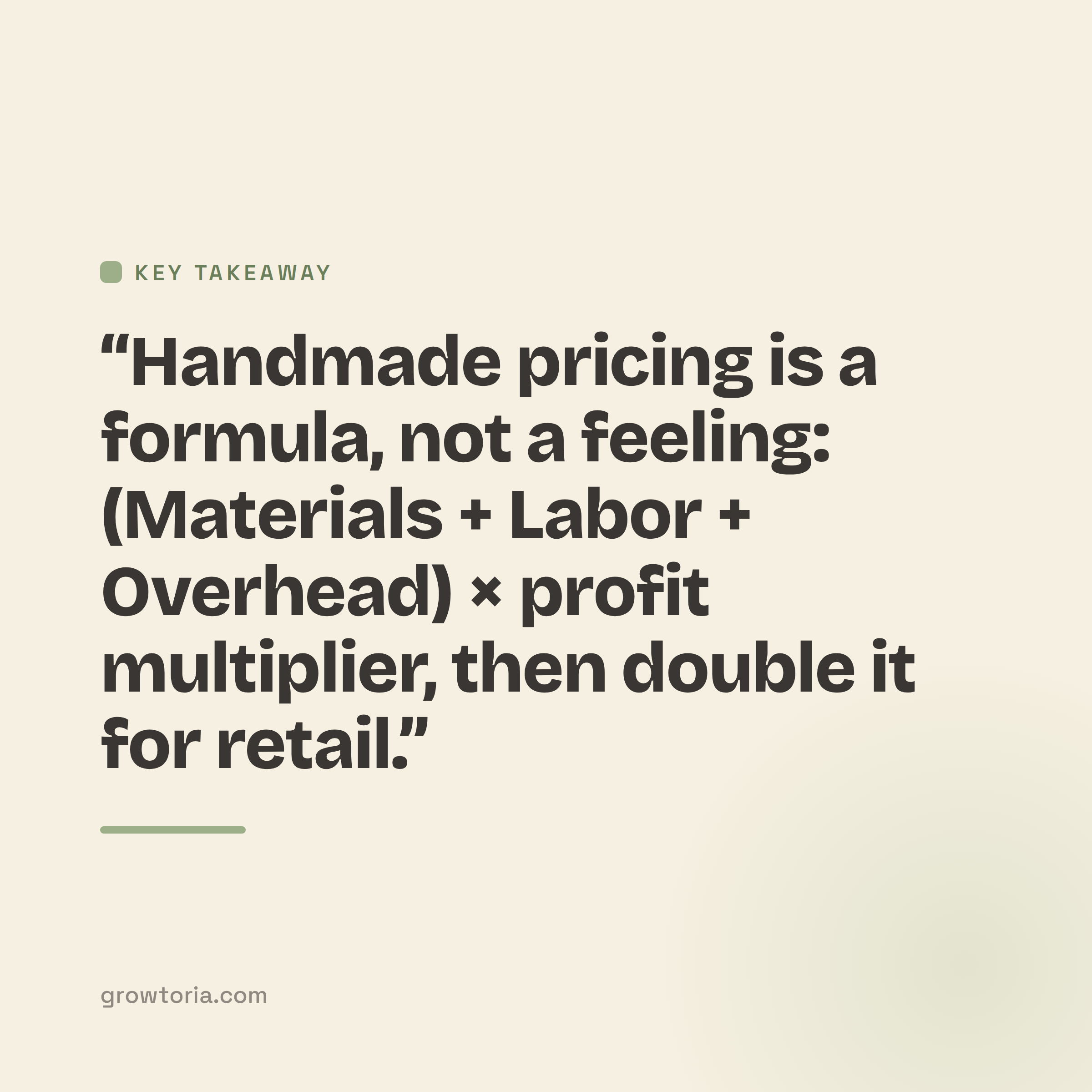
Wholesale price = (Materials + Labor + Overhead) × Profit multiplier
Retail price = Wholesale × 2 to 2.5
This is a form of cost-plus pricing — the most transparent and defensible method for handmade sellers. Four inputs. That’s it. Let’s break each one down so you can reprice your next batch tonight.
1. Materials cost (down to the drop of glue)
Weigh, measure, and count every input that goes into one unit. A candle isn’t just wax — it’s wax, wick, fragrance oil, dye, jar, warning label, and box. If a $40 bag of wax yields 20 candles, your wax cost per candle is $2.
Round up, not down. If you’re spending $0.83 in materials, log $1. Tiny rounding covers waste, spoilage, and the mystery costs you always forget.
2. Labor cost (pay yourself first)
Pick an hourly rate and stick to it. Most makers should start between $20 and $40 an hour depending on skill and location. Then time yourself making one unit — including packing and admin — and multiply.
If a pair of earrings takes 30 minutes and you value your time at $25 an hour, that’s $12.50 in labor per pair. If that feels absurdly high, your pricing was absurdly low.
3. Overhead (the invisible tax on every sale)
Overhead is everything you spend to run the shop that isn’t in the product itself: marketplace fees, payment processing, packaging, shipping labels, subscriptions like Canva or QuickBooks, studio rent, insurance, and marketing.
Estimate total monthly overhead and divide by units sold per month. If you spend $400 a month running the shop and ship 100 items, add $4 in overhead per unit. Done.
4. Profit multiplier (this is not optional)
Once you’ve added materials + labor + overhead, that’s your cost, not your price. Multiply by 1.3 to 2.0 to get your wholesale price. That 30–100% margin is real profit — the money that funds new tools, ads, savings, and paying yourself a raise next year.
5. Retail vs wholesale (build both, every time)
Even if you never sell to a boutique, calculate retail as roughly 2× wholesale. This keeps the door open for wholesale accounts later and protects your retail customers from feeling cheated when a shop starts carrying your work.
Choosing the right profit multiplier for your craft
Not every product deserves the same multiplier. The right number depends on your market position, production volume, and competitive pressure in your niche. Here’s a practical guide:
- 1.3× — Use only when you’re in a price-sensitive market and overhead is already very low. This is a survival multiplier, not a growth one.
- 1.5× — A solid default for most handmade sellers. Covers unexpected costs and creates a small reinvestment reserve.
- 1.75× to 2.0× — Appropriate for limited-edition work, custom orders, or products with a long lead time. Accounts for revision rounds and specialty materials sourcing.
- 2.0×+ — Reserved for high-skill, one-of-a-kind pieces — fine jewelry, original paintings, hand-thrown pottery — where the artist’s reputation commands a genuine premium.
A useful market signal: if your products sell out within 48 hours of listing, you’re almost certainly using too low a multiplier. Rapid sell-out speed is the market telling you to charge more.
Sample pricing at a glance
Here’s what the formula looks like across four common handmade products, using a $25/hour labor rate and a 1.5× profit multiplier:
| Product | Materials | Labor | Overhead | Wholesale (×1.5) | Retail (×2) |
|---|---|---|---|---|---|
| 8oz soy candle | $4.00 | $12.50 (30 min) | $3.00 | $29.25 | $58.50 |
| Silver hoop earrings | $6.00 | $12.50 (30 min) | $2.00 | $30.75 | $61.50 |
| Crochet baby blanket | $18.00 | $100.00 (4 hrs) | $5.00 | $184.50 | $369.00 |
| Custom layer cake | $22.00 | $75.00 (3 hrs) | $8.00 | $157.50 | $315.00 |
Notice something? The crochet blanket most makers sell for $65 is actually a $369 retail item. That’s not greed — that’s what the math says a fair wage looks like for four hours of skilled work.
A step-by-step example: pricing an 8oz candle
- Materials: $1.20 wax + $0.60 wick and warning label + $1.10 fragrance oil + $0.80 dye + $2.50 jar + $0.80 box = $7.00
- Labor: 25 minutes to pour, label, and box @ $28/hr = $11.67
- Overhead: $500 monthly overhead ÷ 120 candles/month = $4.17
- Cost total: $7 + $11.67 + $4.17 = $22.84
- Wholesale (×1.5): $34.26
- Retail (×2): $68.52 — round to $68
Compare that to the $22 you see most Etsy candles listed for. The seller charging $22 is losing money on every sale and doesn’t know it. Understanding how to price handmade products at this level of precision is what separates thriving shops from ones that quietly close after two years.
The 5 pricing mistakes that quietly kill handmade shops
- Matching a hobby seller’s price. They aren’t running a business. If you copy them, you aren’t either — you’re subsidizing buyers on their behalf.
- Skipping labor for “simple” items. Simple items still take time. Time is money. Log every minute.
- Forgetting to price for sales and discounts. Bake a 15–20% discount cushion into retail so promos don’t wipe out profit margin entirely.
- One price for every channel. Etsy, craft fair, wholesale, and your own website all carry different fee structures. Price accordingly or one channel will always lose money.
- Never raising prices. Materials go up every year. Your rate should too. A once-a-year 8–15% review is the bare minimum.
How to price handmade products for different sales channels
The same product needs a different price depending on where you sell it. Fees, shipping expectations, and buyer psychology all shift by platform. Mastering channel-specific pricing is one of the most practical aspects of knowing how to price handmade products for real business growth.
- Etsy or Amazon Handmade: Use full retail. Fees run approximately 6.5% transaction plus payment processing. If you use Etsy Ads, build in an additional 5–10% buffer on top of your overhead calculation.
- Your own Shopify or Squarespace store: You can price 5–10% below marketplace retail because processing fees are lower and you keep the customer relationship. Reward direct buyers without publicly undercutting your Etsy listings.
- Craft fairs and pop-ups: Match retail. Cash buyers expect to see the same prices as online, and booth rental fees should already live inside your monthly overhead figure.
- Wholesale to shops: Use your wholesale number and hold it firm. Never negotiate below cost × 1.5, no matter how much “exposure” a boutique promises. Wholesale is a volume game — protect your floor price or the relationship costs you money.
- Social media and DMs: Always quote your published retail price. Custom order premiums of 10–20% are standard and reasonable for bespoke or personalized work.
The U.S. Small Business Administration recommends reviewing pricing at least once per year and any time a core material cost shifts by more than 5%. Build the habit now, before a supply chain spike catches you underpriced across an entire product line.
Track your prices (and your real profit) in one place
Pricing math is only half the job. You also need to verify whether your prices actually work once fees, refunds, and shipping credits hit your bank account. Many makers discover their correctly-calculated retail price still produces a razor-thin net margin because of fees they hadn’t fully accounted for in overhead. Tracking real outcomes is just as important as knowing how to price handmade products on paper.
If you’d rather skip building the spreadsheet yourself, the Product Pricing Calculator is the done-for-you version of everything in this guide — plug in materials, labor rate, and overhead, and it spits out wholesale and retail prices instantly. For Etsy sellers who want to see actual profit after fees, the Etsy Bookkeeping Spreadsheet tracks every listing, transaction, and payment processing fee so you know exactly what lands in your account each month.
Makers in specific niches can grab tailored versions: the Candle Making Cost Calculator, Jewelry Pricing Calculator, Crochet Pricing Calculator, or Recipe Cost Calculator for Bakers. Same proven formula, prewired for your craft. Browse the full range on our free tools page or explore every product in the Growtoria shop.
Frequently asked questions
How do I know if my handmade prices are too low?
Run two quick tests. First, calculate your effective hourly rate: (revenue − materials − fees) ÷ hours worked. If it’s below minimum wage, your prices are too low. Second, if you dread large orders because they mean more work for the same thin margin, you’re pricing at cost rather than for profit. Running the how to price handmade products formula on your bestseller is usually the fastest wake-up call a maker can get.
Should I use keystone pricing (materials × 4) for handmade products?
Use it only as a fast sanity check. Keystone pricing assumes labor and overhead are trivial, which is rarely true for handmade goods. The Materials + Labor + Overhead × multiplier method is more accurate, more transparent, and easier to defend when customers ask why the price is what it is.
How often should I raise prices on my handmade shop?
Review annually at minimum, and immediately any time a core material cost jumps 5% or more. Announce price increases 2–4 weeks in advance so loyal customers can place orders at the current rate — this reliably produces a short-term sales spike rather than lost buyers. Learning how to price handmade products correctly isn’t a one-time event; it’s an ongoing business practice tied to real-world cost changes.
What if my calculated price is way higher than competitors on Etsy?
That’s expected, and it’s a healthy sign. Most competitors are underpricing and unknowingly subsidizing their buyers. Your job isn’t to be the cheapest; it’s to communicate value clearly. Better photography, detailed descriptions, a compelling process story, and a focused niche allow you to charge more without justification. Sellers who truly understand how to price handmade products correctly outperform discount competitors over time — because they can afford to reinvest in quality, marketing, and customer experience.
Your next step
Pick your single best-selling product tonight. Run it through the formula: materials + labor + overhead, times 1.5 for wholesale, times 2 for retail. Compare to what you currently charge. If the gap makes you flinch — good. That gap is the raise you’ve been giving your customers instead of yourself.
Mastering how to price handmade products isn’t a one-time exercise. Do this once per quarter, adjust for new material costs, and watch your handmade shop stop feeling like a very expensive hobby and start behaving like the sustainable business it deserves to be.