Difference in Quote and Estimate: 5 Key Facts
The difference in quote and estimate trips up almost every new freelancer, tradesperson, and small-business owner — and getting it wrong can cost you money or a client. In plain terms: a quote is a fixed price you commit to, while an estimate is an educated guess that can move. Send the wrong one and you either eat the overspend or look unprofessional when the final bill jumps.
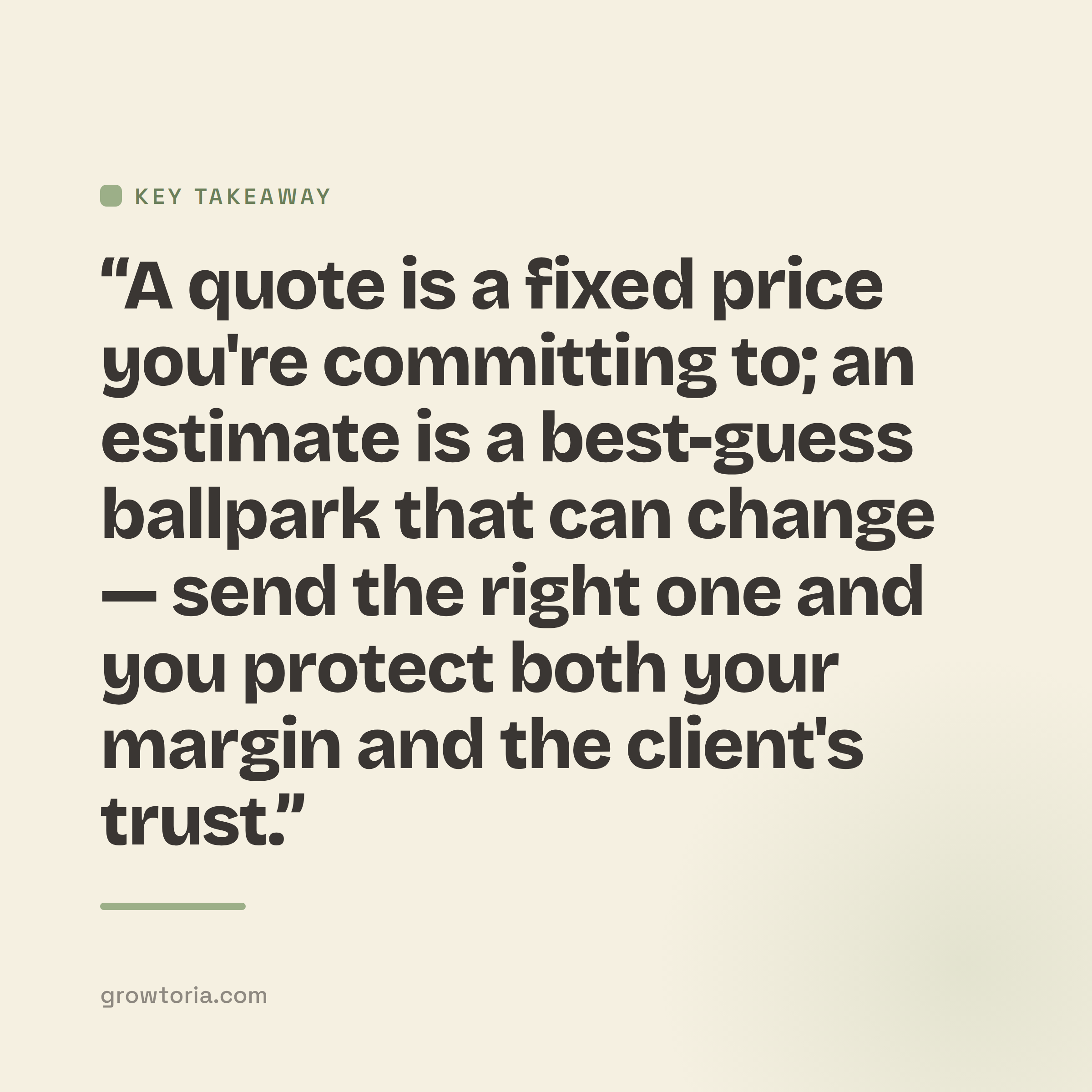
Quick answer: A quote is a firm, fixed price you promise to honour once the client accepts it — it shouldn’t change unless the job scope does. An estimate is your best-guess ballpark of the likely cost, offered when you can’t be certain yet. Quotes bind you; estimates only guide.
What is the difference in quote and estimate?
The core difference in quote and estimate is commitment. A quote locks in a number; an estimate signals a range. Both are pricing documents you send before starting work, but they carry very different promises.
Think of it this way: a quote says “This is what it will cost.” An estimate says “This is roughly what it should cost, based on what I know today.” That single word — will versus should — is the whole game.
What is a quote?
A quote is a fixed, itemised price for a clearly defined job. Once the customer accepts it, you’re generally expected to deliver at that price, even if your costs creep up.
Use a quote when the scope is nailed down and you can measure everything: a fitted kitchen, a logo design package, a one-off cleaning of a known-size flat. Because a quote is binding-in-practice, always attach conditions — validity window, what’s included, and what triggers a new price.
What is an estimate?
An estimate is an approximate cost given when parts of the job are still unknown. It’s honest about uncertainty and leaves room for the final figure to shift.
Use an estimate for open-ended or hard-to-scope work: a renovation where you can’t see behind the walls, a repair before diagnosis, or a project that depends on the client’s decisions. A good estimate still shows your workings — labour, materials, and a contingency — so the client understands why the number could move.
Quote vs estimate: a side-by-side comparison
Here’s the difference in quote and estimate laid out on one table so you can decide in seconds which to send.
| Factor | Quote | Estimate |
|---|---|---|
| Price certainty | Fixed — the agreed number | Approximate — can change |
| Best for | Well-defined jobs | Uncertain or evolving scope |
| Binding once accepted? | Usually yes (treat it as a promise) | No — it’s a guide only |
| Detail level | Itemised, final | Ballpark, with a range |
| Risk you carry | Higher — you absorb overruns | Lower — client shares the risk |
| Client expectation | “This is what I’ll pay” | “It’ll be around this” |
Notice the trade-off: a quote wins trust and closes deals faster, but it puts the risk on you. An estimate protects you from surprises, but a vague one can scare a buyer off. Your job is to match the document to how much you actually know.
When should you send a quote vs an estimate?
Send a quote when you can measure the whole job today; send an estimate when real unknowns remain. The deciding question is simple: Can I see everything I’m being asked to price?
- Send a quote when the specs are fixed, you’ve done the job type many times, and materials and hours are predictable.
- Send an estimate when the scope could grow, the site is unseen, or the client hasn’t finalised their choices.
- Send an estimate first, then a quote for bigger jobs — estimate to get the yes, then quote once you’ve surveyed the details.
Whichever you choose, cost the job properly before you put a number on it. Our step-by-step on how to cost a job walks through labour, materials, and margin so your quote or estimate is built on real numbers, not gut feel. If you’re weighing how to present the price to win the work, the best way to quote a job covers the delivery.
Is a quote legally binding — and is an estimate?
A quote is generally treated as a binding offer once the client accepts it, while an estimate is not a firm commitment to a final price. That’s the practical legal line, though exact rules vary by country and contract.
In consumer terms, dictionaries capture the intent well: to quote is to state a definite price, whereas to estimate is to judge approximately. Because a quote reads as a promise, protect yourself with clear terms:
- State how long the quote is valid (e.g. “valid for 30 days”).
- List exactly what’s included — and, just as important, what isn’t.
- Explain when the price changes (extra scope, price rises, access problems).
- Label an estimate clearly as an estimate, never as a quote.
Those few lines are the cheapest insurance you’ll ever write. They keep an accepted quote from becoming a loss and stop an estimate from being mistaken for a fixed price.
How to write a quote or estimate that wins the job
A winning quote or estimate is specific, itemised, and easy to say yes to. Follow these seven steps whichever document you’re sending.
- Confirm the scope in writing. Restate what the client asked for so you’re both pricing the same job.
- Cost your inputs. Add up materials, labour hours, and any subcontractors before you touch the price.
- Apply your margin. Mark up for profit and overhead — don’t quote at cost.
- Itemise the lines. Break out each element so the client sees value, not just a lump sum.
- Add contingency (for estimates). Build in a sensible range so overruns don’t blindside anyone.
- Set the terms. Validity, deposit, payment schedule, and what a change order costs.
- Send it fast and follow up. The quickest professional response often wins the job.
Doing this by hand in a word processor is slow and error-prone. The done-for-you shortcut is the Quote & Estimate Generator App — it builds professional quotes and estimates, auto-calculates tax, and turns any accepted quote into a full invoice with one click, all offline with no subscription. Prefer a print-ready form for site or workshop use? The contractor estimate template gives you an itemised quote form you can fill in and send as a PDF in minutes; you can also grab our templates on our Etsy shop if that’s where you like to buy.
Common mistakes with quotes and estimates
Most pricing disputes come from a handful of avoidable slips. Knowing the difference in quote and estimate is only useful if you apply it cleanly.
- Calling an estimate a quote. If the final bill jumps, the client feels misled — label documents correctly.
- Quoting an uncertain job. Never fix a price on work you can’t fully see; estimate it instead.
- Skipping the terms. No validity date or change-order clause means you eat every overrun.
- Under-costing to win. A cheap quote that loses money is worse than no job. For trades and makers, a solid contractor estimate template keeps your lines consistent; painters can follow how to quote a painting job for a worked example.
Frequently asked questions
Is a quote more expensive than an estimate?
Not inherently — they price the same work. But a fair quote often looks slightly higher because you’re building in a buffer to cover the risk of a fixed price. An estimate can look cheaper up front, then rise if the job grows.
Can a quote change after it’s accepted?
Only if the scope changes. If the client adds work, or you find hidden problems your terms exclude, you issue a revised quote or a change order. Absent that, an accepted quote should hold at the agreed price.
Should I give a quote or an estimate for a repair?
Give an estimate before diagnosis and a quote after. You can’t fairly fix a price until you know what’s wrong, so estimate the likely range, then confirm a firm quote once you’ve inspected the fault.
Do I need to itemise a quote?
Yes, whenever you can. Itemised quotes convert better because the client sees exactly what they’re paying for, and they make change orders far easier to justify later.
What’s the difference in quote and estimate for taxes or deposits?
Neither is an invoice, so neither triggers tax on its own — tax applies when you invoice. A quote can, however, state a required deposit and payment schedule, which an estimate usually shouldn’t, since the estimate isn’t a firm commitment.
Send the right document, get paid faster
The difference in quote and estimate comes down to one promise: a quote fixes the price, an estimate guides it. Match the document to how much you truly know, spell out your terms, and you’ll avoid the disputes that eat margins.
Ready to stop building these by hand? Create professional quotes, estimates, and invoices in minutes with the Quote & Estimate Generator App, or browse the rest of our free tools to price and invoice your next job with confidence.