How Do I Calculate How Much to Charge for a Cake? (Formula)
If you have ever asked yourself “how do i calculate how much to charge for a cake”, you are probably already undercharging. Most home bakers price by gut feel or by copying the bakery down the road, and both methods quietly leave out the two biggest costs: your time and your overhead. This guide gives you a formula you can apply to your next order tonight, with a fully worked example and a size-by-size pricing table.
Quick answer: To calculate how much to charge for a cake, add ingredient and packaging cost, your labor (hours × hourly rate), and a share of overhead, then divide by (1 – your target profit margin). Example: $103 total cost at a 20% margin = $128.75, rounded to $130.
How do I calculate how much to charge for a cake? The 4-part formula
You calculate a cake price by adding up four things and then adding profit on top. The formula looks like this:
Price = (Ingredients + Packaging + Labor + Overhead) ÷ (1 – Profit margin)
Each part covers a different cost that a customer never sees but you always pay:
- Ingredients: the exact cost of what goes into this cake, not the cost of the bags you bought.
- Packaging: cake board, box, dowels, ribbon, toppers, labels.
- Labor: every hour you spend on the order, multiplied by a real hourly rate.
- Overhead: the monthly costs of running the business, spread across your orders.
Profit is separate from labor. Labor pays you for the work; profit pays the business so it can replace a stand mixer, absorb a refunded order or grow. If you skip profit, one bad week wipes you out.
Step 1: Cost your ingredients by the gram, not by the bag
Ingredient cost is the price you paid divided by the package size, multiplied by the amount the recipe uses. Weighing in grams makes this exact; cups make it a guess.
For example, a 2 kg bag of flour at $3.20 costs $0.0016 per gram. A recipe that uses 375 g of flour therefore costs $0.60 in flour. Repeat that for every ingredient, including the “small” ones: vanilla, food colouring and meringue powder add up fast.
We cover this per-item method in more depth in our guide on how to calculate food cost per item. For cakes, two extra rules matter:
- Include frosting and filling. Buttercream for an 8-inch cake can cost more than the sponge itself, because butter is your most expensive staple.
- Add 5-10% for waste. Trimmed domes, leftover frosting in the bowl and the test batch of a new colour all cost money.
Step 2: Add packaging and order-specific extras
Packaging is easy to forget because you buy it in bulk. Yet a sturdy box and board can cost $2-$5 per cake, and a custom acrylic topper can cost $8-$15 on its own.
List everything that leaves your kitchen with the cake:
- Cake board or drum
- Box (and window insert, if used)
- Dowels or supports for tiered cakes
- Toppers, flowers, sprinkles, gold leaf
- Labels, ribbon, care cards
Charge for custom extras as separate line items. That way, when a customer asks for “the same cake but simpler”, you can remove a line instead of guessing a discount.
Step 3: Pay yourself for every hour (yes, including cleanup)
Labor is your hourly rate multiplied by the total hours the order takes. The mistake most bakers make is counting only decorating time.
A realistic 8-inch, two-layer buttercream cake usually breaks down like this:
- Customer messages and quoting: 20 minutes
- Shopping and prep: 30 minutes
- Baking and cooling: 1 hour of active time
- Levelling, filling and crumb coat: 45 minutes
- Final coat and decoration: 1 hour
- Cleanup and handover: 25 minutes
That is roughly 4 hours. At $20 an hour, labor is $80. To pick a defensible rate, check what bakers earn locally; the U.S. Bureau of Labor Statistics publishes median pay for bakers, which is a sensible floor. A custom decorator with a portfolio should sit above it, not below.
Step 4: Spread your overhead across every cake
Overhead is the monthly cost of running your bakery divided by the number of orders you make in a month. It is the step almost every “cake calculator” online leaves out.
Typical home bakery overhead includes:
- A share of electricity and gas (ovens run hot for hours)
- Cottage food licence, permits and liability insurance
- Website, order-form software and payment fees
- Equipment replacement: mixers, pans, turntables, piping tips
- Marketing, photography props and bookkeeping (see what small business bookkeeping costs)
If those total $150 a month and you make 30 cakes, overhead is $5 per cake. In the U.S., part of these home costs may also be tax-deductible; the IRS explains the rules in its guide to the home office deduction.
Step 5: Add profit with margin, not markup
Profit margin is the share of the selling price you keep, while markup is a percentage added to cost. They are not the same, and mixing them up is a classic way to earn less than you planned.
Suppose your cake costs $103 to make:
- 20% markup: $103 × 1.20 = $123.60. Your real margin is only 16.7%.
- 20% margin: $103 ÷ 0.80 = $128.75. You actually keep 20% of the price.
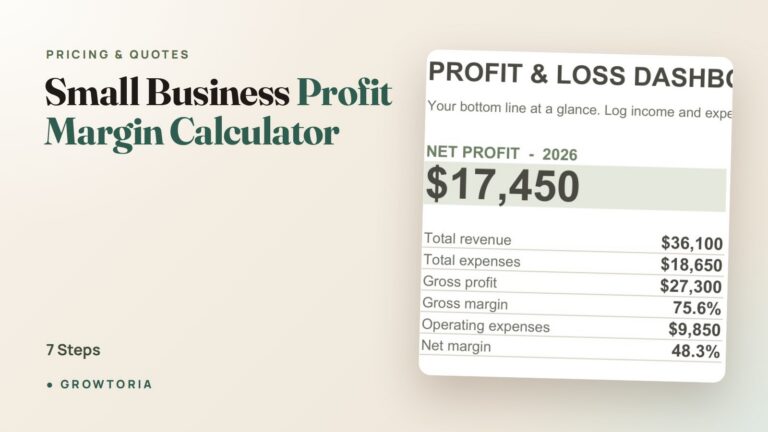
Most home bakers aim for a 15-30% margin on top of paid labor. For context on what is normal across industries, see our breakdown of the average profit margin for small business. You can also test different margins in seconds with our free small business profit margin calculator.
Worked example: pricing an 8-inch buttercream cake
Here is the full calculation for a two-layer, 8-inch vanilla cake with buttercream, serving about 24 people. Use it as a template and swap in your own numbers.
- Ingredients (with 7% waste): $14.50
- Packaging (board + box): $3.50
- Labor: 4 hours × $20 = $80.00
- Overhead: $150 ÷ 30 cakes = $5.00
- Total cost: $103.00
- Price at 20% margin: $103 ÷ 0.80 = $128.75, rounded to $130
That works out to about $5.42 per serving. Notice that labor is 78% of the cost. In other words, the question is rarely “are my ingredients too expensive?” and almost always “am I paying myself?”
How much should a cake cost by size?
A cake’s price should rise with size, but the price per serving usually falls, because some labor (quoting, setup, cleanup) stays the same. The table below applies the exact same formula, $20/hour, $5 overhead and a 20% margin, to common round two-layer sizes.
| Round cake size | Approx. servings (1×2 in slices) | Ingredients + packaging | Labor hours | Total cost | Price at 20% margin | Price per serving |
|---|---|---|---|---|---|---|
| 6-inch | 12 | $11 | 3 | $76 | $95 | $7.92 |
| 8-inch | 24 | $18 | 4 | $103 | $130 | $5.42 |
| 10-inch | 38 | $27 | 5 | $132 | $165 | $4.34 |
| 12-inch | 56 | $38 | 6.5 | $173 | $220 | $3.93 |
The lesson: a flat “$4 per serving” price would lose you money on a 6-inch cake and slightly overprice a 12-inch one. Calculate each size once, then save it as your base price list.
Should I just copy competitor cake prices?
No, use competitor prices as a sanity check, not as your price. Another baker may buy butter wholesale, decorate twice as fast or be quietly losing money.
Instead, calculate your cost-based price first. Then compare it with three or four local bakers:
- Your price is much higher: look for slow steps you can speed up, or position yourself as the premium, fully custom option.
- Your price is similar: good. Compete on reliability, taste and how easy you are to order from.
- Your price is much lower: you are probably leaving money on the table. Raise it.
The same logic applies to any food business; our owner’s guide on how to price menu items for real profit shows how cafés and food trucks balance cost and market price.
The done-for-you shortcut: stop redoing the maths
Running this formula by hand works, but it is slow when a customer wants a quote for three sizes and two flavours before dinner. That is why we built the Home Bakery Manager App. You save your ingredients once, and it prices each cake by ingredients, labor and margin, shows your profit and builds order forms. It runs offline, with no subscription.
If you already know your prices and mainly need clean paperwork, the Bakery Cake Order Form App captures every custom order, prices it automatically and shows the deposit due and balance remaining on a PDF you can send the customer. Prefer buying through Etsy? You can also grab our baking tools on the Growtoria Etsy shop.
Common cake pricing mistakes to avoid
Even with a formula, a few habits keep home bakers underpaid. Watch for these:
- Not charging for consultations. Hour-long tasting calls belong in your labor time.
- Discounting for friends by default. Decide in advance what discount you offer, if any, and stick to it.
- Ignoring price increases. Re-cost your recipes every three months; butter and eggs move fast.
- Skipping deposits. Take 30-50% upfront so a cancelled order does not cost you ingredients and a Saturday.
- Rounding down. Round to clean numbers, but round up: $128.75 becomes $130, not $125.
Frequently asked questions
Should I charge per serving or per cake?
Calculate per cake, then quote per serving if your customers find that easier. Calculating per cake captures the fixed time every order needs, while per-serving quotes help customers compare sizes. Just make sure your per-serving figure comes from the formula, not a guess.
How much should I pay myself per hour as a home baker?
Start with at least your local median baker wage, then add a premium for custom decorating skill. Many home bakers use $15-$30 an hour. Whatever you choose, apply it to every hour, including shopping, messaging and cleanup.
Is a 20% profit margin good for a cake business?
Yes, 20% on top of paid labor is a healthy target for a home bakery. Below 10%, a single ruined cake or refund erases a week of profit. Highly custom or wedding work can justify 30% or more.
How do I price fondant, tiered or sculpted cakes?
Use the same formula, but track hours honestly, because labor jumps sharply. A sculpted cake can take 10-15 hours, so add supports, extra boards and delivery as separate line items. Never price a sculpted cake as a “bigger round cake”.
How much deposit should I take for a custom cake?
Most bakers take 30-50% of the total when the order is confirmed, with the balance due a few days before pickup. For wedding cakes, a non-refundable deposit that covers ingredients and blocked calendar time is standard.
Price your next cake with confidence
Pricing a cake is not guesswork: cost the ingredients, add packaging, pay yourself for every hour, share out overhead, then divide by one minus your margin. Do it once per size and flavour, and you will have a price list you can defend to any customer.
Want the numbers done for you? Try the Home Bakery Manager App and price your next order in minutes.