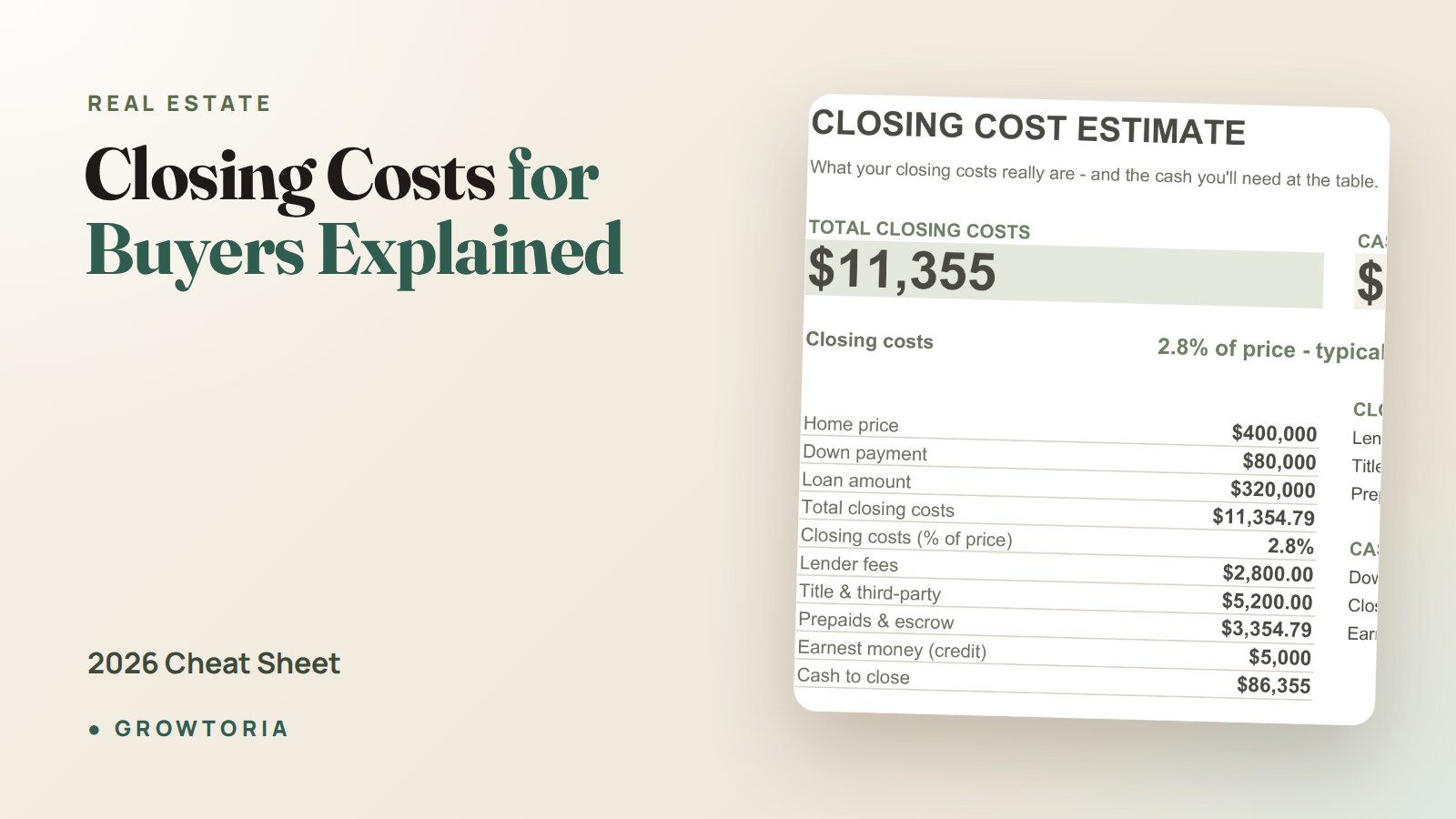
Closing Costs for Buyers Explained: 2026 Cheat Sheet
If you’re buying your first home — or your fifth — getting closing costs for buyers explained in one place is usually the missing piece. You’ve saved the down payment, you’ve been pre-approved, and then the lender hands you a Loan Estimate with two dozen fees you’ve never seen before.
By the end of this guide, you’ll be able to open that Loan Estimate, spot the fees that are inflated, and estimate your total cash-to-close before you’re sitting at the signing table.
What Closing Costs Actually Cover
Closing costs are every fee, tax, and prepayment that gets settled the day ownership transfers. They pay the people who made the sale possible — the lender who underwrote your loan, the title company that proved the seller actually owns the house, the appraiser, the county recorder, the insurance company, and the tax authority.
They’re separate from your down payment. If you’re putting 10% down on a $400,000 home, you’re bringing $40,000 for the down payment plus (usually) another $8,000–$20,000 in closing costs. Miss that second number in your budget and you’ll find out on day 30 of a 45-day escrow.
The CFPB’s Loan Estimate rules require your lender to send a standardized 3-page form within three business days of your application. That form is the source of truth. Every number below maps to a line on it.
The Two Buckets: Lender Fees vs Third-Party Costs
Closing costs split cleanly into two buckets, and knowing which is which tells you where you can negotiate.
Lender fees are set by the lender you chose. Different lenders charge wildly different amounts for the same work — this is your leverage.
Third-party costs are set by the service provider (title company, appraiser, county). You can sometimes choose the provider, but the price is theirs, not the lender’s.
| Line Item | Who Sets It | Typical Range (on a $400k loan) | Negotiable? |
|---|---|---|---|
| Origination fee | Lender | $0–$4,000 | Yes — shop lenders |
| Underwriting / processing | Lender | $500–$1,500 | Sometimes |
| Discount points | Lender (optional) | 1% per point | Your choice |
| Appraisal | Third-party | $500–$900 | Mostly fixed |
| Title insurance (lender’s) | Third-party | $1,000–$2,500 | Shop title companies |
| Title insurance (owner’s) | Third-party | $1,000–$3,000 | Shop title companies |
| Recording & transfer taxes | Government | $500–$4,000+ | No |
| Prepaid interest | Lender (formula) | 1–30 days of interest | Time your closing |
| Escrow reserves | Lender | 2–6 months of taxes + insurance | Depends on loan type |
How Much You’ll Actually Pay
The industry rule of thumb: closing costs run 2% to 6% of the loan amount for a buyer. The wide range depends on your loan type, your state’s transfer taxes, and how many months of taxes and insurance your lender wants held in escrow.
- Conventional loan, low-tax state: 2–3% is realistic.
- FHA or VA loan: 3–5% (upfront mortgage insurance or funding fee is baked in).
- High-tax state (NY, NJ, PA, IL): 4–6%+ because of transfer taxes and mortgage recording tax.
On a $400,000 loan, that’s an $8,000 to $24,000 spread. That’s why the Closing Cost Calculator is worth running before you write an offer — the “how much house can I afford” answer changes by tens of thousands once closing costs enter the math. If you’re still weighing whether to buy at all, pair it with the Rent vs Buy Calculator for the honest side-by-side.
Closing Costs for Buyers Explained: The Full Line-by-Line Breakdown
Here’s every category you’ll see on a Loan Estimate, in the order they typically appear.
Loan-related charges (Section A)
Origination fee. The lender’s payment for doing the loan. Usually 0.5–1% of the loan amount, but some lenders advertise “$0 origination” and make it back on the interest rate. Always compare the APR, not just the origination.
Underwriting fee. A flat $500–$1,500 for the underwriter’s review. Often bundled into “processing” or “administration” fees. Ask for the itemization in writing.
Discount points. Optional. Each point equals 1% of the loan and buys down your interest rate by roughly 0.25%. Worth it if you’ll hold the loan long enough to break even — usually 5+ years.
Rate-lock extension. If closing gets delayed past your lock expiration, you’ll pay $200–$1,000 to extend it. Ask up front what the extension fee is so it doesn’t surprise you.
Third-party services (Sections B and C)
Appraisal. $500–$900 for a licensed appraiser to confirm the home is worth what you’re borrowing. Paid up front, usually within the first week.
Credit report. $30–$60 pulled by the lender.
Flood certification. $15–$25 to determine whether the property sits in a FEMA flood zone.
Title search and title insurance. Two flavors: the lender’s policy (required, protects the bank) and the owner’s policy (optional but strongly recommended, protects you). Costs are set by the title company and can vary 40%+ between providers in the same market.
Settlement / closing fee. $400–$1,500 to the title company or attorney who runs the closing.
Survey. $300–$800 in states that require a new one (not all do).
Taxes and government fees (Section E)
Recording fees. The county recorder charges $50–$300 to record the new deed and mortgage.
Transfer taxes. A percentage-based tax on the sale, ranging from zero in some states to 2%+ in New York City. Sometimes paid by the seller — check your purchase contract.
Prepaids and escrow reserves (Sections F and G)
This is the section that catches buyers off guard. You’re not just paying fees — you’re pre-funding your escrow account.
Prepaid interest. Interest from your closing date through the end of the month. Close on the 3rd? You’ll prepay 27–28 days of interest. Close on the 28th? Only 2–3 days.
Homeowners insurance. The lender collects the full first year of premium at closing.
Property tax reserves. Usually 2–6 months of taxes, held in escrow so the lender can pay your property tax bill when it’s due.
Mortgage insurance. If you’re putting less than 20% down on a conventional loan, expect an upfront and monthly PMI charge. FHA loans have a 1.75% upfront MIP baked into the loan balance.
How to Estimate Your Closing Costs Before You Sign
You don’t have to wait for a Loan Estimate. You can get within a few hundred dollars in ten minutes:
- Pick your loan amount. Home price minus down payment.
- Estimate lender fees. Use 1% of the loan amount as a placeholder.
- Add third-party services. $2,500 is a reasonable national average.
- Add title insurance. About $3.50–$5 per $1,000 of loan for the lender’s policy, similar for the owner’s.
- Add transfer and recording taxes. Google “[your state] real estate transfer tax buyer.”
- Add prepaids. 15 days of interest + 1 year of homeowners insurance + 4 months of property tax.
Or skip the pen-and-paper: the Closing Cost Calculator has every line item pre-formulated with editable ranges for your state and loan type.
7 Ways to Lower Your Closing Costs
Not every fee is negotiable — but enough of them are that a buyer who asks the right questions can trim 15–30% off the total.
- Get three Loan Estimates. Federal law says lenders must give you one within three days. Comparing origination fees alone often saves $1,000–$3,000.
- Ask for lender credits. The lender pays some of your closing costs in exchange for a slightly higher interest rate. Great if you’re short on cash and plan to refinance later.
- Shop your title insurance. The lender picks a default title company. You can pick your own, and rates vary 40–60%. This is the biggest under-used lever.
- Time your closing to month-end. Fewer days of prepaid interest equals a smaller cash-to-close.
- Ask the seller to cover costs. Seller concessions of 2–3% are common in buyers’ markets. Structure it into the offer.
- Consider a no-closing-cost loan. Higher rate, less cash today — only worth it if you plan to refinance in 2–3 years.
- Check first-time buyer programs. Many states offer closing-cost grants or forgivable loans for qualifying buyers — often up to $10,000.
The Closing Timeline: When You’ll See Each Number
Understanding the timing helps you know when to push back and when it’s too late.
- Day 0–3: Loan Estimate arrives. Compare it to competitors.
- Day 3–10: Choose your title company. Order the appraisal.
- Day 10–30: Underwriting. Fees can shift; keep receipts.
- Day 30–40: Closing Disclosure arrives — required at least 3 business days before signing. Compare it line by line to your Loan Estimate. Any fee that jumped more than 10% requires the lender to justify it.
- Closing day: Wire the cash-to-close, sign 80+ pages, get keys.
If you’re stretching the down-payment budget, this is also the moment to double-check your monthly cash flow. A simple budget spreadsheet and a debt-to-income calculator keep the mortgage from becoming a monthly stress test after closing. And if you’re buying an investment property rather than a primary residence, the numbers change again — the rental property analysis guide walks through cash-on-cash and DSCR math.
Frequently Asked Questions
Are closing costs tax deductible for buyers?
Most aren’t. Discount points can be deductible in the year you buy (if you itemize), and prepaid property taxes and mortgage interest often are. Origination, appraisal, title insurance, and settlement fees are not deductible on a primary residence — but they do get added to your cost basis, which matters when you eventually sell.
Can I roll closing costs into my mortgage?
Sometimes. FHA and VA loans allow limited roll-ins. On a conventional loan, you’d typically need to either raise the sale price (using seller concessions) or accept a higher interest rate in exchange for a lender credit. Rolling costs in means paying interest on them for 30 years — usually more expensive than paying cash if you can.
How much are closing costs on a $300,000 house?
At 2–6% of the loan amount, expect $5,000–$16,000 depending on your loan type and state. On a $300k purchase with 10% down (a $270k loan), a reasonable middle estimate is $8,000–$12,000. Get quotes from three lenders and three title companies before you assume the national average applies.
Who pays closing costs — buyer or seller?
Both, but for different line items. Buyers pay all lender-related fees, the appraisal, title insurance (usually both policies), and their share of taxes and prepaids. Sellers typically pay the real estate commissions (5–6% total), transfer taxes in many states, and any concessions negotiated into the contract.
What happens if I can’t cover the closing costs at signing?
Closings get postponed or cancelled. If you’re short, options include requesting seller concessions, asking for a lender credit (higher rate, less cash), or delaying closing to save more. Never wire funds you don’t have — a bounced wire from the buyer’s side can kill the deal and cost you your earnest money.
Tools for real estate investors
- Fix and Flip Calculator — ARV, rehab, the 70% rule and profit on any flip.
- Real Estate Investor Toolkit — Flip, Rental, BRRRR and Airbnb calculators in one bundle.
- Rental Property Analyzer (BRRRR) — full cash-flow analysis.
