Freelance Day Rate Calculator UK: 7-Step Guide
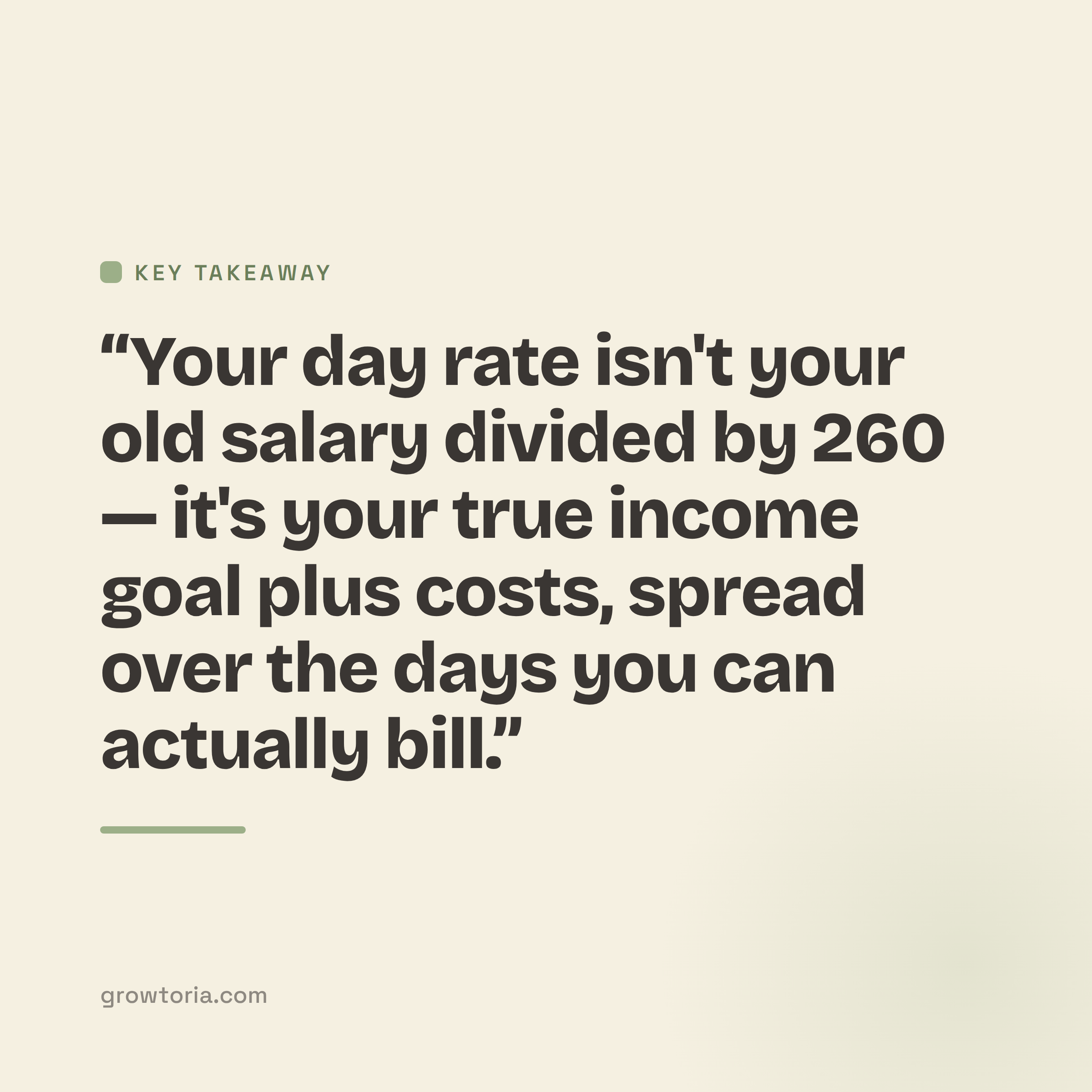
Setting a rate with a freelance day rate calculator UK method is the fastest way to stop guessing and start charging what your work is actually worth. Too many freelancers take their old salary, divide by 260 working days, and quote that — then wonder why they end the year skint. Your day rate has to cover far more than a payslip ever did: your own tax, pension, holiday, sick days, software, insurance and the unpaid hours you spend finding the next client.
Quick answer: To calculate a UK freelance day rate, add your target take-home pay, tax, pension and business costs into one annual figure, then divide by your realistic billable days (usually 200–220, not 260). A £60,000 target over 220 billable days is roughly £273 per day before rounding up for risk.
Below is the exact 7-step process, a worked example, and a free tool that does the maths for you. If you also quote fixed-price projects, pair this with our guide on the best way to quote a job.
What is a freelance day rate calculator UK freelancers actually need?
A freelance day rate calculator UK freelancers can trust does one job: it converts the income you want to keep into the price you must charge, after accounting for everything a permanent employer used to pay silently on your behalf.
When you were employed, your employer covered pension contributions, National Insurance, paid holiday, sick pay, equipment and training. As a freelancer, that bill lands on you. So your day rate is never “salary ÷ working days” — it’s a gross-up.
Think of it in three layers:
- What you want to take home — the money that reaches your bank account.
- What the taxman and pension take first — Income Tax, National Insurance and any pension you fund yourself.
- What it costs to run the business — software, insurance, accountant, hardware, admin.
Add those up, divide by the days you can genuinely bill, and you have a rate that survives contact with reality.
How do you calculate a freelance day rate in the UK? (7 steps)
Calculate a UK freelance day rate by turning your annual income goal plus costs into a total, then dividing by realistic billable days. Here is the step-by-step version you can run on paper in ten minutes.
1. Set your target take-home pay
Start with the number you want to actually keep after tax — say £40,000. Be honest about your living costs, not aspirational. This is your floor, not your dream.
2. Gross up for tax and National Insurance
You pay your own Income Tax and Class 4 National Insurance as a sole trader. As a rough working buffer, add 25–35% on top of your take-home target to cover it. Check the current bands on the official gov.uk Income Tax rates page before you finalise anything.
3. Add your pension
No employer is matching your contributions now. If you want £3,000 a year going into a SIPP, that’s £3,000 added to the total. Skipping this is the most common freelance mistake.
4. Add your annual business costs
Total up software subscriptions, professional indemnity insurance, your accountant, hardware, a co-working desk, phone and training. For most solo freelancers this lands between £2,000 and £8,000 a year.
5. Work out your REAL billable days
This is where most calculators go wrong. There are about 260 weekdays in a year, but you cannot bill all of them. Subtract holiday, bank holidays, sick days, admin, marketing and dead time between contracts.
6. Divide the total by billable days
Take your grand total (steps 1–4) and divide by your billable days (step 5). That’s your minimum day rate.
7. Round up for risk and profit
Add a 10–20% margin so you’re not just breaking even. This buffer absorbs late payers, scope creep and the client who ghosts you. Now you have a rate you can defend.
Worked example: what should a £60,000 target cost per day?
Here’s the full build-up so you can see how the freelance day rate calculator UK logic plays out with real numbers. The right-hand column shows how billable days swing your rate dramatically.
| Item | Conservative (200 billable days) | Optimistic (220 billable days) |
|---|---|---|
| Target take-home | £40,000 | £40,000 |
| Tax + National Insurance buffer (30%) | £12,000 | £12,000 |
| Pension contribution | £3,000 | £3,000 |
| Business costs | £5,000 | £5,000 |
| Total to earn | £60,000 | £60,000 |
| ÷ Billable days | 200 | 220 |
| Minimum day rate | £300 | £273 |
| + 15% risk/profit margin | £345 | £314 |
Notice the trap: to keep £40,000, a UK freelancer needs to invoice around £300–£345 a day. Divide your old £40k salary by 260 and you’d quote £154 — less than half of what you actually need. That gap is why freelancers burn out charging “employed” rates for “self-employed” risk.
How many hours are in a freelance day rate?
A UK freelance day is almost always 7.5 to 8 hours of chargeable work. Anything a client asks for beyond that should be billed as overtime or pro-rata, and you should say so in writing before the contract starts.
Define it explicitly in your terms:
- Standard day: up to 8 hours.
- Half day: up to 4 hours, usually charged at 60% of a full day (not 50% — the admin overhead is the same).
- Overtime: your day rate ÷ 8, often with a small uplift.
Being specific here stops the classic “can you just squeeze in one more thing” from quietly eroding your rate. If you find yourself doing this maths every time you win work, it’s worth understanding your true costs first — our walkthrough on how to cost a job covers that in detail.
Should you register for VAT as a UK freelancer?
You must register for VAT once your taxable turnover passes the UK threshold, which is £90,000 in a rolling 12-month period. Below that, registration is optional — and it changes how you present your day rate.
Two practical points:
- Always state whether your rate is “plus VAT” or VAT-inclusive on every quote. Ambiguity here causes real disputes.
- Business clients can usually reclaim VAT, so charging it rarely loses you work; consumers cannot, so it effectively raises your price to them.
Confirm the current figure and rules on the official gov.uk VAT registration thresholds page, and if you’re just getting started, the setting up as self-employed guide is the right first stop.
The done-for-you shortcut
Running these numbers once is easy; keeping them updated as your costs and goals change is the annoying part. Instead of rebuilding a spreadsheet every January, use our free freelance day rate calculator — plug in your income goal, costs and billable days, and it returns your hourly, day and project rate instantly.
Want something branded you can send straight to clients? The Freelance Rate Card Calculator turns your target income into a clean, professional pricing sheet with hourly, day and project tiers — you can also grab it on our Etsy shop. Once you’re winning work, the Freelancer Invoice Tracker keeps every unpaid invoice visible so your hard-won rate actually reaches your bank.
Frequently asked questions
What is the average freelance day rate in the UK?
It varies hugely by discipline, but many UK freelancers charge between £250 and £500 a day, with specialists in tech, finance and design going well above £600. Rather than copy an “average,” calculate your own floor from your income goal and costs — an average that doesn’t cover your bills is useless.
How do I convert my salary into a freelance day rate?
Don’t just divide by 260. Take your target take-home, add roughly 30% for tax and National Insurance, add pension and business costs, then divide by 200–220 billable days. As a fast rule of thumb, a sustainable freelance day rate is often 1.5–2× the naive “salary ÷ working days” figure.
How many billable days should I plan for?
Plan for 200–220 out of roughly 260 weekdays. Subtract 25–28 days of holiday and bank holidays, a handful of sick days, and 20–30 days a year for admin, marketing and gaps between contracts. Assuming you’ll bill all 260 is the fastest route to underpricing.
Should my day rate include VAT?
Only if you’re VAT-registered, which becomes mandatory above £90,000 turnover. Whatever you decide, always label your rate clearly as VAT-inclusive or “plus VAT” on quotes and invoices so there’s no confusion when the client pays.
Is a day rate better than an hourly rate?
Day rates suit longer engagements and protect you from clients nickel-and-diming your hours; hourly suits short, unpredictable tasks. Many UK freelancers publish both, plus fixed-project pricing, so clients self-select. You can build all three tiers from the same underlying number.
Start with the number, not the guess
The freelance day rate calculator UK approach comes down to one shift in thinking: price from your real costs and income goal, never from your old salary. Work the seven steps, protect your billable days, and add a margin for risk. Then make it repeatable with our free tools hub so next year’s rate review takes minutes, not a lost afternoon.