Debt Snowball vs Avalanche: Which Wins in 2026?
The debt snowball vs avalanche debate is one of the oldest arguments in personal finance – and it matters more than most people realise. Pick the wrong method and you’ll either pay more in interest than you had to, or quit halfway through because the plan felt like it was going nowhere.
The good news: both methods work. Both end with you being debt-free. The differences are in the order you attack your debts, how much interest you burn on the way, and how motivated you feel from month one.
This guide breaks down both methods with real numbers, the psychology behind why people finish (or quit), and a step-by-step plan you can run this weekend.
What is the debt snowball method?
The debt snowball method lines up all your debts from smallest balance to largest, ignoring the interest rate entirely.
You pay the minimum on every debt, then throw every extra dollar you have at the smallest one. When that first debt disappears, you take its full payment and roll it onto the next-smallest. The payment “snowballs” – it grows as each debt falls.
The method was popularised by Dave Ramsey and is built entirely around psychology: quick wins keep you going.
How the snowball works in practice
Say you have four debts:
- Medical bill: $400 at 0%
- Store card: $1,200 at 24%
- Credit card: $4,000 at 22%
- Car loan: $9,000 at 6%
Snowball order: medical bill → store card → credit card → car loan. That $400 bill vanishes in a month or two. You feel like a hero. You keep going.
What is the debt avalanche method?
The debt avalanche method lines your debts up by interest rate, highest to lowest. Balance size is irrelevant.
You still pay minimums on everything, but every extra dollar attacks the debt with the highest APR. When that one is gone, you move to the next-highest, and so on down the list.
The math is unbeatable: paying off high-interest debt first means less interest accrues while you work. You save more money – often hundreds or thousands – and finish sooner.
The same four debts, avalanche order
Using the example above, the order flips: store card (24%) → credit card (22%) → car loan (6%) → medical bill (0%).
The store card is $1,200 – not tiny – so the first “win” takes longer. But every day you delay, that 24% keeps eating you.
Debt snowball vs avalanche: the side-by-side comparison
Here’s the honest breakdown, no cherry-picked examples:
| Feature | Debt Snowball | Debt Avalanche |
|---|---|---|
| Order of attack | Smallest balance first | Highest interest rate first |
| Total interest paid | Higher | Lower (mathematically optimal) |
| Time to debt-free | Slightly longer | Slightly shorter |
| Time to first “win” | Fast (weeks) | Slow (months) |
| Best for | People who need momentum | People who love spreadsheets |
| Emotional payoff | Strong from day one | Delayed but real |
| Risk of quitting | Low | Higher for some personalities |
The math: how much does each method actually save?
Let’s run the numbers with a common household mix of debts. Assume $200/month extra to throw at debt beyond the minimums.
With balances of $500 (18% APR), $3,000 (24% APR), $7,500 (19% APR), and $12,000 (7% APR), the avalanche typically saves several hundred dollars in interest and finishes one to three months sooner than the snowball. The gap widens on bigger debts and higher APRs.
The Consumer Financial Protection Bureau recognises both approaches as valid strategies, noting that the “right” one depends on what will keep you focused – which is the honest answer.
The psychology: why most people quit before the finish line
Here’s where the debt snowball vs avalanche question gets real. Research out of Northwestern’s Kellogg School of Management found that people who paid down small balances first were more likely to eliminate their entire debt – even though avalanche was mathematically superior.
The reason is simple: paying off a whole debt feels different from shaving a few dollars off a mountain. That feeling matters when you’re staring down two or three years of sacrifice.
Momentum vs math
Behavioural economists call it “small wins” theory. Quick milestones release dopamine, and dopamine is the fuel that keeps you throwing extra money at debt instead of ordering takeout.
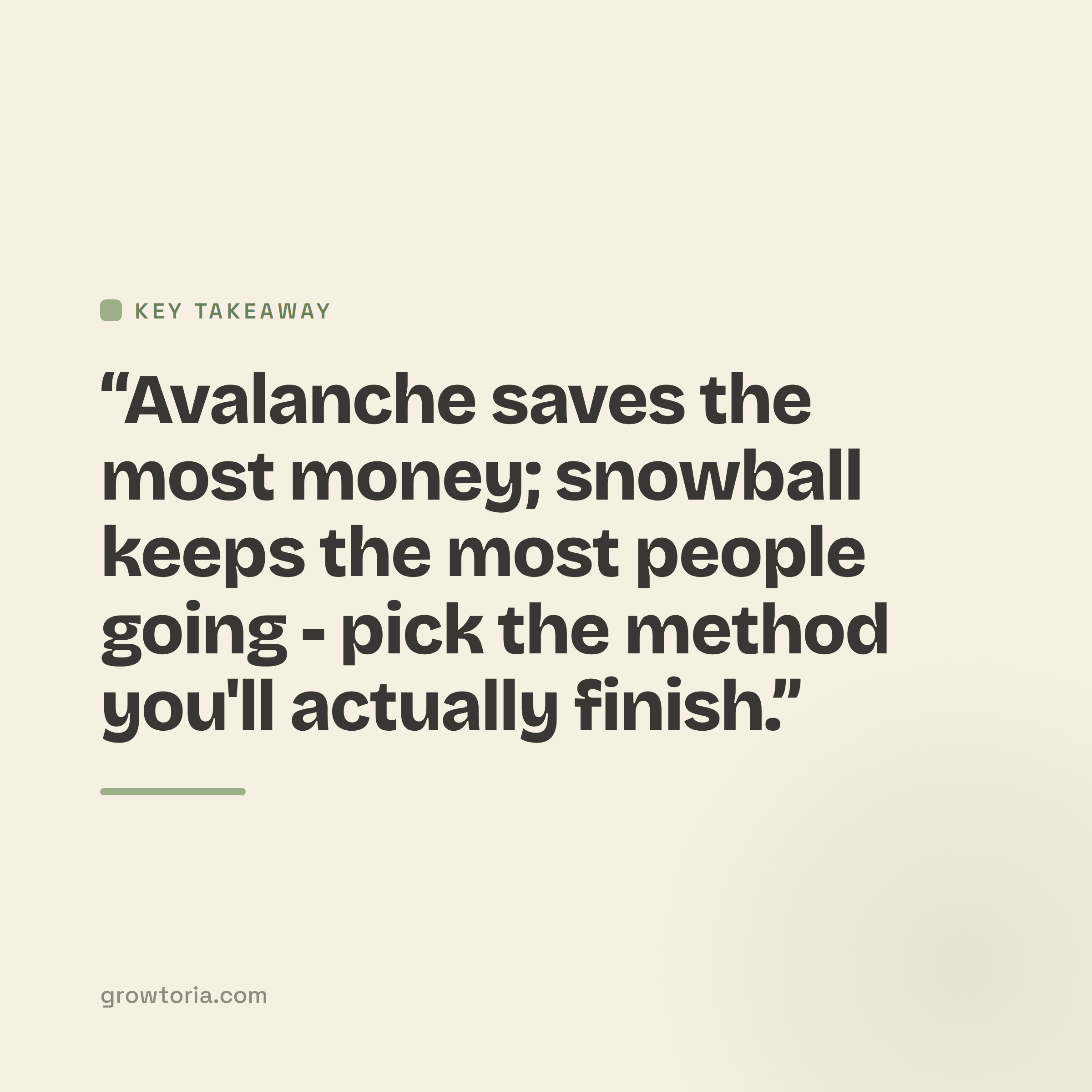
If you can honestly say a spreadsheet keeps you motivated, avalanche is more money in your pocket. If you know yourself and you need visible progress fast, snowball is better – because the best debt plan is the one you actually complete.
How to choose between debt snowball vs avalanche
Pick honestly. This is not a personality quiz – it’s a self-audit.
Pick the snowball if…
- You’ve quit debt plans before
- You have at least one very small debt you can crush in a month
- Motivation is your biggest challenge, not math
- You want visible progress to share with a partner or accountability buddy
Pick the avalanche if…
- You have one or two debts with very high APRs (20%+) that are actively bleeding you
- You’ve stuck to budgets before and don’t need constant wins to keep going
- You want the maximum dollar savings, even if the first “win” is months away
- You enjoy tracking numbers and watching the interest column shrink
Or try a hybrid
Nothing in the personal finance rulebook stops you from combining the two. A common hybrid: knock out any debt under $500 for the psychological jumpstart, then switch to avalanche for the rest. You get the momentum and the math.
A step-by-step debt payoff plan (works for both methods)
- List every debt in one place. Include balance, minimum payment, and APR. A single sheet works – a debt payoff tracker that handles both snowball and avalanche in one view is faster.
- Order your debts. Sort by balance (snowball) or APR (avalanche). Rewrite the list in that order and pin it somewhere visible.
- Find your “extra” number. Look at your monthly budget and identify how much you can throw at debt beyond minimums. Even $100 changes the timeline dramatically.
- Automate minimums on every debt. This protects your credit score and removes late fees from the equation.
- Pay the extra to your target debt. Do this manually if you need the ritual, or automate it and forget about it.
- Roll the payment forward. When one debt is gone, add its full payment to the next debt in line. This is where snowball or avalanche actually starts working.
- Recalculate every three months. Interest rates change, balances change, life changes. A quick check keeps the plan honest.
If you want to see the exact month you’ll be debt-free before committing, run your numbers through a free debt payoff calculator first.
Common mistakes that sabotage both methods
The method matters less than the mistakes. Watch for these:
- Only paying minimums. Without extra payments, snowball and avalanche are the same as doing nothing structured.
- Adding new debt while paying off old debt. This is the single biggest reason people never escape – freeze the cards if you have to.
- Ignoring the emergency fund. A small $1,000 buffer stops a flat tyre from becoming another credit-card balance.
- Refinancing without a plan. Consolidation can lower your rate, but it only helps if you commit to the payoff schedule instead of “freeing up” the extra money for spending.
- Skipping the tracker. Debt paid off without a record is debt you’ll quietly re-accumulate. Visibility is half the discipline.
Beyond the two methods: what else moves the needle
Neither snowball nor avalanche accounts for the levers that speed up either plan:
- Balance transfer offers. A 0% APR transfer for 15-21 months can wipe out interest entirely on your biggest card – if you have the discipline to pay it off inside the promo window.
- Windfalls. Tax refunds, bonuses, and side-income go straight to the target debt, not the general fund. This is where months turn into weeks.
- Income before frugality. Cutting spending has a floor. Earning more doesn’t. A weekend side gig or one salary negotiation can do more than any budgeting app.
For a well-known breakdown of the avalanche approach and its variants, Investopedia’s debt avalanche entry covers the mechanics and edge cases in depth.
Frequently asked questions
Which is better in the debt snowball vs avalanche debate?
Avalanche saves you more money in interest. Snowball keeps more people motivated enough to actually finish. If the interest difference is small (a few hundred dollars) and you know you struggle with long projects, snowball wins on outcomes. If the difference is large and you’re a natural finisher, avalanche wins on math.
Does Dave Ramsey recommend snowball or avalanche?
Dave Ramsey is the best-known advocate of the snowball method. His argument is that personal finance is 80% behaviour and 20% math, so the plan that keeps you going is the plan that works. Whether you agree or not, the underlying insight is real – people quit optimal plans all the time.
How long does it take to pay off debt with the snowball method?
It depends on your total balance, your APRs, and how much extra you can put toward debt each month. Most households paying an extra $200-$500/month clear $15,000-$25,000 in credit-card debt within two to four years. Running your specific numbers through a payoff calculator gives you a real timeline instead of a guess.
Can I switch from snowball to avalanche later?
Yes, and many people do. A common path is snowball for the first two or three small debts (to build momentum), then avalanche for the bigger balances (to save on interest). Nothing breaks if you switch – the important thing is that the extra payments keep flowing.
Should I invest while paying off debt?
If your employer offers a 401(k) match, contribute enough to get the match – it’s free money. Beyond that, aggressively pay down anything above ~7% APR before investing. Below that, splitting extra money between debt and investments is a reasonable trade-off.
Does the debt snowball vs avalanche choice affect my credit score?
Not directly. Both methods pay debts down, which lowers your credit utilisation – and that helps your score either way. The bigger score impact comes from consistently paying every minimum on time, which both methods require.