The Modern Lead Gen Playbook for 2026
$29.00
Description
Who this is for
- Founders of B2B companies between $1M and $15M ARR running outbound themselves or with a small SDR team, who want a B2B lead gen playbook they can measure and tune instead of a slot machine.
- Heads of Growth and VPs of Sales at post-Series A companies taking a new SDR team from zero to repeatable.
- Agency operators and senior SDRs/AEs who already know the basics of outbound and want a complete second-generation system, not another list of subject lines.
The problem
Most B2B lead gen is tactics stacking. One channel carries the quarter, then cools, and the pipeline collapses with it. The ICP is a slide, not a filter. Lists are static snapshots that go stale within weeks. Sequences live on a single channel. Lead scoring ranks leads but never rejects any. And leads that took real work to generate get lost between marketing, the SDR and the AE.
That is pipeline that spikes. Pipeline that compounds comes from a system: a sharp buyer definition, outreach timed to real signals, channels that reinforce each other, scoring that filters, and a handoff tight enough that the AE already knows what the SDR knows.
This ebook is that B2B lead gen playbook: five components, one system, and a 30-day plan to put it in place.
What you’ll get
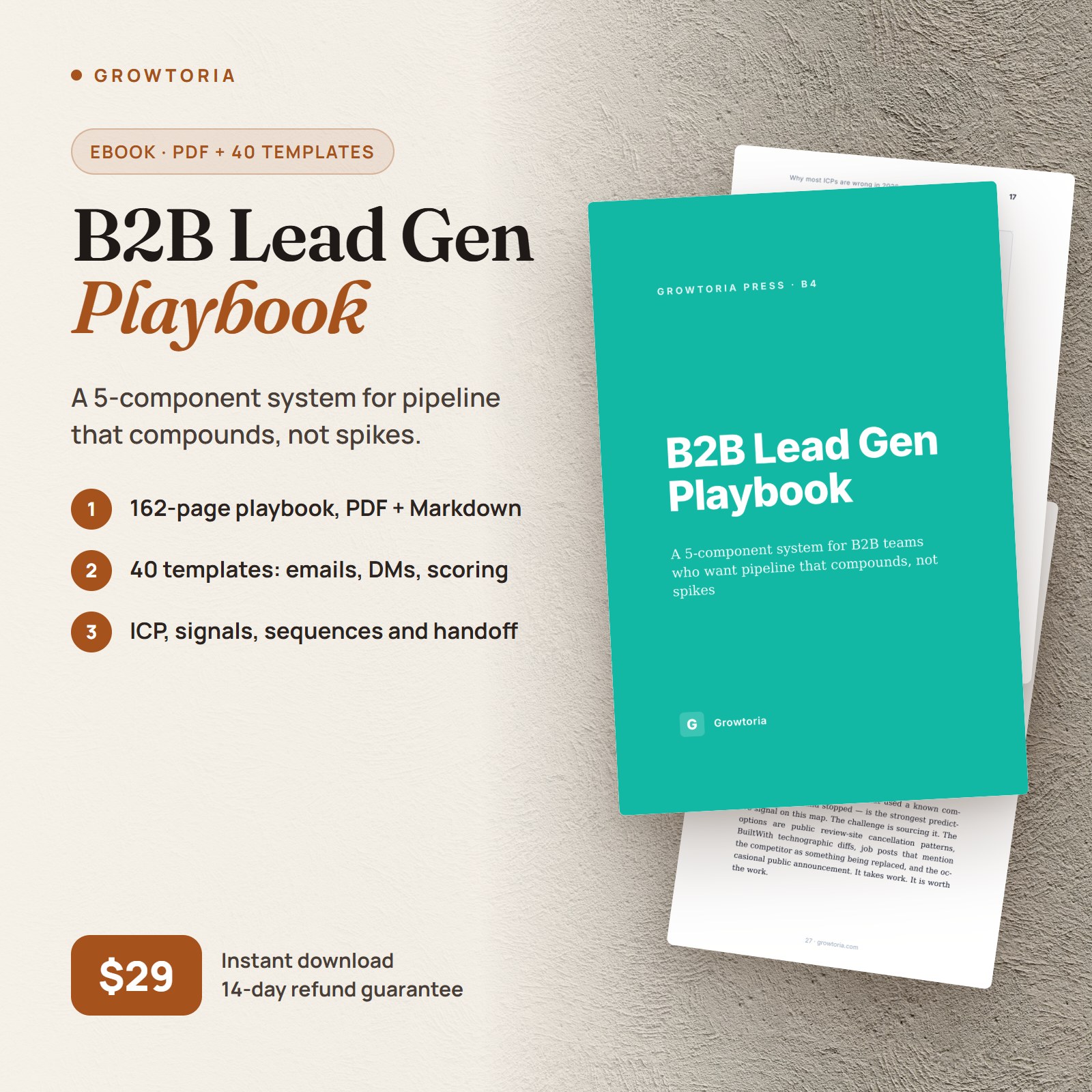
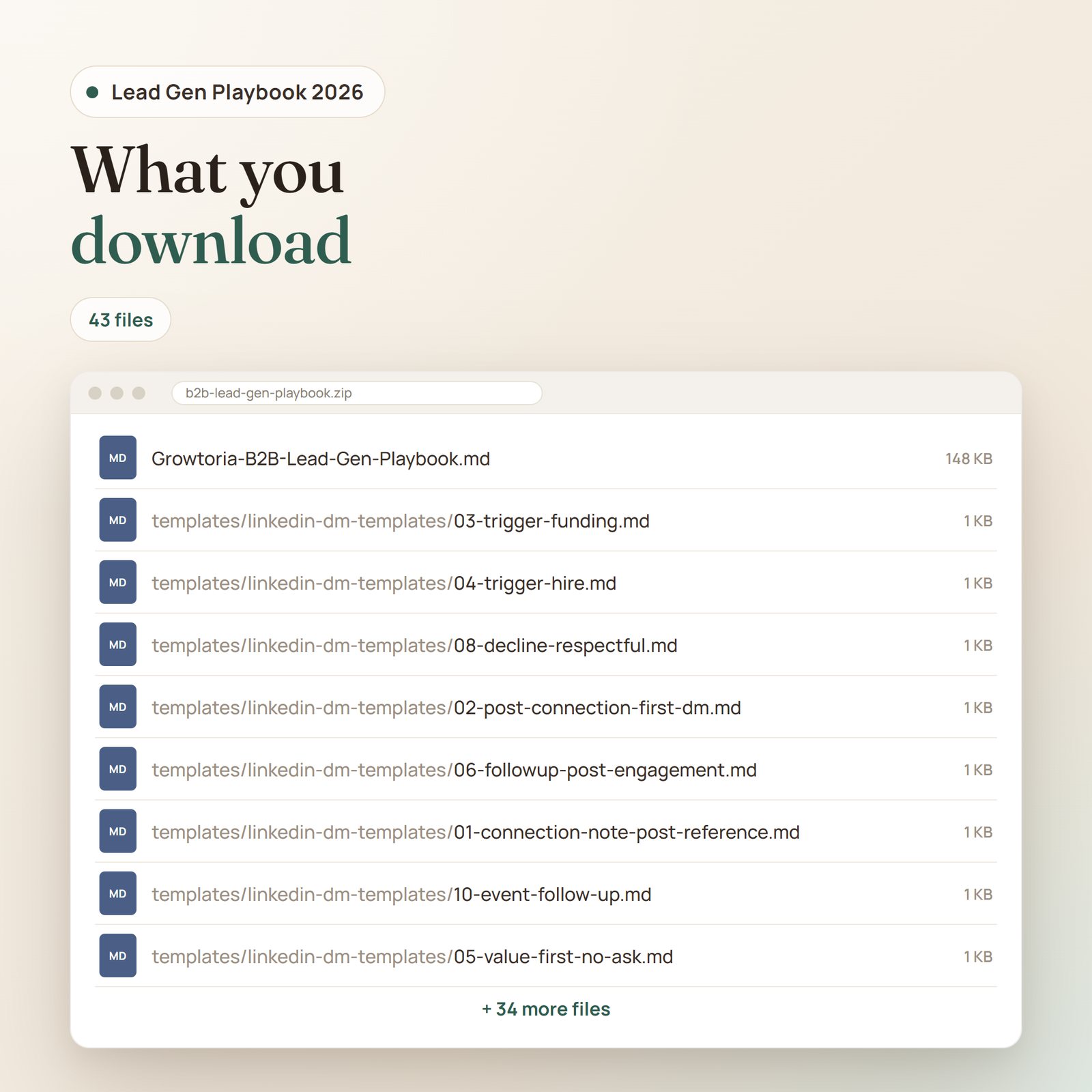
- The ebook as a 162-page PDF covering the five-component system end to end.
- A Markdown edition of the full book, easy to search, copy from, or paste into your own docs.
- README.txt with a map of every file in the download.
- A templates/ folder with 40 ready-to-adapt templates in 5 folders: 20 cold email templates, 10 LinkedIn DM templates, 5 scoring sheets (CSV and Markdown), 3 sequence frameworks, and 2 handoff protocols. Every template uses placeholder variables you replace with your own details.
Inside the ebook
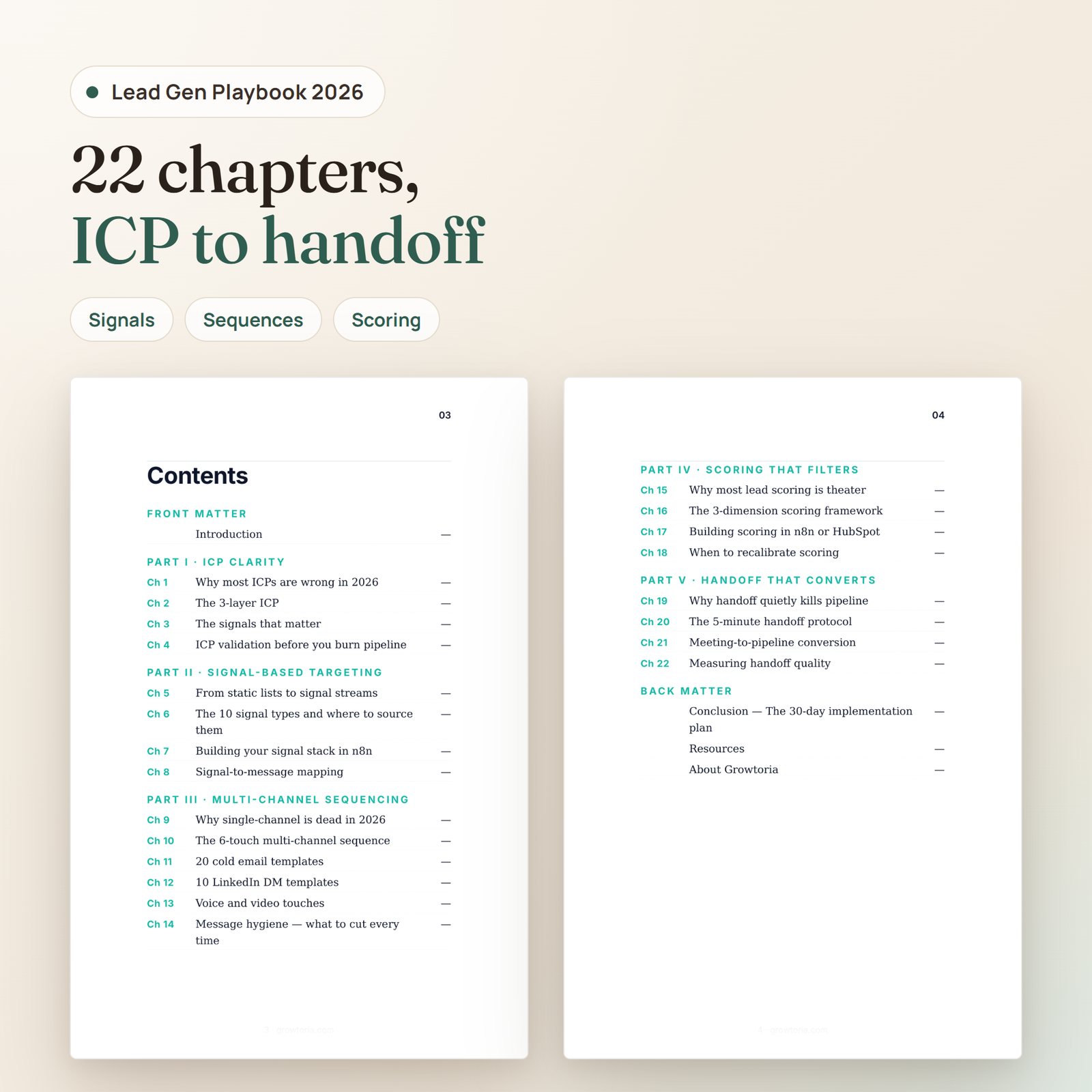
- Introduction — The pipeline that compounds: the five components of the system, who the book is for, and what you should have running by the end of the month.
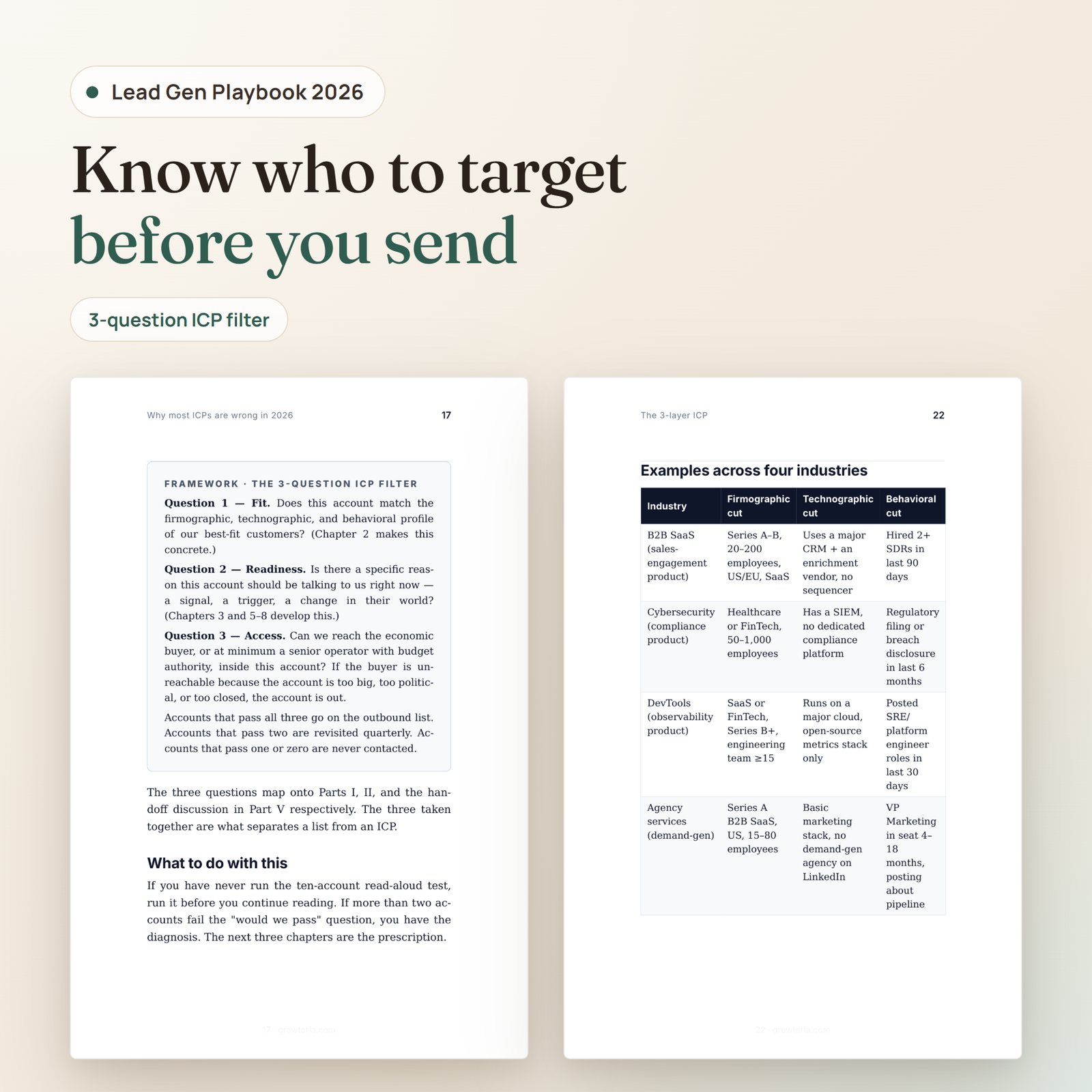
- Part I — ICP clarity: why most ICPs are wrong, the 3-layer ICP (firmographic, technographic, behavioral), a tiered map of fifteen buying signals, and a 7-point validation checklist.
- Part II — Signal-based targeting: moving from static lists to signal streams, ten signal types and where to source them, a reference architecture for a signal stack in n8n, and signal-to-message mapping.
- Part III — Multi-channel sequencing: the 6-touch, three-channel sequence over ten business days, 20 cold email templates, 10 LinkedIn DM templates, voice and video touches, and message hygiene.
- Part IV — Scoring that filters: why most lead scoring is theater, the Fit × Intent × Engagement framework with reject, nurture, SDR-ready and AE-ready thresholds, implementation in n8n or HubSpot, and when to recalibrate.
- Part V — Handoff that converts: why handoff quietly kills pipeline, the 5-minute SDR-to-AE handoff protocol, meeting-to-pipeline conversion, and how to measure handoff quality.
- Conclusion — The 30-day implementation plan: a week-by-week rollout, plus what to cut if your month is tighter.
- Resources: further reading, tool categories, and the template index.
What you’ll be able to do
- Rewrite your ICP as a filter with explicit reject criteria, and validate it against your best and worst customers before you burn pipeline.
- Build a signal stream that ingests events, applies your ICP filter and routes passing accounts to the right SDR and sequence.
- Match each signal to a message angle and write first touches that name the signal instead of pitching the product.
- Run a coordinated 6-touch sequence across email, LinkedIn and voice, with clear escalation rules for every buyer response.
- Score leads on three dimensions and set thresholds that actually reject leads, then audit and recalibrate the model every month.
- Hand meetings from SDR to AE in five minutes with a 6-field notes format, a Slack template and SLAs, and track whether the handoff is leaking.
- Roll the whole system out in 30 days following a week-by-week plan.
FAQ
I’m a solo founder with no SDR team. Is this too much?
No. The Conclusion includes a founder-led path: run the ICP, signal and sequence weeks yourself, skip the handoff week, and add scoring later only if your volume justifies it.
Do I need n8n or HubSpot?
No. Chapters 7 and 17 use n8n and HubSpot as worked implementations, but the same patterns work in Zapier, Make.com or custom code. The book names tool categories rather than endorsing vendors.
Is this for complete beginners?
It assumes you have run some outbound before. If you have never sent a cold email, the Introduction suggests starting with a foundational outbound book first and coming back for the full system.
Are the templates ready to send?
They are ready to adapt. All 40 templates use placeholders for details such as first name, company and signal; Part III explains how to fill them and which touch each one fits.
Are the examples real case studies?
No. The worked examples are hypothetical and show how the frameworks work. Figures labeled as rules of thumb are planning assumptions, not benchmarks, so you measure your own baseline.
Does it cover demos, negotiation or discovery calls?
No. The book focuses on getting the right buyers to a meeting and handing them off cleanly. Part V stops at handoff and meeting-to-pipeline metrics.
What if I’m not satisfied?
See our guarantee below.
Our guarantee
If this guide doesn’t help you, email [email protected] with your order number within 14 days of your purchase and we refund you in full. No forms, no reason needed, and you keep the file. Full details in our Refund Policy.


