
Launch Your AI Agency in 2026
$29.00
Description
Who this is for
- Services founders wondering whether “becoming AI” means pivoting the business or repositioning it, and how narrow that repositioning needs to be.
- Agency owners at $20K–$100K MRR losing margin to AI-native competitors, when the real problem is positioning and pricing.
- Senior operators at a SaaS company or consultancy considering launching an AI-augmented agency in 2026.
- Consultants and freelancers who have already closed a handful of engagements and want to build a small, focused agency.
The problem
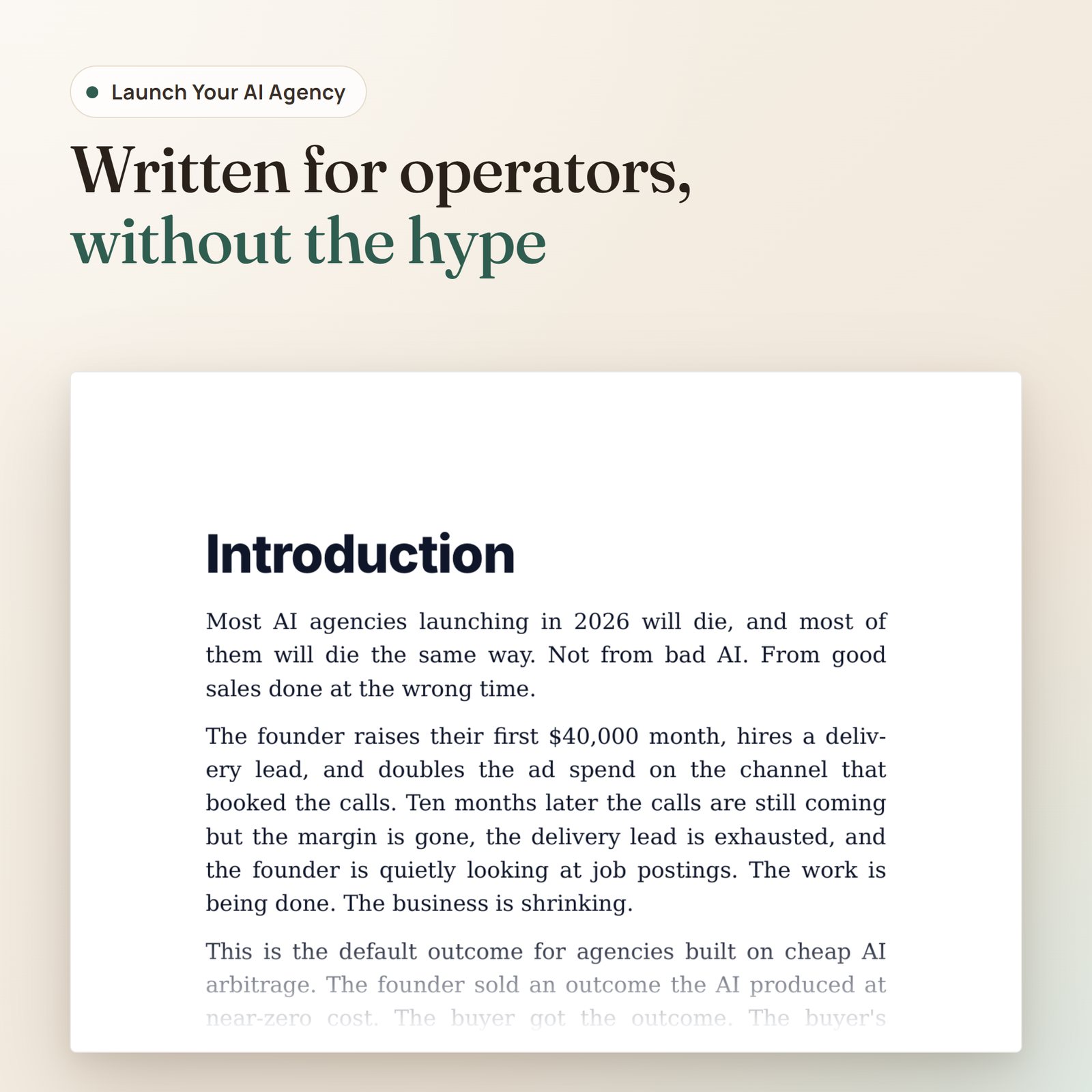
Many AI agencies launching in 2026 are built on cheap AI arbitrage: they sell an outcome the AI produces at near-zero cost, price it as if human hours were still involved, and lose the margin as soon as buyers and competitors catch up. Others wrap a public model in a dashboard, or promise outcomes they cannot deliver consistently.
Most writing on the subject doesn’t help. One side is hype; the other is high-level theory. Very little of it deals with the practical questions: how narrow to position, how to price off hours, where the first clients come from, how to deliver with AI without losing quality, and when to hire.
This ebook is a practical blueprint for building the other kind of agency: narrower, priced in ways competitors cannot copy in a quarter, and using AI as leverage for a senior operator’s taste rather than as a substitute for it.
What you’ll get
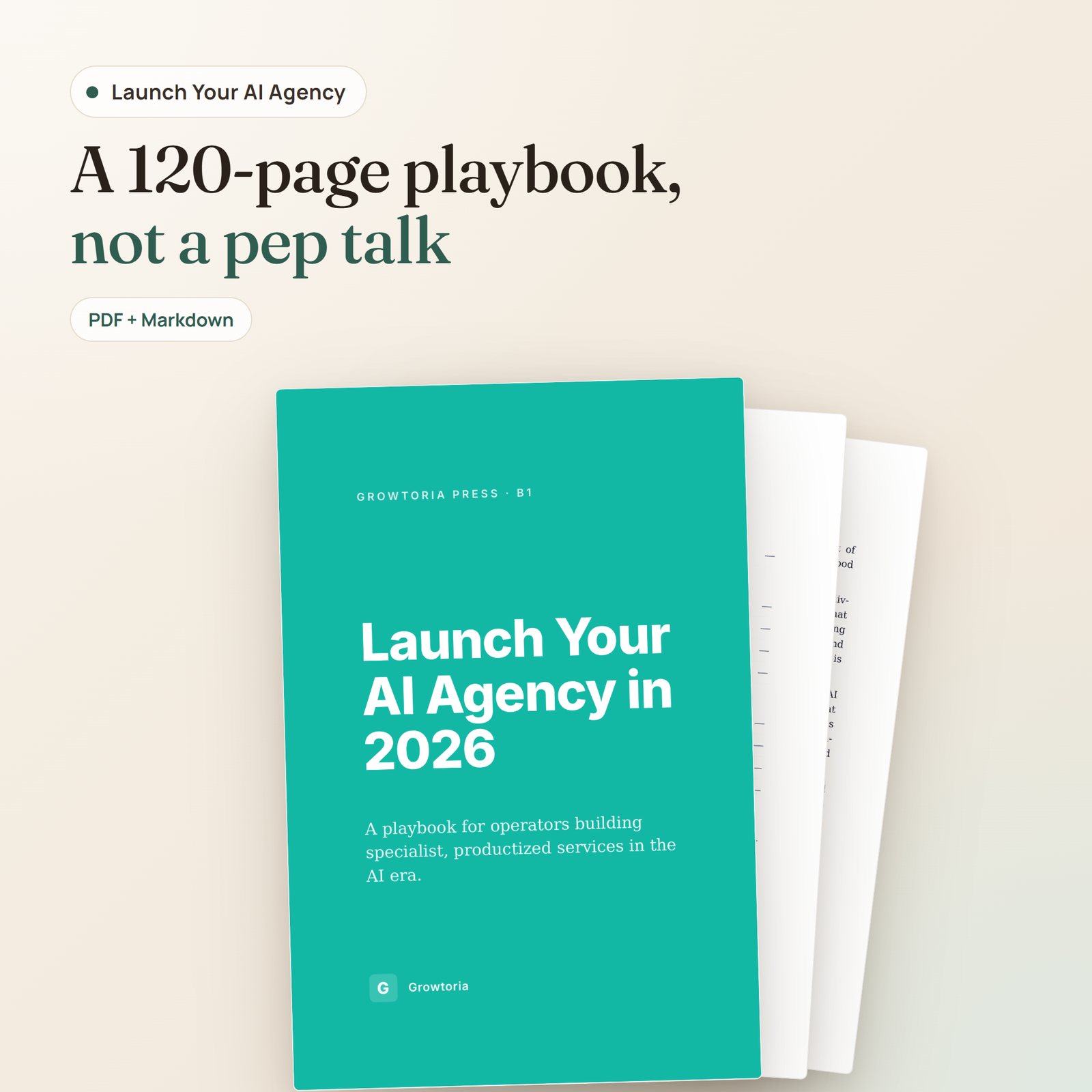
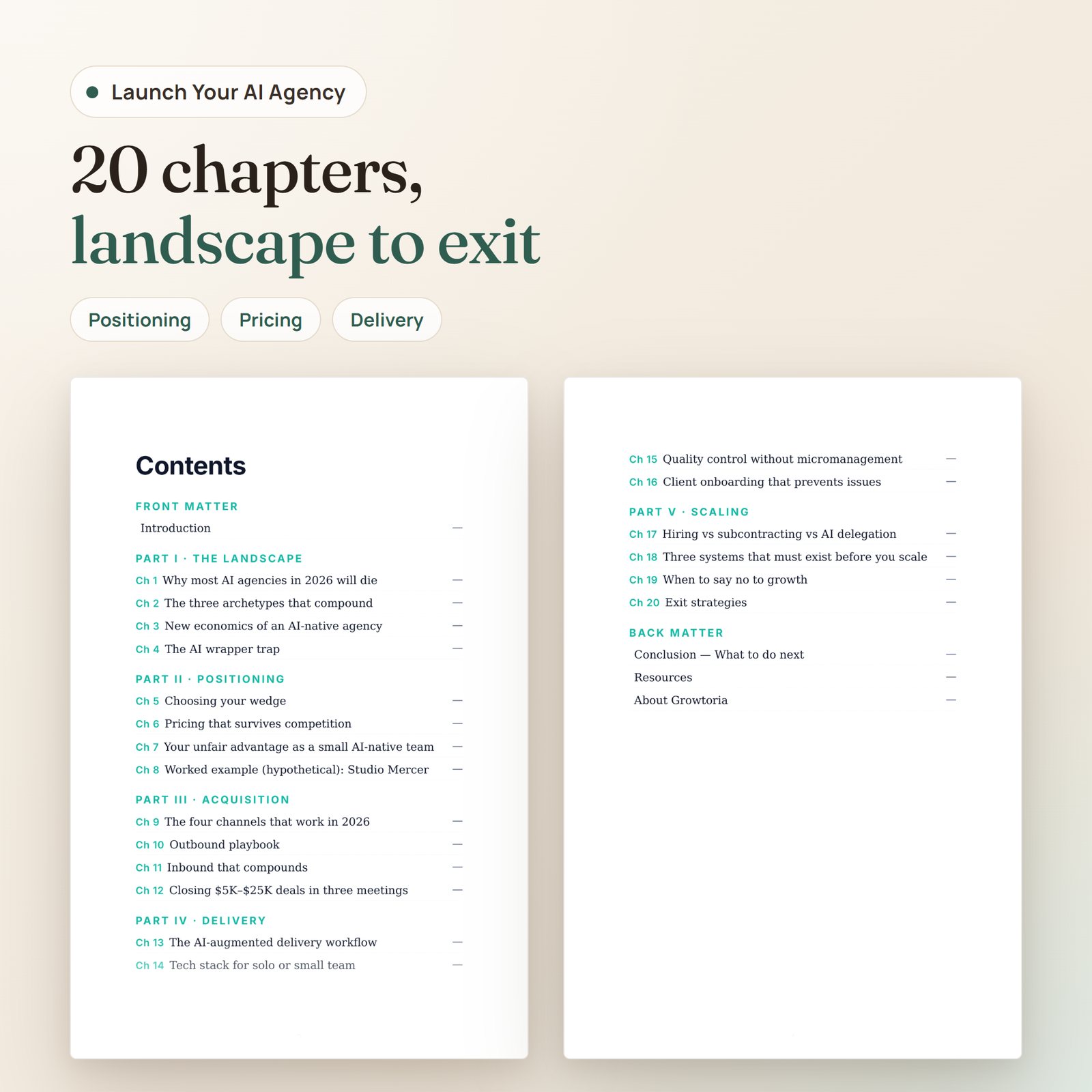
- The ebook in PDF (120 pages), designed for on-screen reading and home printing: an introduction, 5 parts and 20 chapters, a conclusion with a 30-day action list, and a resources section.
- A Markdown edition of the same text, easy to paste into your own notes or load into an AI assistant for reference.
- README.txt describing the files.
Inside the ebook
- Part I — The Landscape (Chapters 1–4): why most AI agencies in 2026 will die, the three archetypes that compound, the new economics of an AI-native agency, and the AI wrapper trap, with a four-layer moat model and a seven-question diagnostic.
- Part II — Positioning (Chapters 5–8): choosing your wedge, pricing that survives competition (four pricing models and how to handle discount requests), your unfair advantage as a small AI-native team, and a chapter-long hypothetical worked example, Studio Mercer, that applies the frameworks month by month.
- Part III — Acquisition (Chapters 9–12): the four channels that work in 2026, an outbound playbook (research-led email, trigger-based DM, no-pitch follow-ups), inbound that compounds, and closing $5K–$25K deals in three meetings with a six-question discovery script.
- Part IV — Delivery (Chapters 13–16): the AI-augmented delivery workflow, a tech stack for a solo or small team, quality control without micromanagement, and client onboarding that prevents issues, built on a five-document kit.
- Part V — Scaling (Chapters 17–20): hiring vs subcontracting vs AI delegation, three systems that must exist before you scale, when to say no to growth, and exit strategies.
- Conclusion and Resources: five actions for the next 30 days, sequenced by starting position, plus a short list of books, tools, and communities.
What you’ll be able to do
- Diagnose your starting position: recognize the arbitrage, wrapper, and promiseware patterns, pick a compounding archetype, and map which moats you actually have.
- Write a wedge sentence that is narrow on at least two of industry, service, and differentiator, then narrow it again.
- Move off hourly pricing: choose between productized, value-based, retainer, and hybrid models, and answer discount requests without cutting your price.
- Run a focused acquisition plan: commit to two channels, write research-led cold emails and trigger-based DMs, and follow up without pitching.
- Run a short, structured sales cycle: discovery without pitching, a one-page proposal, and a clean walk-away when the deal is wrong.
- Deliver with AI without losing quality: a senior-junior workflow, a definition of done, staged reviews, and a five-document onboarding kit.
- Scale deliberately: decide between AI, subcontractors, and hires, build sales, delivery, and finance systems, filter out bad revenue, and choose a realistic exit shape.
FAQ
Am I too early to start an agency?
The book is written for readers who have already closed a handful of engagements under some name: as a consultant, a freelancer, or inside someone else’s services business. If you are pre-launch, Part I helps you choose your archetype before any client has formed an opinion of you, and the conclusion includes a sequencing plan for pre-launch founders.
I’m senior but I don’t want to be the salesperson.
Part III assumes founder-led sales: channels, outbound, inbound, and a three-meeting close. Part V (Chapter 17) explains when to hire a salesperson: as the third hire, after an operator and a delivery lead, and only once you have a proven sales script, an inbound pipeline, and a commission structure.
What if I don’t want to hire anyone?
Part V (Chapter 17) recommends AI delegation first and subcontractors second, with hiring only once those are exhausted. Part IV (Chapter 14) covers a lean tool stack for a solo operator or small team, including an illustrative annual cost estimate for a one-person agency.
Is this AI-specific or just “how to launch any agency”?
AI-native specifically: the AI wrapper trap and the economics of an AI-native agency (Part I), and the AI-augmented senior-junior delivery workflow (Part IV). The positioning, pricing, and scaling frameworks also apply to services businesses in general.
Are the case studies real?
No. The worked examples, including Studio Mercer, are hypothetical. They show how the frameworks apply; they are not results from real engagements. Figures labeled as rules of thumb are planning assumptions, not benchmarks.
Does it include templates?
The frameworks, checklists, a six-question discovery script, and example email and DM structures are inside the book. There are no separate template files: the download contains the PDF, the Markdown edition, and README.txt.
What if I’m not satisfied?
See our guarantee below.
Our guarantee
If this guide doesn’t help you, email [email protected] with your order number within 14 days of your purchase and we refund you in full. No forms, no reason needed, and you keep the file. Full details in our Refund Policy.


