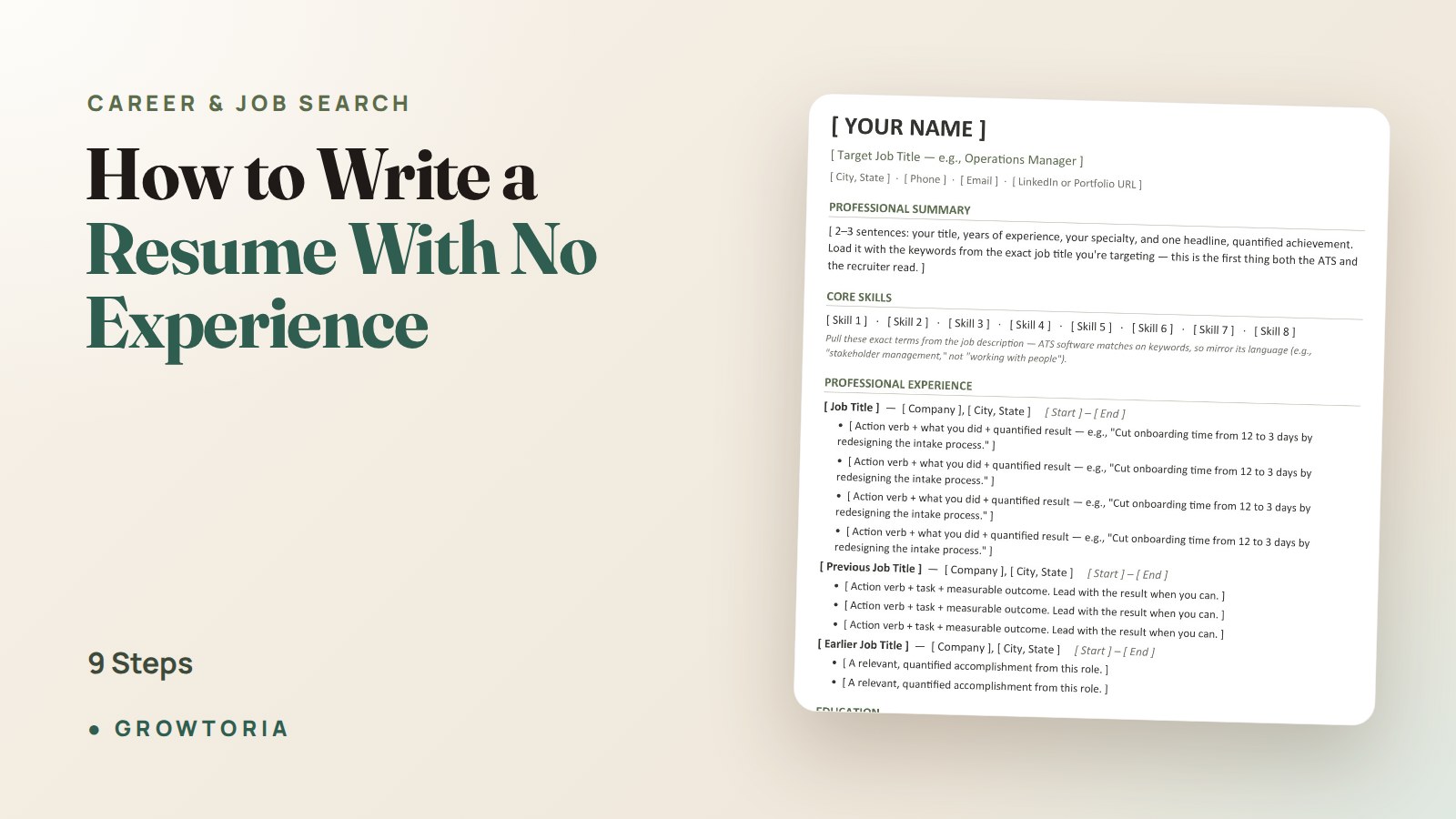
How to Write a Resume With No Experience: 9 Steps
Learning how to write a resume with no experience feels impossible when every posting asks for two years of it. But recruiters don’t actually want two years — they want proof you can do the job. That’s a very different bar, and it’s one you can clear today.
This guide walks you through nine steps to build a resume that gets read, passes the ATS scan, and earns a phone screen — even if you’ve never held a paid role in the field.
Why “no experience” doesn’t mean “nothing to offer”
Hiring managers screen resumes in about seven seconds on the first pass. In those seconds, they’re not counting years. They’re pattern-matching for one thing: can this person produce the outcome I need?
You’ve already produced outcomes. School projects shipped. Volunteer events happened because you organized them. Side hustles brought in real revenue. That’s experience — it just isn’t labeled as a job title yet.
The whole exercise of how to write a resume with no experience is really an exercise in translation: taking the work you’ve already done and reframing it in the language recruiters scan for.
How to write a resume with no experience in 9 steps
Work through these in order. Don’t skip step 1 to get to “the writing” — the format decision determines everything else.
Step 1: Pick the right resume format
You have three real options: reverse-chronological, functional, and combination (hybrid). If you have zero paid experience, the combination format wins nearly every time. It leads with a skills summary and projects section, then lists education and any part-time or volunteer work below.
Avoid pure functional resumes. Recruiters associate them with hiding gaps, and most ATS systems parse them poorly.
Step 2: Write a summary, not an objective
Delete the phrase “seeking a challenging opportunity where I can grow.” It says nothing. Instead, write 2-3 sentences that name the role you want, the skills you bring, and one concrete result.
Weak: “Recent graduate seeking marketing role to develop my skills.”
Strong: “Marketing graduate with hands-on experience running a student-org Instagram account that grew from 400 to 3,200 followers in six months. Skilled in Canva, Meta Ads Manager, and Google Analytics.”
Step 3: Reframe school, projects, and volunteer work as experience
This is where most zero-experience resumes fall apart — and where a small mindset shift unlocks pages of material. Every one of these counts as experience if you led it, delivered it, or measurably improved it:
- Capstone or thesis projects
- Freelance gigs (even one-off, even unpaid)
- Volunteer roles at nonprofits, churches, or events
- Student org leadership
- Class projects with a real client or brief
- Personal projects with a public artifact (GitHub repo, portfolio site, YouTube channel)
- Sports team captaincy, tutoring, camp counseling
Give each one a clear role name (“Marketing Lead, Campus Sustainability Club”) and a start-end date. It looks like a job because it was a job — just an unpaid one.
Step 4: Lead every bullet with an achievement, not a task
Recruiters skim the first two words of each bullet. If those words are “Responsible for” or “Helped with,” you’ve lost them. Start with a strong verb and end with a number when you can.
Formula: Action verb + what you did + measurable result.
- “Rewrote nonprofit’s donation page copy, lifting monthly gifts by 18% over three months.”
- “Organized 12-team intramural tournament for 140 students, coordinating referees, brackets, and prizes.”
- “Built a Python script to auto-tag 4,000 photos for a family history archive, cutting manual work by ~40 hours.”
If you don’t have a number, use scale (“team of 8,” “$1,200 budget,” “six-week timeline”). Concrete beats vague every time.
Step 5: Match the resume to the job description
Open the job posting. Highlight every skill, tool, and phrase repeated more than once. Those are the terms the ATS is scanning for. Weave them into your summary, skills section, and bullets — but only where they’re honestly true.
This is not keyword stuffing. It’s aligning your language with the employer’s language so the parser and the human both recognize a match.
Step 6: Build a skills section that actually earns its space
Split it into two lines: Tools (specific software you can open right now and use — Excel, Figma, HubSpot) and Skills (higher-level capabilities like copywriting, data analysis, event coordination).
Skip soft-skill clichés like “team player” and “detail-oriented.” They’re invisible on the page and unprovable in a bullet.
Step 7: Keep it to one page and make it scannable
With no experience, one page is the rule. Use a single clean font, 10-11pt body text, and enough white space that a scan doesn’t feel exhausting. No photos, no graphics, no columns that the ATS will scramble.
If you’d rather start from a proven layout than fight Word margins for two hours, the ATS Resume Template Kit gives you editable Word and Google Docs files that are already ATS-safe, plus a short guide on how to fill each section.
Step 8: Pass the ATS check before you send
Roughly 99% of Fortune 500 companies use an applicant tracking system to filter resumes before a human ever opens them. A gorgeous PDF that fails parsing is worth less than a plain one that passes.
Quick ATS checklist:
- Save as .docx or a text-based .pdf (never a scanned image)
- Use standard section headings: Summary, Experience, Education, Skills
- Avoid tables, text boxes, headers, and footers for critical info
- Spell out acronyms once (“Search Engine Optimization (SEO)”)
- Match at least 60% of the hard-skill keywords from the job description
You can pressure-test your file with the free ATS resume checker before you apply anywhere.
Step 9: Pair it with a cover letter that fills the gap
A resume shows what you’ve done. A cover letter shows why you’ll figure out what you haven’t. When you have limited experience, the cover letter does more work than usual — it’s where you tell the story your bullets can’t.
Three short paragraphs is plenty: why this specific company, why this specific role, one proof point of learning fast. Templates for this exact structure live in the ATS Cover Letter Template Kit.
Resume format comparison: which one fits you
Not sure which structure to use? This table breaks down the three formats by who they work for.
| Format | Best for | Strengths | Watch out for |
|---|---|---|---|
| Reverse-chronological | Anyone with 1+ years of relevant paid work | Familiar to recruiters, ATS-friendly, easy to skim | Highlights gaps and job-hopping |
| Combination (hybrid) | Career changers, recent grads, zero-experience candidates | Leads with skills and projects; work history still present | Requires strong self-editing to stay one page |
| Functional | Rarely the right choice today | Groups skills over dates | ATS parsers struggle; recruiters distrust it |
A quick before-and-after example
Here’s the same candidate — a college senior applying for a junior marketing role — written two ways.
Before (weak)
- Responsible for social media at student club
- Helped organize events
- Worked on a group project about branding
After (strong)
- Grew Campus Sustainability Club Instagram from 400 to 3,200 followers in 6 months by posting 4x/week and running a UGC campaign
- Led logistics for 3 zero-waste events (~250 total attendees), managing a $1,400 budget and 6 volunteers
- Delivered a 20-page brand audit for a local coffee shop as a capstone client project; owner adopted 4 of 6 recommendations
Same person. Same actual work. The “after” version reads like a hire.
Common mistakes to avoid
- Padding with irrelevant jobs. Your two-week retail gig from four years ago isn’t helping. Cut it if it dilutes the story.
- Listing coursework instead of projects. “Intro to Marketing” is a class. “Ran a $200 Facebook ad test for a local nonprofit as part of Intro to Marketing” is a project.
- Using a creative template with columns and icons. They look great and parse terribly. Save the design flair for a portfolio site.
- Writing in the first person. Resumes are third-person implied. “Managed team of 6,” not “I managed a team of 6.”
- Sending the same resume everywhere. Ten targeted resumes beat 100 generic ones. Tailor the summary and top three bullets each time.
What to do after your resume is done
A finished resume is step one. The next 90 days is what actually lands the job:
- Track every application, contact, and follow-up in one place — the Job Application Tracker keeps this from turning into a spreadsheet mess in week three.
- Prep your interview stories using the STAR method before you get the call. The Interview Prep Workbook gives you fill-in-the-blank frameworks for the most common questions.
- Follow up on every application after 7-10 days with a short, polite note. Roughly a third of candidates never do; you’ll stand out simply by showing up twice.
Frequently asked questions
How long should a resume with no experience be?
One page. Full stop. If you can’t fill a page, use a slightly larger font, more white space, and expand your projects section — don’t add filler. If you’re overflowing, cut older or unrelated items until the strongest work fits.
Should I include my GPA?
Include it if it’s 3.5 or higher and you’re within two years of graduation. Below that, leave it off — a missing GPA reads as neutral, a low GPA reads as a negative. Latin honors, dean’s list, and relevant coursework are always safe to include.
What if I’ve truly never had a job or a project?
Then your first task isn’t the resume — it’s creating one real artifact this week. Volunteer for a local nonprofit’s newsletter. Build a small website for a family member’s business. Take a free online course and ship the capstone. One concrete, dated project turns a blank resume into a starting resume in about ten days.
Do I need a cover letter if the application says “optional”?
Yes, especially with no experience. “Optional” is often a soft filter for candidates who are willing to do more than the minimum. A short, specific cover letter is one of the highest-leverage 20 minutes you’ll spend on any application.
How do I explain gaps or a total lack of experience in an interview?
Directly and briefly, then pivot to what you did with the time. “I spent the last year caring for a family member; while I was home I completed a Google UX certificate and redesigned two local business websites as practice.” Own the timeline, then show the work.
Learning how to write a resume with no experience isn’t about faking a career you don’t have. It’s about naming, sizing, and framing the work you’ve actually done so a recruiter can see it in seven seconds. Do that well, and “no experience” stops being the story on the page.


