Content Marketing for B2B Startups: Founder Playbook
Content marketing for B2B startups is not blogging. It’s not two LinkedIn posts a week. It’s not paying an agency $4k/month to ghostwrite 2,000-word SEO articles nobody in your ICP will ever read. If you’re a solo or lean founder trying to build pipeline from content, the playbook you inherited from HubSpot, SaaStr, and every enterprise marketing blog is optimized for a company that already has 40 people, a demand-gen budget, and three years of runway. You have none of those.
What you have is time (some), taste (hopefully), and a narrow window before your seed round runs out. This is a founder-operated system for making content actually move revenue — not vanity metrics.
Why content marketing for B2B startups is different
Enterprise B2B content marketing works because Cisco has 500,000 backlinks and a sales team of 4,000 people. They can publish anything and someone will buy. You cannot. According to the Content Marketing Institute’s annual B2B research, the top-performing content orgs spend more, publish more, and measure more than everyone else. That’s the ceiling. You’re at the floor.
Three constraints reshape everything for early-stage B2B:
- You don’t have domain authority. Ranking for “CRM software” is impossible. You have to hunt narrower.
- You don’t have a brand. Nobody is Googling your name yet. Content has to introduce you to strangers who don’t know they need you.
- You don’t have a team. Whatever system you build has to survive one operator, part-time, for the next 12 months.
Most content advice quietly assumes you’ve solved these. You haven’t. Either you build a startup-native system, or you burn six months publishing content that ranks for nothing and converts nobody.
Three prerequisites before you publish anything
Founders skip these and wonder why the traffic didn’t come. Don’t publish before you have all three.
1. Positioning that actually differentiates
Not “we help teams scale.” Not “AI-powered platform.” A crisp statement of who you’re for, what you replace, and what you do 10x better. If your positioning fits inside “we’re like Salesforce but for X” or “the Notion for Y,” you can write content. If it doesn’t, everything you publish will sound like everyone else — and rank for nothing because search engines can’t tell you apart from the 400 other pages saying the same thing.
2. A defined ICP with names attached
Not personas. Names. Write down 50 companies that would be a perfect fit. Note the person you’d sell to at each. Now every piece of content has a test: would these specific people click, read, and remember it? The topic might be broad, but the audience is 50 real humans. If it wouldn’t survive contact with them, don’t ship it.
3. One distribution beachhead
Pick ONE channel to own before you touch the second. SEO, LinkedIn, cold email + content, podcast tours, or a newsletter. Solo founders who try all five in month one own zero by month six. The system to run one channel well fits inside a founder’s operating stack — we build ours on top of a connected Notion workspace, but a disciplined spreadsheet works too.
The founder-operated content system
Here’s the weekly cadence that actually works for one operator running content marketing for B2B startups without a team:
Weekly rhythm (3-4 hours total)
- Monday (30 min): Review last week’s data. Which piece got read? Which got ignored? Adjust.
- Tuesday (90 min): Write ONE long-form asset. 1,200-2,000 words. Focused on a real question your ICP is asking.
- Wednesday (30 min): Repurpose Tuesday’s asset into 3 short-form pieces (LinkedIn post, X thread, newsletter blurb).
- Thursday (60 min): Ship. Send. Post. Distribute to the specific 50 people you care about.
- Friday (30 min): Log outcomes. Count qualified conversations booked directly from content.
This is atomic. It compounds. Missing a week won’t kill you. Missing a month will. The whole thing should live inside the same operating system you run the rest of your company from — which is why we bundle content ops with the rest of the founder stack in the Founder OS Suite instead of treating marketing as a separate app.
Channel comparison for early-stage B2B
Not all channels are equal for a DR 0 site with no team. The honest tradeoffs:
| Channel | Time to first pipeline | Compounding | Best when | Kills you if… |
|---|---|---|---|---|
| SEO / organic search | 6-12 months | High | Buyers actively search your problem | Category is too new to be searched |
| LinkedIn (founder-led) | 2-4 weeks | Medium | ICP is on LinkedIn daily | Founder hates writing publicly |
| Cold email + content | 1-2 weeks | Low | Small ICP (<5,000 accounts) | You can’t write emails people reply to |
| Podcast (guest appearances) | 4-8 weeks | Medium | Founder is the product story | ICP doesn’t listen to podcasts |
| Newsletter | 3-6 months | High | You have a genuine POV | Your content is derivative |
For most B2B startups with 6-18 months of runway, we recommend starting with founder-led LinkedIn plus a small SEO bet on 5-10 bottom-of-funnel keywords. LinkedIn buys you weeks; SEO buys you years. Both can be run by one person.
Distribution beats production
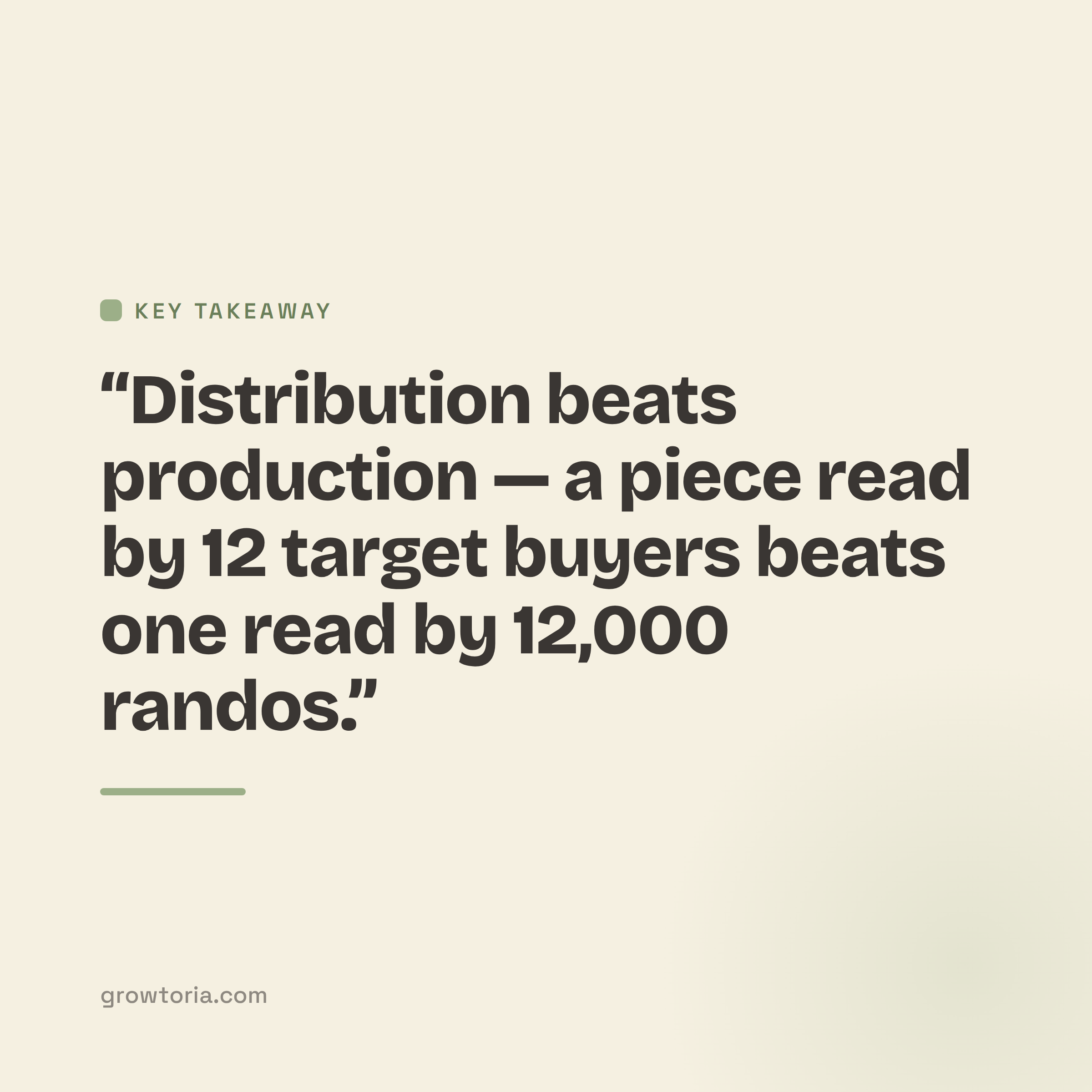
The most common failure mode in content marketing for B2B startups: founders spend 90% of their time producing and 10% distributing. Flip it. A great piece read by 12 target buyers beats a great piece read by 12,000 randos who will never buy.
Distribution playbook that costs you nothing but time:
- Direct DM to 5 target buyers per piece. “Wrote this because I kept hearing [X problem] from founders like you. Curious if it resonates.” Not selling. Sharing.
- Repost the piece 3-4 weeks later. Nobody saw it the first time. This isn’t shameful — it’s respectful of the algorithm.
- Turn every reply into a warm intro. If someone comments once, engage. If they engage twice, book a call.
- Repurpose across formats. Long-form → thread → carousel → newsletter → sales one-pager. Same idea, five surfaces.
If you don’t have the bandwidth to do this consistently, don’t publish yet. Either wait, or hire distribution out. Startups that need pipeline in weeks (not quarters) should look at done-for-you lead generation to keep the top of funnel warm while content compounds in the background.
What to measure (and what to ignore)
Vanity metrics that mean nothing for B2B startups: page views, impressions, followers, generic “engagement rate.”
Metrics that actually matter:
- Qualified conversations booked directly from content. Count them weekly. Should trend up month over month.
- Reply rate from ICP. If the right 50 people aren’t replying, the content isn’t landing — regardless of what your analytics dashboard says.
- Assisted revenue. Ask every closed customer where they first heard of you. Simple, honest, imperfect — but far more useful than a Google Analytics attribution model that’s guessing anyway. Ahrefs has a good primer on why last-click attribution lies to you.
- Rank position for 5-10 bottom-of-funnel keywords. Not all keywords. Just the ones with buying intent that match your positioning.
Audit quarterly. Kill anything that isn’t producing conversations. Double down on what is. Six-month reviews on a startup budget are too slow.
Frequently asked questions
How long before content marketing works for a B2B startup?
Founder-led LinkedIn: 4-8 weeks to first inbound conversations if you post 3x/week and DM prospects. SEO: 6-12 months to compounding organic traffic, longer if your category is competitive. Newsletter: 3-6 months to reach an audience big enough to matter. Anyone promising faster is selling you something.
Should a pre-seed B2B startup do content marketing at all?
Only if the founder can commit 3-4 hours a week for 12+ months. Otherwise, spend that time on cold outbound, customer research, or product. Content marketing for B2B startups compounds — but only if you don’t quit. Half-built content engines are worse than no content engine, because they signal to prospects that your company is inconsistent.
Blog on our own domain, or Medium/Substack/LinkedIn?
Own domain, always. Rented platforms don’t build SEO equity for your company. The one exception: a newsletter on Substack or Beehiiv where the discovery mechanism (search + recommendations) is a genuine distribution channel. Even then, cross-post the essay to your own site with a canonical tag pointing home.
How much should we actually spend on content?
If it’s just you writing: $0-200/month in tools (Ahrefs Lite, Beehiiv, maybe an AI writing assistant). If you’re hiring: $2k-5k/month gets you a good freelance writer or a fractional content lead. Agencies at $5k-10k/month rarely make sense pre-Series-A unless they own distribution, not just production. Want a second opinion on where to invest? Book a strategy call and we’ll pressure-test your plan.
What’s the biggest mistake founders make with B2B content?
Writing to impress peers instead of solving problems for buyers. If your last five posts are meta-commentary on marketing tactics or “how we built X,” you’re writing for other founders on LinkedIn — not your ICP. Buyers want specific, boring, useful content about their problem, in their language. Boring compounds. Clever does not.