How to Systematize My Business: A Founder’s Playbook
Every founder hits the same wall around year two. Revenue is fine, the calendar is full, and yet nothing scales because the entire operation runs out of your skull. If you’ve been Googling how to systematize my business at 11pm after another day of context-switching, you’re not lazy and you’re not behind — you’re at the exact stage where the founder-as-bottleneck problem stops being a quirk and starts being the ceiling. This playbook is the one I wish someone had handed me: a five-layer stack, a 30-day execution plan, and the honest tradeoffs between building it yourself and buying something that already works.
Quick frame before we go in: “systematizing” doesn’t mean turning your business into a soulless corporate machine. It means making sure the things you’ve already figured out — how you sell, how you deliver, how you hire, how you decide — exist somewhere other than your memory. Done right, you get more freedom, not less.
Why most founders fail to systematize (even when they try)
I see the same three failure patterns over and over with the operators I work with.
Failure 1: They confuse documentation with systems. A Notion page titled “How we onboard clients” with three bullet points is a note, not a system. A system has triggers, owners, inputs, outputs, and a place where the work actually happens.
Failure 2: They try to systematize everything at once. They block off a “systems week,” map 40 processes, get exhausted by Wednesday, and never look at the docs again. Systematization is a habit, not a project.
Failure 3: They build for a team they don’t have yet. Solo founders write SOPs as if a 12-person ops team is about to onboard. The result is over-engineered docs nobody — including future-you — will read. Build for the next hire, not the imaginary org chart.
The founders I work with who finally crack how to systematize my business don’t have more time or more willpower. They just stop treating it as a documentation project and start treating it as an operating system. Which brings us to the stack.
The real cost of staying unsystematized
Before diving into the how, it helps to get honest about the cost of doing nothing. Business process management research consistently identifies operational bottlenecks — not market conditions — as the primary reason founder-led businesses stall between $500k and $2M in annual revenue. The founder isn’t failing. The operating model is.
In practical terms, the hidden cost looks like this: three to five hours a week answering questions that a good SOP would make unnecessary; one to two key client moments dropped every month because there’s no handoff checklist; and a hiring process that takes twice as long as it should because nothing is written down. Add those up over a quarter and you’re looking at 60–90 hours lost and two or three client-trust events damaged — before you’ve made a single strategic mistake.
That’s why learning how to systematize my business is less about efficiency and more about compounding. Every hour you invest in a system pays back repeatedly. Every hour you don’t is a cost you’ll repay again next week.
The 5-layer stack for systematizing a business
Every well-run lean company I’ve studied has these five layers, whether they name them that or not. Build them in order — skipping a layer guarantees the next one collapses.
Layer 1: Capture — your second brain
Before you can systematize anything, you need a single trusted place where ideas, decisions, client notes, and reference material land. Not Slack. Not email. Not seven different notebooks. One inbox, one place, one workspace. Notion is the default for a reason — it bends to almost any structure — but Obsidian, Capacities, or even a structured Google Drive work if you commit. The non-negotiable: capture must take less than 10 seconds. If it takes longer, your brain will route around it and you’re back to square one.
Layer 2: SOPs — the operating manual
Standard Operating Procedures are the smallest unit of a system: “when X happens, do Y, in this order, using these tools.” Write them in the moment you do the work — a Loom recording plus a short checklist beats a 2,000-word document every time. The GitLab team published their entire company handbook as a public, version-controlled document. It’s the gold standard for what a mature SOP layer looks like and worth studying even if you’ll never be that big (see GitLab’s public handbook).
Layer 3: Workflows — the assembly line
An SOP describes the steps. A workflow is where the steps actually live and get tracked. This is your CRM pipeline, your client onboarding board, your content production tracker. The shift here is mental: work doesn’t happen in your inbox, it happens in a board with stages, owners, and clear exit criteria. If a task isn’t on the board, it doesn’t exist.
Layer 4: Automation — the multiplier
Only now do you automate. Founders who automate before they have a stable workflow just build faster chaos. Once a process runs the same way three times, automate the boring connective tissue: form → CRM, deal won → onboarding kickoff, invoice paid → next-step task. Zapier, Make, and n8n are the obvious picks. Native integrations — Notion API, HubSpot workflows — are even better when available.
Layer 5: Review — the feedback loop
This is the layer everyone skips and it’s the one that compounds the most. A weekly 30-minute review where you ask three questions: What broke? What got automated? What’s the next thing only I can do? Without this loop your system quietly rots. With it, the system gets better every week without anyone doing dedicated “systems work.”
How to systematize my business in 30 days
The mistake is treating systematization as a six-month overhaul. You can get the first useful version live in four weeks if you’re disciplined about scope. Here’s the exact plan I give founders who ask me how to systematize my business quickly, without burning a month on setup:
Week 1 — Audit and consolidate
List every recurring activity in your business. Sales calls, client delivery, content, finance, hiring — everything you do more than once a month. Don’t write SOPs yet. Just inventory. Then kill, delegate, or defer anything not directly tied to revenue or strategic moat. Most founders discover that 20–30% of their week is pure noise that evaporates the moment they see it written down and questioned.
Week 2 — Build the spine
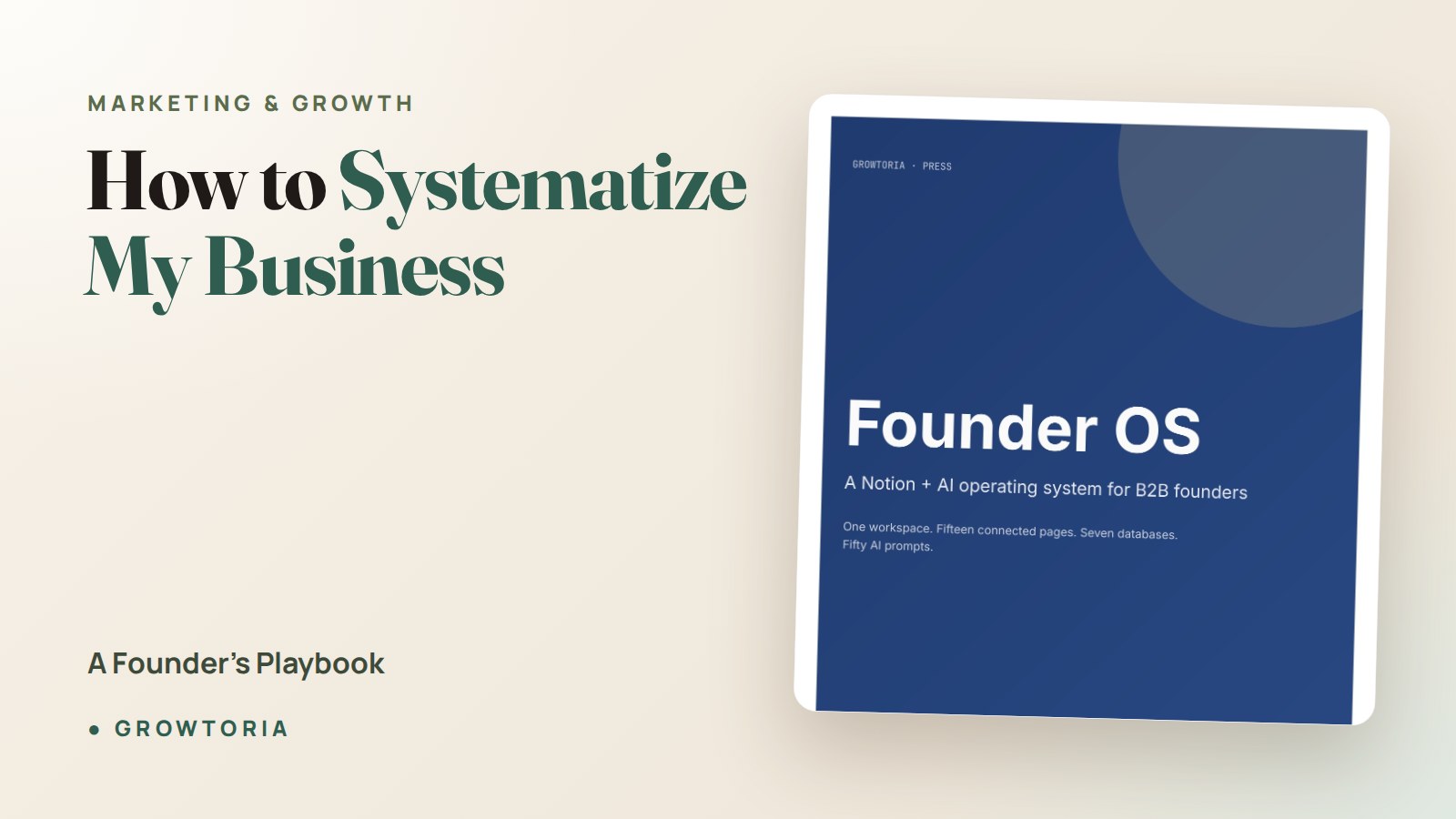
Pick one workspace and migrate everything into it. Set up four core areas: Clients, Content, Operations, Personal. Connect your task system to each area. Do not over-design. The structure should fit on one screen and be immediately obvious to someone who’s never seen it before. This is what a pre-built workspace like Founder OS gives you out of the box — a pre-wired Notion spine plus AI prompts to run it — so you skip the two weeks of architecture-tinkering most founders lose to this phase.
Week 3 — SOP the top three
Pick the three highest-leverage processes: usually new-client onboarding, your core delivery loop, and your sales follow-up sequence. Record yourself doing each one once. Drop the Loom link plus a checklist into the workspace. Done. Resist the urge to document all 27 processes — the first three are 80% of the value, and the rest will still be there next month.
Week 4 — Automate one handoff
Find the single most annoying manual handoff in your week — proposal-sent → reminder-scheduled is a common one — and automate it end to end. One automation, fully working, no exceptions. Now you’ve proven the loop works. Next month, add one more. This incremental rhythm is exactly how consistent operators answer the question of how to systematize my business without burning out on the project itself.
Build vs. buy: an honest comparison
Every founder hits this fork when figuring out how to systematize my business. Do you build the whole stack from scratch, or start with a template purpose-built for the job? The honest answer depends on your time horizon and what you’re optimizing for:
| Approach | Time to first version | Upfront cost | Customization ceiling | Best for |
|---|---|---|---|---|
| Build from scratch | 4–8 weeks | $0 (your time) | Unlimited | Founders who enjoy systems design and have genuinely unusual workflows |
| Generic free template | 1–2 weeks | $0 | Low — usually breaks when you push it beyond basic use | Side projects, early validation stages |
| Purpose-built founder workspace | 1–3 days | $50–$300 | High if built modularly | Solo and lean B2B operators who need it working this week |
| Hire an ops consultant | 3–6 weeks | $3k–$15k | High | Teams of 5+ with complex existing tooling to migrate or integrate |
For most solo and lean B2B founders, option three wins on pure ROI. Your time is the scarce resource — paying $200 to skip three weeks of architecture decisions you’d likely reverse anyway is the obvious move. That’s exactly why we built the Founder OS Suite as the fully upgraded path: a complete workspace plus SOP and automation templates pre-wired and ready to run from day one.
Tools that actually pull weight
Knowing how to systematize my business is only half the equation — the other half is picking tools that don’t fight you. These are opinionated picks based on what I use or recommend to clients running lean B2B operations. None are sponsored.
- Workspace: Notion. Flexible, powerful, and the closest thing to a true operating system for a small business without custom software.
- Task management: Notion if you want everything in one place; Linear if you do anything resembling product or engineering work.
- SOP recording: Loom for the walkthrough video, Scribe for auto-generated step-by-step text guides your team can actually search.
- Automation: Zapier for speed and simplicity, Make for complex branching logic, n8n if you want to self-host and retain full data control.
- CRM: Folk or Attio for solo founders. HubSpot once you have a real sales motion and a team to run it consistently.
- Forms and intake: Tally is faster and cheaper than Typeform for 90% of use cases — start there and only upgrade when you hit a genuine ceiling.
Mistakes to avoid when systematizing
Even founders who understand how to systematize my business conceptually make these errors in execution:
- Documenting before you’ve stabilized the process. If you’ve done it twice, you don’t have a process — you have a hypothesis. Wait for rep three before you write anything down.
- Choosing tools before processes. The tool is the easiest part. Nail the workflow first; the right tool becomes obvious once the flow is clear.
- Building systems for control instead of clarity. If your SOPs feel like a leash, your team won’t follow them. Systems should remove decisions about boring things so people can spend their judgment on the things that actually matter.
- Never revisiting. A system that isn’t reviewed for six months is fiction. Put the weekly review on your calendar or it will not happen.
- Trying to do it alone when you’re past the inflection point. If you’re north of $20k/month with no systems in place, the cost of staying disorganized is now larger than the cost of getting outside help. Explore our services if you want a second pair of eyes on where to start and what to tackle first.
Frequently Asked Questions
How do I systematize my business if I’m still the only one doing the work?
Especially then. The point of systematizing as a solo founder isn’t delegation — it’s freeing your working memory. Every process you offload to a checklist is cognitive space you get back for the decisions only you can make. Start with the three tasks you do most often and resent the most. That’s your highest-leverage starting point by definition.
What’s the difference between a system and an SOP?
An SOP is one document describing how a single task gets done. A system is the combination of the SOP, the place the work happens (board, pipeline, calendar), the trigger that starts it, the person or role responsible, and the review loop that improves it over time. Most founders write SOPs and call it systematizing. They’re meaningfully different things — one is a recipe, the other is a kitchen.
How long does it take to fully systematize a business?
You’ll get the first useful version live in 30 days using the plan above. “Fully systematized” is a moving target — a healthy operation is always systematizing the next bottleneck as it grows. Plan for 90 days to reach a point where you can take a genuine two-week break without the business stalling. That’s the real benchmark.
Should I use AI to help systematize my business?
Yes, but as a leverage layer — not a replacement for thinking. AI is excellent at drafting SOPs from a Loom transcript, summarizing recurring decisions into a decision log, and generating first-pass automation logic. It’s poor at deciding which processes matter and where your actual bottlenecks live. Use it after you’ve done the audit, not instead of it. The thinking still has to be yours.
What’s the ROI of systematizing for a solo founder?
For the founders I’ve tracked, the conservative number is 6–10 hours a week recovered within the first 60 days, and a meaningful drop in dropped-ball mistakes — missed follow-ups, late deliverables — almost immediately. The bigger payoff is psychological: the feeling that the business is something you operate rather than something happening to you. That shift in perspective is the real reason founders ask how to systematize my business in the first place, and it’s what a solid operating system actually delivers.